
Recognition can be late in coming for many artists, but perhaps especially so for women whose originality and talents too often become overshadowed by their more famous romantic partners. Museums are often eager to put on shows making this very argument as women artists are rediscovered. Sometimes the thesis succeeds; other times, it does not.
The latest of these is the case of the German artist Gabriele Münter (1877-1962), whose reputation, until recent decades, rested less on her own body of work than on her long-time connection to her mentor and lover, the Russian expressionist Wassily Kandinsky (1866-1944). The Guggenheim Museum’s exhibition, Gabriele Münter: Contours of a World, attempts to rectify the imbalance.
The good news is that it succeeds in introducing viewers to paintings that dazzle with bold color combinations, unusually cropped compositions and Münter’s own avant-garde blend of stylized naturalism and abstraction. But the show’s limited size (confined to three galleries) and focus, primarily on her work between 1908 and 1920, leave too many aspects of the artist unexplored.
No mention is made of how Münter managed to continue painting under Hitler and during World War Two
Born in Berlin, Münter began drawing in childhood but did not discover painting until 1902. Crucially, she was captivated with photography before painting. Her obsession with the former began in 1898, soon after her mother’s death (her father had died in 1886), when Münter and her sister embarked on a two-year trip across the United States.
They began in New York and then journeyed to Texas, Arkansas and Missouri to stay with the extended families of relatives who had emigrated to America before the Civil War. (Is the American flag seen draped over a table in her 1909 painting “Still Life, Red” a fond souvenir?)
Throughout her travels, Münter drew almost everything in sight, filling six notebooks. After laying hands on her first camera – a Kodak Bull’s Eye No. 2 – she snapped more than 400 photos. Sixteen of those, displayed here, show her intuitively experimenting with composition, holding the camera much higher or lower than usual and catching her subjects at unusual angles that prefigure her later work in paint.
She also documented slices of local life, such as the Emancipation Day (now called Juneteenth) celebrations in Marshall, Texas, on June 19, 1900. The most notable of these photographs to contemporary eyes shows three elegantly dressed black women proudly enjoying their participation, as equals, in the events of the day. I wondered – but found no answers in the exhibition materials – how she may have reacted to the racial attitudes and prejudices she encountered in the American South then – and if and how those memories resonated later, when she was living in Hitler’s Germany.
Kandinsky entered her life in 1902, shortly after her return from America. It was difficult then to find an art school open to female students, but Kandinsky had founded a co-ed avant-garde institution. Münter joined and thus began their artistic and romantic union, which lasted until the start of World War One, when Kandinsky left her to return to Russia.
In the years between, the two traveled extensively through Europe and Tunisia and lived for a time in Paris, where she became enchanted by the audacious colors of Henri Matisse and the Fauves. In 1911, along with Kandinsky and Franz Marc, she founded the influential German expressionist group known as Der Blaue Reiter (The Blue Rider) and showed work with them.
She also used funds from her family inheritance to purchase a home in the Alpine market town of Murnau, Germany, which would remain her base until her death. Its colorful streets, mountain vistas and seasonal landscapes, along with portraits of her neighbors, frequent her paintings through the decades. “Snow and Sun” (1911) follows a solitary villager traversing a street whose snow drifts shine with impressionist-style daubs of sunlit color, alternating with more subdued wintry shadows.
In “The Blue Gable” (1911), a pastel-colored rainbow arises above the off-kilter houses that line a snow-covered street, desolate save for a mysterious hooded figure, seen only from the back. The bright yellow house depicted here and her winterscape “The Yellow House” (1911) echo her love of Vincent van Gogh’s palette; his influence is further visible in her use of perspective in “Living Room in Murnau” (1910), which shows Kandinsky ensconced in the bedroom in the back.
Portraits, she wrote, are “the boldest and the most difficult, the most spiritual, the most extreme task for the artist.” Her “Self-Portrait in Front of an Easel” (1908-09) reveals the artist staring into the beyond with pensive intensity as she sits before her easel, her thumb securely curled around her artist’s palette and brushes. Her saint-like white gown is accented by a bright red pendant, her head crowned with a broad-brimmed straw hat which echoes the swirling colors of her shawl.
Black lines block out the different forms that make up “Head of a Young Girl” (1908), emphasizing the broad yet harmonious color contrasts between her ruby-red sweater and blue and green collar, and again between the contours of her blond hair and robin’s egg-blue ribbons. Yet as vibrant as these colors are, her expression is downhearted.
“Still Life After Shopping (on the Tram)” (1909-12), is a kind of portrait without a head, depicting a cropped view of a seated woman dressed in blue and wearing white gloves, balancing on her lap a variety of colorful packages and holding onto a folk-art decorated purse. Is it a clever satirical comment on the urban materialism often bemoaned by Münter and Kandinsky?
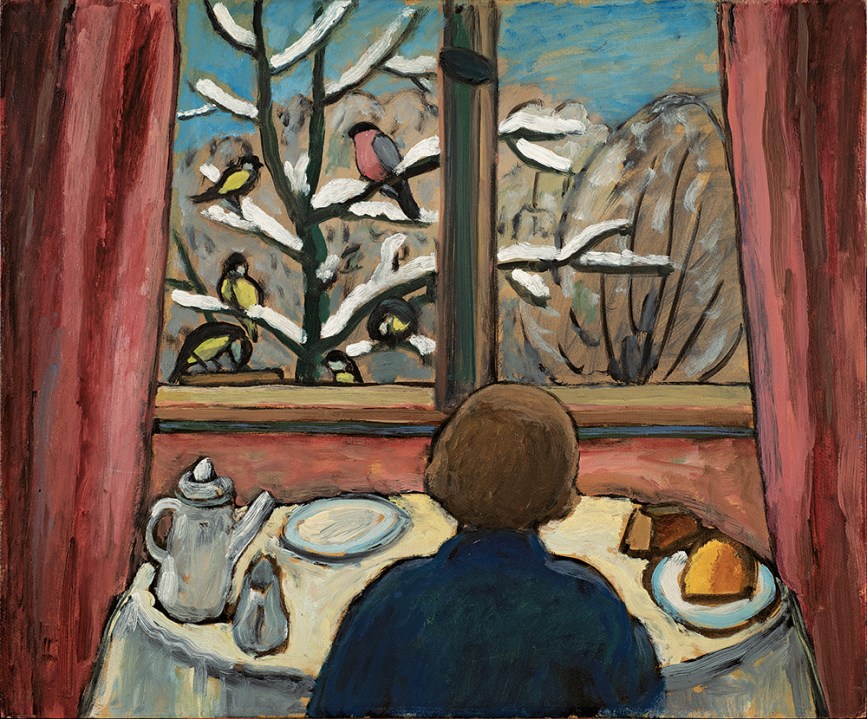
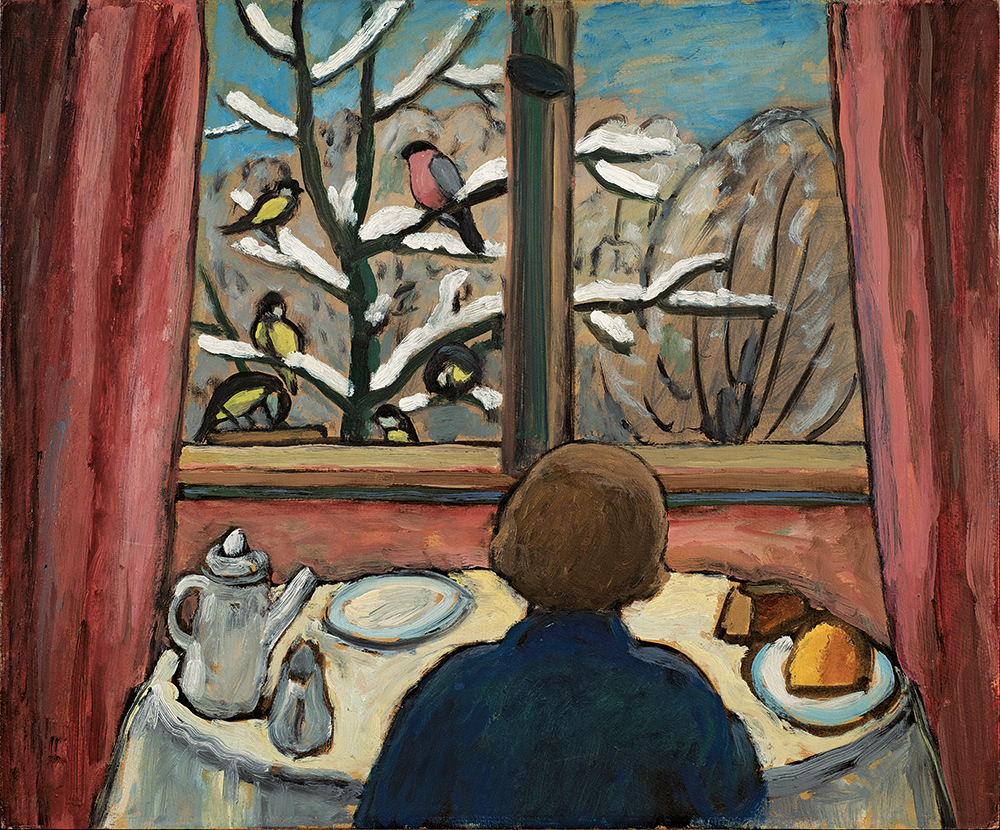
“Scaffolding” (1930) presents another urban scene, this time a multitiered view of construction work above a Paris street filled with traffic. Münter presents the workers atop the scaffolding as darkened stick-figure silhouettes against a yellow-pink sky, while at street level, a narrow car window provides a view of the similarly silhouetted legs of the pedestrians passing by. By contrast, “Breakfast of the Birds” (1934) evokes pastoral calm as we seem to join the lone woman seated at a table set for morning coffee as she looks outside to bare branches covered by snow and filled with a flock of birds.
Although the exhibit also includes works dated as late as 1954, no mention is made of how Münter managed to continue painting under Hitler and during World War Two. Unlike Kandinsky, her work was not banned by the Nazis as “degenerate art” – perhaps she was shielded, as some sources suggest, by her lack of visibility. It’s unclear under what circumstances she participated in several Reich-sponsored exhibitions prior to 1942.
But she risked her life by hiding in her basement many works by Kandinsky and other outlawed members of the Blue Rider group. Although Nazi agents searched her home more than once, these pieces were never discovered. In 1957, she donated this collection of more than 400 works to Munich’s Lenbachhaus. For that, she is to be commended. And despite the disappointing omissions of this exhibition, I look forward expectantly to future shows that will introduce us to the full measure of her work.




Comments