Photography

The photographer who connects Bob Dylan and the Beatles

MAX JONES: “What do you think of the Beatles as artists and people?” BOB DYLAN: “Oh, I think they’re the best. They’re artists and they’re people.” —Melody Maker, March 1965 For more than 60 years, people have been fascinated by the connections between Bob Dylan and the Beatles. All were born during World War Two. All loved the music of Little Richard and Elvis Presley and Eddie Cochran; all were blues fans swept off their feet by rock and roll. Dylan was a Minnesota boy who early in his life became the avatar of the American folk scene, and then a protean man containing multitudes, both musically and otherwise.

bob dylan

The auteur Eugène Atget

Few connoisseurs of the image are unfamiliar with the great French photographer Eugène Atget (1857-1927). But his name is, unfortunately, unfamiliar to the lay person. This is a shame: his gloriously detailed, sharply focused black-and-white images of late 19th- and early 20th-century Paris evocatively conjure the shadows and lights of the boulevards, parks and alleyways of the Belle Époque. His astonishing close-ups of finely crafted architectural details are as striking as his sometimes surreal views of storefront windows and food-stall displays. Whether training his bulky large-format view camera on scenes interior or exterior, he reveals an aesthetic sensibility exquisitely sensitive to the world around him.

Don McCullin shows no signs of slowing down

“Life to me has been bigger than any Hollywood film,” says legendary photojournalist Don McCullin when we meet to discuss his latest exhibition A Desecrated Serenity at New York’s Hauser & Wirth. But when I broach the subject of actual film in the works - a big Hollywood biopic involving director Justin Kurzel – McCullin would rather I didn’t: “I feel ashamed even thinking about it. If you celebrate your success, it’s damaging. I’ve always done what I’ve done because I wanted my father’s name to be important. I’ve done my best to tread the path and behave myself because his name belongs to whatever I do. He didn’t have a very long life, you see. He died at 40 when I was 13.

Eyes of the Storm revisits an era

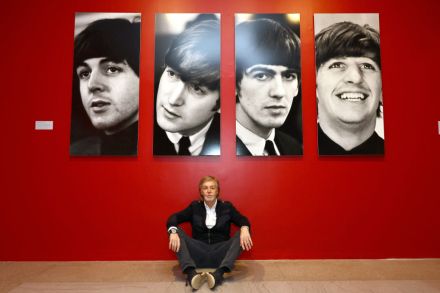
At Eyes of the Storm, the de Young Museum’s exhibition of photographs taken by Paul McCartney, mainly on the Beatles’ first American visit, the typical viewer will be surprised to find herself empathizing more with the rock stars than the audience. In early photos, the crowds – and the band members – are eager, curious and frank. But through the months and the cities and photoshoots, the Beatles learn to pose. They soon find themselves flattened by a camera’s gaze in a way all too familiar to just about everyone today. The collection opens with the Beatles’ British tour in 1963 and residency in Paris in early 1964. “We were just wondering at the world,” McCartney writes, “just excited about all these little things that were making up our lives.

McCartney

The buildings Richard Nickel championed

Perusing the listings of a recent auction, I noticed an intriguing, relatively flat piece of copper-plated cast iron featuring intricate foliate and geometric designs. It was a baluster designed by the firm of Adler & Sullivan in 1893 for the old Chicago Stock Exchange. The 1972 demolition of that building, thanks to the “urban renewal” undertaken by many progressive American cities during the mid-twentieth century, led to this bit of architectural salvage coming up at auction many years later. It also led to the death of an idealistic photographer and activist named Richard Nickel. When Nickel (born in 1928) was killed on April 13, 1972, his body was not recovered for weeks.

nickel

We are failing to curate the present

When I try to write a letter by hand, my hand has forgotten how to do it. I stumble at the end of words. I trip over letters I’ve known since I was five. It’s odd, too, because writing by hand is what I do. I am paid to letter the titles of books and draw offbeat, sophisticated hand-lettering for advertisements. I am a professional handwriter and I am losing my grip. Have I become obsolete or is it the pen? Writing manually has become abnormal. I now think onto my laptop’s screen via an arrangement of letters on a keyboard, an arrangement originally devised to insert a steadying difficulty into the typing sequence to protect the typist from speeds that might be dangerous. At one time it was believed that speed was dangerous, but now speed is the elixir.

artists

Girls on film

We are familiar with Dorothea Lange’s gritty photographs of Okies during the Dust Bowl. New Woman Behind the Camera, which opens this month at the Metropolitan Museum of Art, showcases Lange alongside over 120 other female photographers who refashioned modernist photography in the same years. Photography developed through an ambivalent relationship to high art: the camera was often seen as a medium for journalism or advertising. Yet the modernist works here showcase the flexibility of the form. Still, there are inherent tensions in an exhibit like this. Georgia O’Keeffe once declined an invitation to be included in an exhibit of ‘women artists’: she wanted to be seen as competing with the best, not as part of an inferior subgroup.

woman

Terry O’Neill: ‘Hollywood is lonely’

At the Maddox Gallery in Gstaad, that strange, swanky village on the roof of Switzerland, Jay Rutland is showing me the latest exhibition by photographer to the stars Terry O’Neill. It’s a lovely summer day, clear sunlight streaming in through the windows, and the high peaks on the horizon have never looked more inviting, but the Alpine view pales beside the photos on the walls. O’Neill photographed the world’s biggest rock stars and movie stars, the most famous people on the planet, yet these portraits are so fresh and intimate you almost feel you know them — not as aloof superstars but as fragile, familiar friends. Here’s Audrey Hepburn playing beach cricket with a piece of driftwood, grinning like a kid on holiday.

Stayin’ alive in ’75

This article is in The Spectator’s January 2020 US edition. Subscribe here. ‘Ford to City: Drop Dead’ was the headline of the New York Daily News. To which the City said to Ford, you first. When the Daily News ran that famous headline on October 29 1975, New York was teetering on bankruptcy. President Gerald Ford had declared he would veto a federal bailout. It looked like the Big Apple was stewed. The world had written off New York. The feeling was mutual: the city had written off the world. Between 1970 and 1980, the city lost nearly a million residents, over a tenth of its population. Still, New York attracted people who, against the reigning wisdom, would not or could not live anywhere else.

meryl meisler

The artist who breathes Technicolor life into historic photographs

There is something of The Wizard of Oz about Marina Amaral’s photographs. She whisks us from black-and-white Kansas to shimmering Technicolor Oz. When Howard Carter leans over Tutankhamun’s open sarcophagus (1922), he does so in the glare of pharaonic gold. A photograph of fallen American soldiers on the Gettysburg battlefield (1863) shocks the more when we see the colour of the blood soaking through shirts. The Javanese dancers who performed at the Exposition Universelle in Paris (1889) are gorgeous in madder pinks, jades and golds.