
Before David Cameron got the job of prime minister, he was asked why he wanted it. ‘Because I’d be good at it,’ he replied. This has always been told as evidence of Cameron’s arrogance and hubris, but it was also, until the end, a defendable position. I’ve always thought Keir Starmer thought largely the same. He’d risen to the top of the law and considered politics a logical career change. He believed he could get more done that way. The Cameron quote I’ve always thought genuinely hubristic came when he told another friend questioning his desire to get to No. 10: ‘How hard can it be?’
Both Cameron and Starmer know the answer to that. Politics is bloody difficult. Our problems are deep and intractable. There are enemies everywhere (including in your own party) and you have to have a plan and the ability to execute it. Until the referendum campaign, he largely did. But Starmer was less temperamentally or politically equipped to be prime minister.
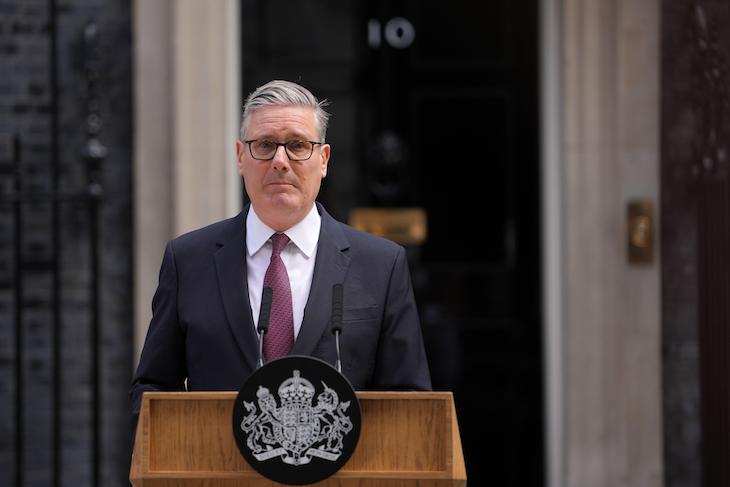
In his resignation speech, Starmer fairly boasted that he had changed his party, driven out the anti-Semites and won a landslide election victory. He also deserves credit for keeping the show on the road long enough with Donald Trump to get a tech arrangement over the line (though much of that is now in doubt) and for continuing Britain’s support for Ukraine. But his mistakes far outweigh his triumphs. How exactly did a landslide win turn into a premiership shorter than that of Theresa May and Boris Johnson?
Douglas Adams said the meaning of life, the universe and everything was 42. So here are the 42 reasons Keir Starmer failed:
1. He thought politics reprehensible and beneath him and never acquired the craft of doing it well.
2. The original sin was that he had no plan before the general election and his efforts to develop one in power were comical (remember the missions, pillars and targets?).
3. Knowing he didn’t know how to prepare for government, he hired Sue Gray to do it for him, but she had spent decades blocking and covering up mistakes, not driving policy development or even running a department.
4. He let his (brilliant) campaign manager Morgan McSweeney focus on the campaign, rather than force him to consider life after the election (McSweeney now admits this was a mistake).
5. He approved a pledge not to raise income tax, national insurance and VAT before the election, which he did not need to do to win the election and which dramatically limited his options once he won.
6. The election landslide led Starmer to mistakenly talk about his mandate when it was actually a generational rejection of the conservatives.
7. On winning power, instead of telling the country the cavalry had arrived to save the economy, which Rishi Sunak had already got moving in the right direction, he and Rachel Reeves said things were even worse than they feared and announced they would have to put up taxes, killing any feel-good factor.
8. As soon as he won, Starmer was embroiled in Giftgate after accepting free glasses for himself and free clothes for his wife, Lady Victoria. Thinking himself a good man, he couldn’t comprehend how bad it looked to the public and took far too long to close the issue down, resentfully defending his wife to a fault.
9. The first major mistake in power was to let the Treasury cut winter fuel benefits for pensioners, a move about which the public remains white-hot with rage to this day.
10. Since he was unable to formulate a political argument, he missed the chance to means test this and make the reasonable argument that millionaires should not be on benefits.
11. He let Reeves take months and months, during which doom and gloom escalated. So by the time she lifted her first red box for Budget 2024 the finances had deteriorated and money was even tighter.
12. The pair boasted that growth was their top priority and then imposed £40 billion of tax rises, including a £25 billion raid on employers’ national insurance, which has cost jobs, investment and growth.
13. Starmer failed to drop the plan to slap VAT on private school fees, which barely earned a penny for the exchequer, forced schools to close and forced less affluent parents into the state sector, further overburdening state schools, particularly when it came to children with special educational needs.
14. His second foundational error, according to voters in focus groups, was his handling of the Southport killings of three young girls. The PM and his team denied it was a terrorist attack even though the perpetrator Axel Rudakubana had been referred to the government’s Prevent programme and had ricin and an al Qaeda training manual in his house. This created the notion that he would not tell difficult truths on security and cultural issues. Again, it still comes up to this day, unprompted.
15. Starmer supported harsh sentences against those on the far right who rioted, while leaving the impression he did not speak out against left-wing protestors – a tendency which left him characterised as ‘Two Tier Keir’.
16. Starmer assumed turning up to work as a serious person and delivering would be enough, but delivery requires a drive and purpose and relentlessness he lacked.
17. He assumed that not being the ‘wicked Tories’ would allow him to get a much better deal with the EU. Turns out, the EU is not much less keen on his ‘cherry picking’ on single market access as they were when the Tories tried it.
18. Having never been a minister, he first praised the civil service as a Rolls-Royce maligned by the Conservatives, then publicly denounced it for presiding over a ‘tepid bath’ of mediocrity, then backed down. He neither tamed it nor reformed it nor galvanised it into action.
19. Starmer chose Chris Wormald as his first Cabinet Secretary (against the advice of the selection panel – who wanted Tamara Finkelstein – and McSweeney, who wanted Oliver Robbins), the most pedestrian, establishment, unrevolutionary character available, and then asked him to enact radical reforms. A year later Starmer became apparently the last person on earth to realise he was wrong, something any civil servant or journalist could have told him on day one.
20. In general, Starmer ran a Downing Street operation which ministers saw as a black hole, from which decisions did not emanate. Failure starts at the top.
21. Starmer himself lacked any curiosity about policy. He would read for an hour and emerge to say nothing, no aide says he bombarded them with ideas on a Monday morning.
22. This led to a failure to interrogate policy properly. Instead of encouraging arguments between his aides to thrash things out, as Cameron and Boris Johnson did, he cut off debate by snapping: ‘I’m not going to make decisions by committee’.
23. Starmer was hopeless with his own MPs, the one group of people who could bring him down before 2029. Dragged to the Commons tea room by aides, he complained later: ‘Never make me do that again.’
24. He was personally petulant, stubborn and distant from those he worked with.
25. When the going got tough, Starmer threw everyone else under the nearest bus to save himself – never an attractive attribute in a leader.
26. The worst example of this was his speech on immigration controls, where he warned about Britain becoming an ‘island of strangers’. By his own admission, he barely read the speech; he had no idea that it echoed the words of Enoch Powell. When Labour MPs went berserk, he went running to his biographer Tom Baldwin and said he regretted those words, kicking his own team in public. Many of them never forgave him and No. 10 became a bear pit of resentment.
27. On Gaza, he did not have a firm policy, first offending his MPs by backing Israel’s right to defend itself, then turning on the government there when it was politically expedient to do so, offending both sides of the conflict.
28. On Iran, he claimed credit for keeping Britain out of the war, but the UK armed forces played a role and Starmer allowed the US to use British bases for ‘defensive’ attacks on Iran’s missile sites. This indecisiveness meant Britain lost face with Gulf Arab allies and caused disproportionate
29. While Starmer continued British support for Ukraine, he was unable to persuade anyone bar France to join his coalition of the willing.
30. He appointed his closest friend in politics, Richard Hermer, as attorney general, enshrining a legalistic punctiliousness in Whitehall which prevented radical reforms to key problems.
31. Most obviously this led to Starmer advocating for a deal to give up sovereignty of the Chagos Islands while also handing over £30 billion for the privilege – all to please an international court which had no jurisdiction over the matter.
32. The beginning of the end came when Starmer caved in to his backbenchers over plans to reduce the amount at which benefits payments would increase. Again, this was billed as a cost-cutting exercise, rather than a moral crusade to get the disabled back to work. His authority was shot thereafter.
33. The lack of understanding came, in part, because Starmer has next to no hinterland. He cannot name a favourite book, he claims not even to dream and, in private, most attest that his only talking points are football and family.
34. Appointing Peter Mandelson as ambassador to the US was another mess. Starmer first wanted George Osborne but allowed himself to be talked into Mandelson by McSweeney.
35. Starmer seemed totally untroubled by the evidence that Mandelson had remained friends with Jeffrey Epstein after his conviction and imprisonment for paedophilia. Extraordinarily, he never even talked to Mandelson before giving him the job.
36. When the news broke about cringeworthy messages between Mandelson and Epstein, Starmer fired Mandelson but never explained why he had appointed him in the first place – as a political operator who could deal with Trump. He made a rod for his own back by pretending he didn’t know the key information.
37. When it emerged that Robbins, the permanent secretary at the Foreign Office, had found a way to mitigate problems with Mandelson’s business interests with China and Russia and had consequently granted him security clearance, Starmer reacted like a scolded child. He claimed, ridiculously, that he would never have appointed Mandelson if he had known there were commercial problems and then summarily fired Robbins, an act which backfired.
38. For months last year, Starmer and Reeves allowed endless speculation that they would break their election pledge and raise income tax, then bottled it. He seemed not to understand that breaking the pledge was toxic and that the speculation was itself killing growth.
39. Starmer tried to move Ed Miliband in a reshuffle last year and when Miliband refused to move, he failed to fire him. That allowed the Net Zero crusade to trump the need for economic growth or capitalising on AI, leaving the UK to buy oil and gas from around the world when it lies untapped in the North Sea.
40. He boasted repeatedly about raising defence spending by the most since the Cold War but then approved a Defence Investment Plan which will only raise spending from 2.6 per cent of GDP to 2.68 per cent. The chiefs say they need more than £30 billion. Starmer offered them £13.5 billion.
41. He and his aides permitted Andy Burnham to stand in Makerfield (having previously blocked him running in Gorton and Denton) because they mistakenly thought he would lose to Reform. Whoops!
42. In his resignation speech, Starmer teared up at the thought of his wife and children, but like Theresa May and Gordon Brown before him, he had mostly failed to show passion in the job.

Comments