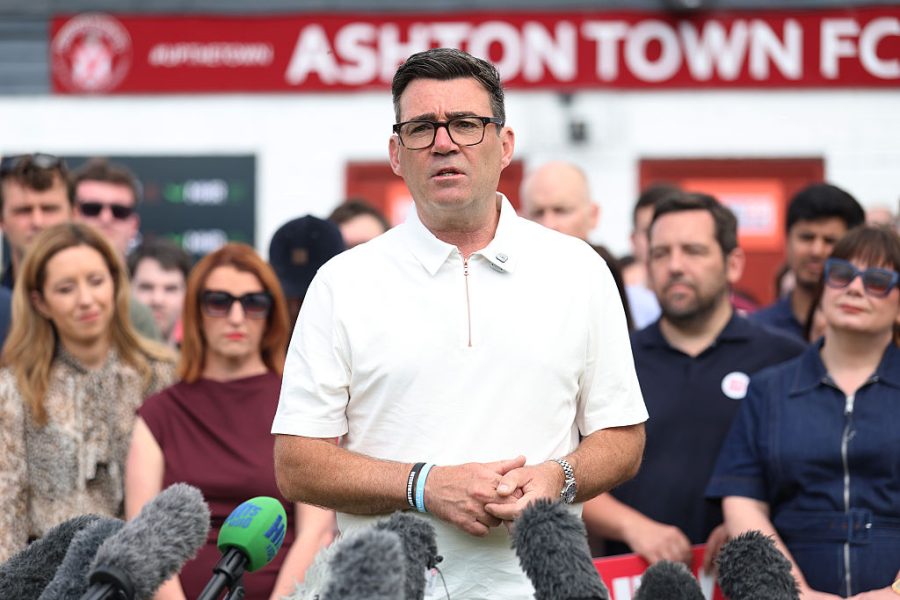
Thursday’s by-elections gave new hope to both the Conservatives and Labour. Both parties have been in the doldrums in the polls for more than a year – with Keir Starmer, at least, paying the ultimate price for his party’s unpopularity this morning. As Andy Burnham and the other victors arrive in Westminster to be sworn in as MPs, Labour and the Tories are hoping their respective successes in Aberdeen and Makerfield portend that they can now get the wind in their sails once more and re-establish their current tenuous relationship with the electorate.
The Conservatives fought Aberdeen South by emphasising their support for the continued exploration and extraction of the remaining oil and gas reserves in the North Sea. Aberdeen was, of course, just the place where such a message would have had resonance – once the oil capital of Britain, it has fallen on harder times now that the height of the North Sea bonanza is well behind us.
Burnham will have to champion the interests of the whole country, not just Manchester
In sharp contrast to the Scottish parliament election at the beginning of May, when Tory support fell to a new all-time low (and fell just as much in Aberdeen as everywhere else) voters appeared to respond. The 25-point increase in the party’s share of the vote in 2024 is the biggest ever rise on its general election vote that the Conservatives have registered in a by-election. Winning just under half the vote, the party secured by far its highest-ever vote share locally in what has hitherto always been a closely fought constituency.
But the key question now is whether this strategy is replicable more broadly. This week, those living in traditionally Tory territory of the South of England are facing the prospect of a record heat wave. On previous occasions, intense heat has served to increase public concern about the impact of climate change. Kemi Badenoch, who has taken much of the credit for the success in Aberdeen, may find herself having to explain how her party’s stance will help avoid the potentially damaging consequences of climate change.

Perhaps the answer to the replicability challenge lies in the Conservative party taking a similar approach to the difficulties being faced by the economy more broadly? Can it find a policy position that provides an effective critique of the government’s stewardship, convinces voters that a Conservative government would deliver economic growth, and draws voters away from the ‘culture war’ politics that is attracting voters to Reform? At the moment at least, that requirement is still to be fulfilled.
For some commentators, the Tory victory in Aberdeen South contained another encouraging implication – that the conviction of Peter Murrell for embezzlement had damaged the SNP, whose vote fell by four points. However, in Arbroath & Broughty Ferry SNP support increased by six points. Unlike the debate about the future of North Sea oil and gas, there is no reason to believe that Murrell’s conviction should resonate more in Aberdeen than in Arbroath. In truth, the results of two Scottish by-elections provide no clear indication either way as to whether the SNP have lost support as a result of the Murrell conviction.
In contrast, Labour’s fate in the two Scottish by-elections was dire – a drop of 19 points in Aberdeen and 18 points in Arbroath. As Keir Starmer acknowledged in his resignation speech this morning, the contrast with Andy Burnham’s success in Makerfield, where Labour’s vote increased by 10 points, simply underlined the apparent gap between Labour’s electoral attractiveness under the Prime Minister and the apparent potential for a brighter future for the party under Burnham.
However, much like the Tory success in Aberdeen, many of the ingredients of Burnham’s success in recording the first increase in government support in a by-election since Boris Johnson’s victory in Hartlepool five years ago are not necessarily replicable across the country as a whole.
Burnham lives just outside the constituency of Makerfield and was previously MP for nearby Leigh. He has acquired a personal popularity as Mayor of Manchester – in 2024, his share of the vote in the mayoral election was 16 points above what his party won in the general election a few weeks later. He has portrayed himself as the champion of the interests of Manchester and, more broadly, of the north of England, against a politics that he feels is too dominated by Westminster. He was nevertheless able to appeal in the by-election both to those still loyal to Labour and those who had become disenchanted with Sir Keir’s leadership.
But in making the now seemingly inevitable transition to Downing Street, Burnham will have to champion the interests of the whole country, not just Manchester. He will also need to develop a narrative about the kind of country he wants to create rather than simply articulating people’s disappointment at the present state of affairs.
That was a transition that Sir Keir never managed to make – a weakness that both Nigel Farage and Zack Polanski have been able to exploit. Yet one of the ironies of Burnham’s victory speech on being declared the winner of the Makerfield by-election was its emphasis on much the same kind of undefined ‘change’ that Labour offered under Starmer in 2024. He promised to ‘bring about the change the country needs’ and argued that his party had a ‘final chance to change’.
What we will now need to hear – from a politician who has something of a reputation for flip-flopping – is just what his vision of change for Britain as a whole is.




Comments