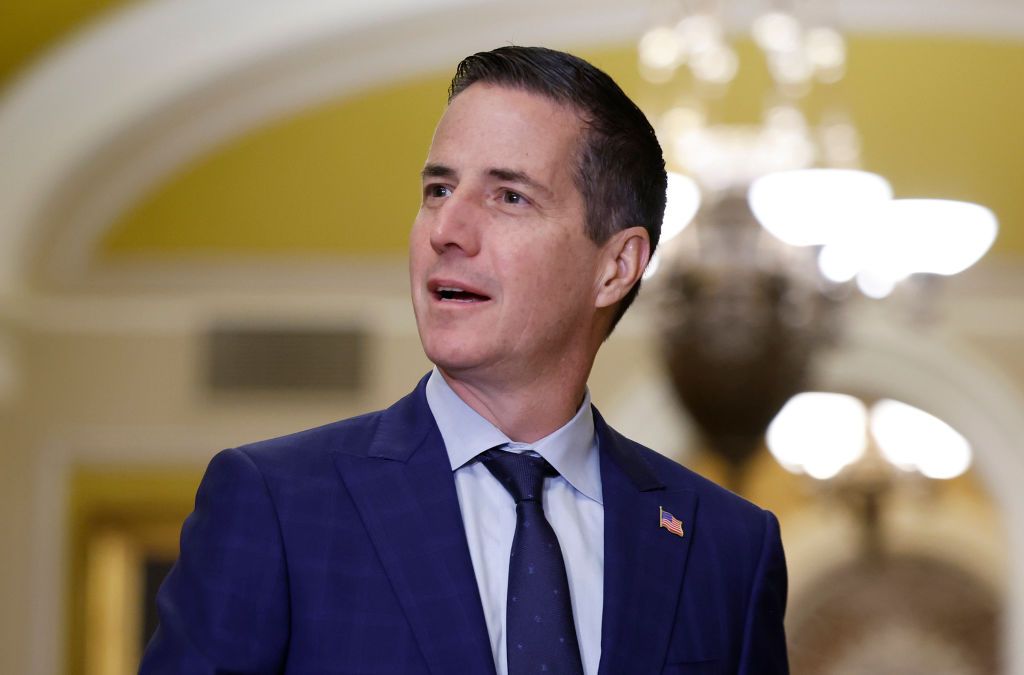
“The American Dream is the dream of the Americas,” declared Bernie Moreno to the assembled at Trump Doral – a sprawling golf resort just outside of Miami. The Ohio senator was there to collect the “Light of Congress” award, bestowed on him by Florida International University’s Adam Smith Center. “We have a window of opportunity right now to transform the Western Hemisphere into a Hemisphere of total prosperity and security,” said Moreno, to an audience which included Dominican President Luis Abinader and FIFA’s Gianni Infantino. The room rose for this native son of Colombia.
Bernie Moreno was born in Bogotá in 1967 and was five when his family moved to Fort Lauderdale. He went on to build a car dealership empire in Ohio. It is a familiar immigrant story, but the Morenos were not a familiar immigrant family. His father, Bernardo Sr., trained as a surgeon at the University of Pennsylvania, went home, became a medical school dean, founded Bogotá’s San Ignacio Hospital and ran the Colombian Institute of Family Welfare. It was Moreno’s mother, who described herself as coming from “outsized privilege,” who insisted on leaving so her children would not grow up entitled. Theirs was a rare case of a family driven abroad by wealth rather than poverty.
Moreno belongs to a new generation of Republican Latino legislators who take a hawkish line on Latin America’s left-wing governments
After a false start in 2022, he won Donald Trump’s endorsement in 2024, beat Sherrod Brown and became Ohio’s first Hispanic senator and one of the first two Colombian-Americans in the chamber. Since then he has introduced a bill to end dual citizenship and has called birthright citizenship into question. The press finds him easy to caricature as the immigrant pulling up the ladder behind him. This is wrongheaded. Theodore Roosevelt insisted there was no room in this country for hyphenated Americanism, and he was right. Full assimilation means putting one’s adopted country first, and that is what Moreno believes he is doing.

He is also a pugnacious economic nationalist. His idea to let buyers deduct interest on loans for American-made cars was folded into last year’s One Big Beautiful Bill. His HIRE Act would tax payments to overseas workers at 25 percent and spend the proceeds on apprenticeships. He has criticized Intel over delays to its planned Ohio chip plant, and this month told data-center builders, against much of his own party, that they should expect no more taxpayer money. To Moreno, neither companies nor people should have to leave home to prosper.
Moreno belongs to a new generation of Republican Latino legislators who take a hawkish line on Latin America’s left-wing governments. The lazy explanation is that these are privileged émigrés. But the Cuban-American old guard was shaped by a single historic grievance, Castro’s revolution in 1959. The newer hawks are replenished every decade: by Venezuela’s collapse, Ecuador’s narco-war, and Nicaragua’s crackdown on dissent.
There is a deeper reason for this sort of interventionism. A country that wants less migration has two strategies. It can police the border, or it can help make the places people leave worth staying in. The second is a slower yet more durable solution to the problem, and it needs legislators like Moreno who know those places and care about what happens to them.
To the Democrats and Colombia’s erstwhile socialist President Gustavo Petro, Moreno’s role in Latin America is simply to shill for the policies of the Trump administration. The charge is unfair but not exactly baseless. In an August 2025 visit to Colombia, Moreno met both Petro and former president Álvaro Uribe, who had just been sentenced to twelve years of house arrest for witness tampering. Moreno called the verdict an attempt to “silence” the man who had “saved Colombia from guerrilla violence.” It was a bold thing for a sitting senator to say about another country’s judicial process, but events would vindicate him: an appeals court later overturned the conviction, though prosecutors have since opened a new case.
Uribe’s shadow fell across this year’s presidential election. Abelardo de la Espriella, the hard-right lawyer sworn in as president on August 7, calls himself Uribe’s friend and disciple. He has sought to cultivate MAGA, making a pilgrimage to Doral earlier this year, where he and Moreno met for coffee. His record is not an unblemished one. According to Bogotá’s Foundation for Press Freedom, de la Espriella sued 109 journalists for libel and slander between 2008 and 2019. Judges threw out most of the cases, but the legal costs fell on the reporters anyway.
Trump endorsed him, and so, in effect, did Moreno, though days before the runoff he disputed having endorsed anyone, despite an earlier series of supportive posts on X. He has never addressed de la Espriella’s lawsuits. Moreno’s Latin America policy rests on the premise that alignment with Washington makes these countries freer as well as richer. A president who sues reporters chips away at that idea, and Moreno, of all people, has the standing in Bogotá to object. Staying silent has undermined a laudable effort to improve things in this part of the world.
Moreno observed both rounds of the election as an accredited international observer, invited by the National Electoral Council itself. His concern about armed groups coercing voters in lawless regions was legitimate. But eleven days before the first round, speaking at the Atlantic Council, he went further, urging the electoral council to treat intimidation as grounds for disqualifying results from parts of the country he called insecure. Petro, not unreasonably, asked him to stick to his brief.
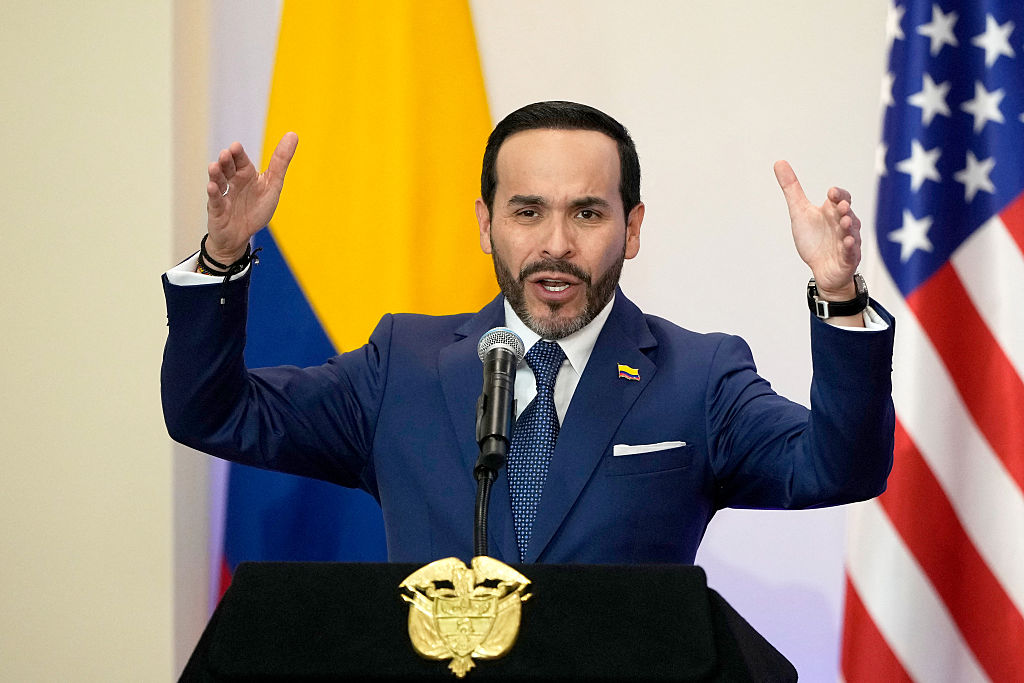
Moreno had little time for de la Espriella’s critics. On August 19 Franklin “Beto” Coral, a pro-Petro activist who had filed criminal charges against de la Espriella, was detained by immigration agents in Arizona, where he had claimed asylum. Moreno backed the arrest, arguing that no one can claim America’s protection while “acting as a foreign agent” against its foreign policy. It is a defensible principle. Petro answered by accusing him of “deceiving” Trump and suggested he was a self-hating Colombian.
De la Espriella won by less than a point, ending Colombia’s first leftist government. Moreno hailed the result as a “historic victory.” The Colombian media have given him the attention they normally reserve for their own politicians. Colombian Senator María Clara Posada, a leading member of Uribe’s Centro Democrático, told me that when Moreno speaks of Colombia, he does so not “with indifference or from a distance,” but “with the interest of someone who keeps a deep bond with the land of his parents.” His defense throughout the election was that engagement does not amount to meddling, and that the decision belonged to the sovereign people alone. He is right. A senator born in Bogotá is entitled to care loudly about Colombia’s future. The line he attempted to walk, and occasionally wobbled from, was to care about the result without trying to put Washington’s thumb on the scales.
Venezuela is the harder test. For years Moreno was among Washington’s most forceful critics of Nicolás Maduro, whom he accused of sponsoring terrorism. Since Maduro’s capture in January, the regime’s survivors have become Washington’s partners, and Moreno’s tone has softened. Of Delcy Rodríguez, Maduro’s own vice-president and now Venezuela’s interim leader, he has said little. He has not been silent on democracy, though. In July, hours after Marco Rubio announced transition talks, Moreno proposed that Venezuela go to the polls on July 24, 2027, Bolívar’s birthday. The idea has its merits, yet he insisted on framing this choice of date as a tribute to two liberators, Bolívar and Donald Trump. A senator who wants to be heard in Caracas as a friend of Venezuelans, rather than of Washington, should avoid rhetorical flourishes of this kind.
To his critics, Moreno’s role in Latin America is simply to shill for the policies of the Trump administration
What Moreno can point to is results. On August 12, the senator stood in Panama City at the Americas Counter Cartel Coalition conference beside Secretary of War Pete Hegseth and Panamanian President José Raúl Mulino as Hegseth signed a memorandum with Colombia’s new Defense Minister, Jorge Mora, making Colombia the coalition’s 19th member and unlocking a billion dollars in security aid. The Shield of the Americas – the pan-American security alliance brokered by Trump – now includes it as well. Moreno had pushed for Colombia’s inclusion for the better part of a year.
In Washington, Moreno is the senator who wants to end birthright citizenship. In Bogotá, and now Panama City, he is a folk hero of the Latin American right, prominent enough to feud with one president, defend another and stand at the table when the documents are signed. How long this influence lasts now depends on his willingness to sometimes tell friends what they would rather not hear.
The Morenos left Bogotá because leaving was the better option, and this never should have been the case for a family of surgeons and deans. The test of Moreno’s policy is whether, a generation from now, a Colombian family like his decides it has no need to go anywhere. That is a more ambitious immigration policy than a wall, and a more generous one as well.





Comments