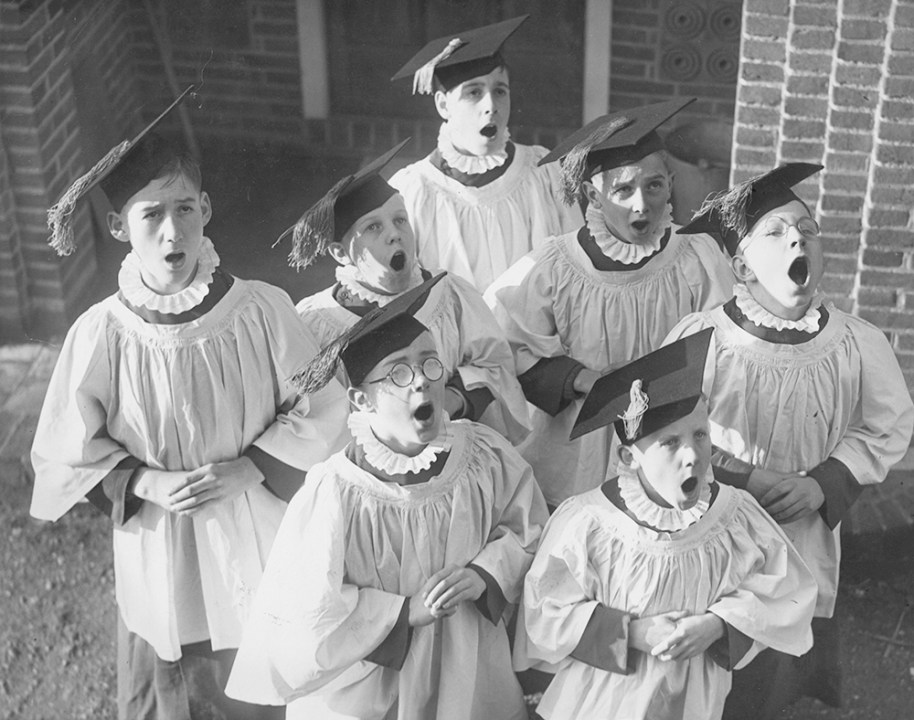
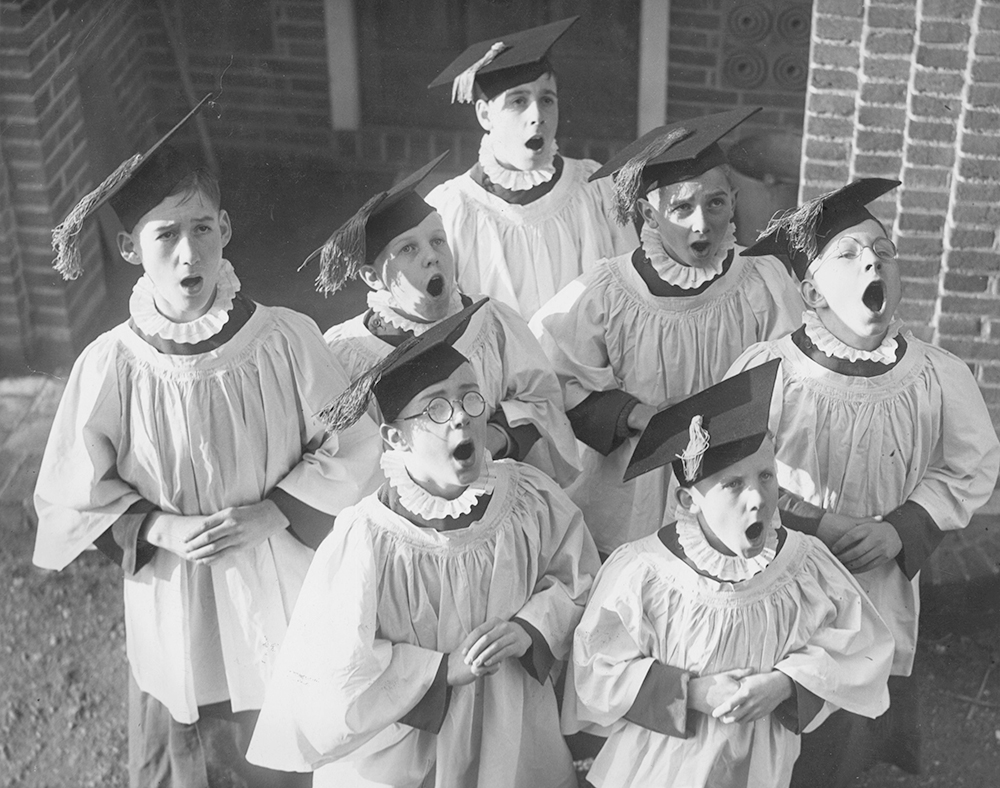
You’d be hard pressed to find a more continuous strand in British culture than the chorister. They’ve been warbling in Westminster Abbey since the 1380s. Every national occasion is marked by choirs, the choristers dazzling in their splendidly anachronistic ruffs and robes, present at moments of collective joy or sadness. Funerals, memorial services, royal weddings, carols from King’s College, Cambridge. They are ornaments to our culture.
Oodles of composers, musicians and singers, professional or not, have, over hundreds of years, stood in the choir stalls at dawn, at midnight, and lifted their voices to the vaulting roofs. Some of the most beautiful music in the canon was written for choirs: Gregorian chants, Thomas Tallis. I challenge anyone to listen to Edgar Bainton’s ‘And I saw a New Heaven’, or Jonathan Dove’s ‘Seek Him that Maketh the Seven Stars’, and not be moved. Early on during lockdown, I drove to the silent shops and John Tavener’s ‘The Lamb’ came on the radio. Such was its emotional impact, I had to pull over.

Choristers are symbols of excellence. The singers are trained in an exemplary manner: the discipline needed for a crack choir to rise early, sing at several services, and stay up till late if needed is extraordinary.
Yet choirs are under threat, from a number of quarters. At parish level, church choirs have been diminishing for years. Processions of choristers were not an unusual sight when I was growing up in the 1980s. Even small village churches had full choirs, with any boy whose voice had not yet broken dragged in to make up the numbers, even if he couldn’t sing. But dropping church attendance led to depleted choirs. Now many church choirs, if they exist at all, are made up of retirees, who deserve applause for their dedication. But who will follow them?
At the same time, choir schools are closing, the most recent being Exeter Cathedral School. You can point the finger at VAT on school fees, a philistine lack of interest in this supposedly elitist occupation, or a combination of both. If choir schools close, then we lose the pipeline of choristers into the universities, cathedral choirs and beyond, and that matters.
Singing in a choir is one of the most transcendent things a child can do. I know, as for most of my school life I was a choirboy. At my day prep school, our choir composed of piping trebles and embryonic sopranos, we were robed in red and sang ‘If I Had a Hammer’.
At my boys’ boarding prep, we wore blue robes and white surplices. Different coloured ribbons round our necks indicated seniority (the cause of much envy, if you weren’t leader of the choir). The church was nestled into the side of the school, and we sang there every Saturday, things like Mozart and Rutter. We also got paid for singing at weddings and in care homes: anything from £1 to £3. The heaven of those three gold coins, ready to be spent on extra tuck. And after choir trips, there was always a stop at the fish and chip shop. Thirty cod and chips, ordered beforehand by phone, greedily devoured by happy, hungry boys.
Every year at our carol service in Arundel, with the frost sparkling and the candles glowing, the voice of the soloist in ‘Once in Royal David’s City’ was enough to make the most hardened or atheistical parent rub away a tear.
When my voice broke in my final year of prep school, I was exiled to handing out the hymn books
When, in my final year of prep school, my voice broke, I was exiled to the job of handing out the hymn books. Devastating. Fortunately, at Lancing College I could use my newly minted tenor voice. The school had a stonkingly good choir under the leadership of the director of music, Neil Cox (himself an accomplished composer). We sported heavy purple robes which smelled of incense and, I imagine, had probably not been changed for decades. There, our repertoire ranged widely. Arvo Part wrote his haunting ‘Triodion’ for the school’s 175th anniversary, and faxed in his corrections. When he conducted us in his own music, we were partaking in something entirely new, yet rooted in ancient music.
We sang in all sorts of places: with massed choirs in the Albert Hall; and in Westminster Abbey itself, where 30 years later the Westminster scholars would -welcome the new King Charles with their teenaged voices.
I remember an Australian school choir came to visit. We Lancingers, overcoated and serious, sang ‘Cantique de Jean Racine’. The Aussies, T-shirted and laughing, sang ‘Waltzing Matilda’ (or something like it). Undeterred, our choirmaster shoved us all together and conducted us in a massive round of ‘London’s Burning’. It was joyful.
Once a singer, always a singer. Now I sing tenor in a handful of choirs, in churches and elsewhere, and often meet ex–choristers and choral exhibitioners and scholars from the universities, as well as semi-professionals and pros. Though we don’t robe up for services (which I miss), I enjoy the thrill of sight-reading new music at speed, and of learning new and challenging repertoire.
All the training I received over the years has not gone amiss: to listen to the conductor, to your fellow singers, to the organist. You are not a single person, but part of a many-throated organism. While applauding excellence in individuals, choirs are also democratic. Even the most prima donna-ish bass or soprano melts into the rest. Choirs take on a life of their own. I am always astonished when, after what feels like about ten minutes’ slightly shaky rehearsal, we sing the anthems and masses all but flawlessly.
The government should be doing all it can to protect our ancient and vital choral tradition. Instead, it seems to revel in the closure of storied, beloved places, and in the waning away of something unique, unmatched in any country in the world. It has taken centuries to build up our choral tradition. It may only take four years to destroy it.






Comments