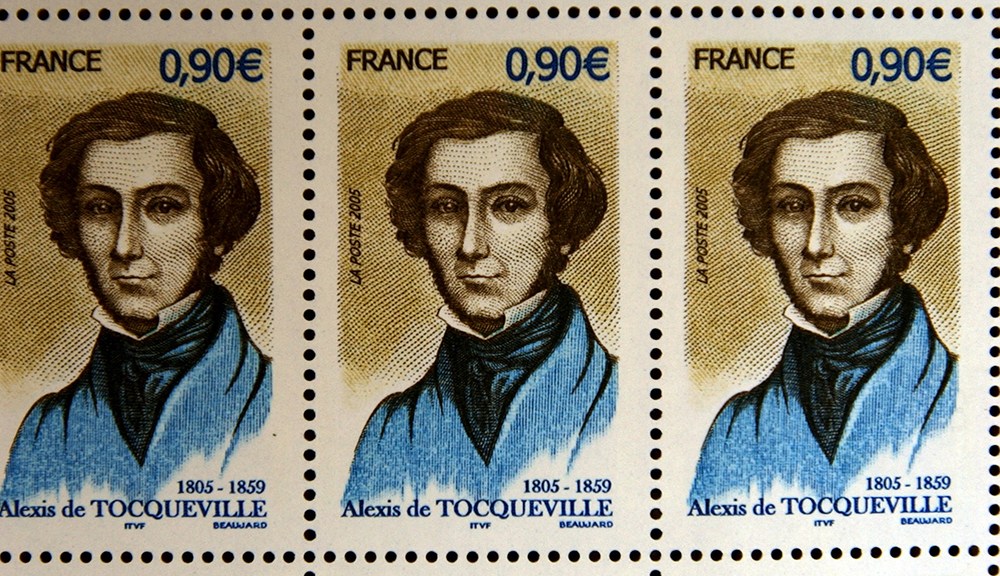
Alexis de Tocqueville foresaw the coming of what he called the tutelary state, intruding itself into every area of democratic society. He did not foresee that democratic government would foster, advance and extend the self-centered, actually narcissistic societies that present-day democracies have become: the direct and inevitable result of vote-seeking politicians ceaselessly and shamelessly flattering their constituents in regard to their immense dignity as democratic citizens while assuring them of their democratic deserts in election seasons, and every other day.
Governor Huey Long of Louisiana stated the thing most directly and shamelessly during the Roosevelt 1930s with his talk of “every man a king.” He, like so many of his successors, might just as well have gone ahead and said, “Every man the center of the universe” – thus pressing democracy to its reductio ad absurdum. According to contemporary democratic belief, everyone (“the rich” excepted) deserves everything, and is living a deprived existence if he (or she, or zit) doesn’t have it. This assumption is supported by modern psychologists, psychiatrists and mental health “experts,” and also by the various mental and emotional therapeutic schools, all of which teach the radical human importance of “self-affirmation,” formerly discouraged in dark, unenlightened, pre-Freudian times as selfishness, arrogance, pushiness, rudeness and aggression.
Notable among the “everything” that no one has, or at least not enough of, are power, money, sex, recognition and attention; also attention, recognition, sex, money and power. Thus those people, or groups, with insufficient power must be empowered; those without enough money must have it redistributed to them; the sexually deprived must be compensated by access to unrestricted pornography; the unrecognized must be granted the 15 minutes of fame that Andy Warhol claimed was their due; and the attentionless must be paid attention.

To the above list, I had nearly forgotten to add that category, regarded as especially special in contemporary democratic society: the “offended.” In modern circumstances in which every man is a king and every woman a queen, nothing could be more obvious than that each man, each woman and everyone in the 73 genders in between must be protected by statute law against what in courtly times was called “lèse majesté”: any act, statement or form of behavior regarded as an affront to the dignity and position of the crowned head of state. “Off with his (or her, or zit’s) head!” has thus become as tediously familiar a demand in the 21st-century West as it was in Lewis Carroll’s Through The Looking Glass. The Red Queen, so easily offended by anyone in close proximity to her, was under-protected by comparison with the average woke democratic citizen of today.
Similarly, the contemporary obsession with identity politics and identity as the basis and frame of all social life has not served to lessen the self-centeredness and narcissism that democratic ideas and democratic feelings have given rise to in advanced democratic societies and their cultures. Paradoxically, citizens of the multicultural democracies of the western world today are at least as mindful as the former premodern aristocracies of Europe and Asia were of their racial, ethnic and class origins, and as proud of them, though not so publicly boastful.
In the US, for example, where no one has referred for a century to quadroons and octoroons, any politician burdened with any political ambition at all and with a skin of a shade only slightly darker than that of a member of the Mayflower Society with a Cape Cod tan, will run for office as a proudly – and defiantly – “Black” or minority candidate, despite having white features and, just by way of example, Hispanic-American parents living in Puerto Rico.
Still, nowhere in modern democratic polity is the self-obsession it has nurtured so blatantly marked as in the popular demand for the recognition and provision of “rights,” which began with the French revolutionaries’ talk of the “rights of man” and has progressed to include the “right” to a free education, free housing, free medical care and a guaranteed annual income.
Mary Ann Glendon, the Harvard professor and author of Rights Talk, was, so far as I know, the first to tackle the subject in its social and political dimension; three decades later, Pierre Manent, the French scholar, addressed it on a more philosophical level in Natural Law and Human Rights.
Not only has the mania for the discovery of formerly unimagined and unimaginable “rights” prompted self-identified democratic activists to defy and seek to override the natural law, its practical result has been to set these innumerable but often contradictory rights one against the other: for example, one man’s right of free speech against another’s right not to be offended, an opposition at the center of an increasingly vicious debate today. This, despite the fact of the first being historically guaranteed under the Constitution and the second an upstart claim guaranteed by nothing. The proponents of the latter are utterly unconcerned with any rights or interests beyond their own. They are the collective face of our world: the aggrieved and angry New Model Democracy of Me.






Comments