
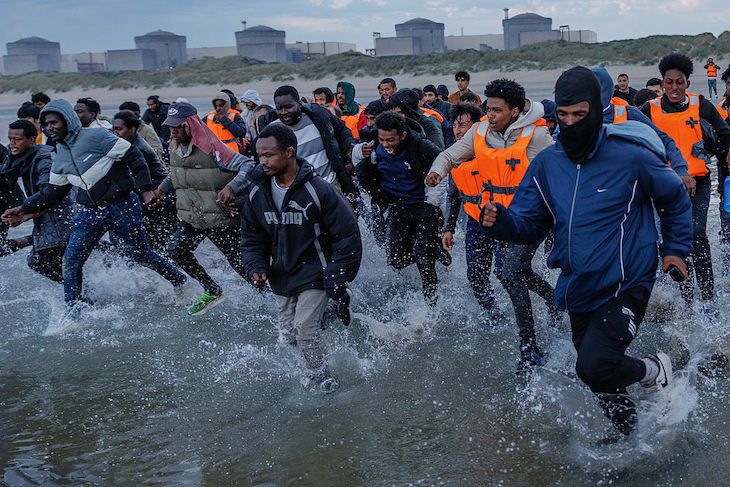
Shabana Mahmood was supposed to be the one who got it. Of all of Labour’s top team, the Birmingham woman from a Pakistani family who had risen to become Home Secretary, seemed to understand that Britain’s liberal approach to migration was ruinously expensive and socially destructive. Mahmood certainly talked tough. But when push came to shove in parliament yesterday, she could not follow through.
High levels of migration hit some harder than others
In a significant watering down of her original plans, Mahmood announced that 300,000 foreign care workers, and the dependents they brought with them, will gain the right to remain in the UK indefinitely after working for only five years on an annual salary of just £25,000.
At that point, they can leave the care sector and take a different job or, indeed, give up working altogether, as they will have access to the full suite of Britain’s benefits system. By the Home Secretary’s own estimate, the bill for this generosity could reach £10 billion.
Critics are right to point to the burden this places on already overstretched taxpayers. But high levels of migration hit some harder than others. As Nigel Farage noted yesterday, immigration is a ‘massive class issue’.
It is ‘good for the rich’, the Reform UK leader told a press conference, ‘the upper middle classes love mass migration’. For the wealthy, a steady supply of immigrants means, ‘cheaper nannies, cheaper chauffeurs, cheaper gardeners’. It is ‘great for big employers because the minimum wage becomes the maximum wage’. But, blasted Farage, ‘the unwashed poor that live north of Watford’ experience things very differently: ‘their rents go through the roof’ and ‘they can’t get a GP’.
Now, I know from personal experience that people in the north do wash. Even the poor ones. But on every other point, Farage is absolutely correct. Importing unskilled or low-skilled workers pushes down working-class salaries while driving up housing costs. When high levels of migration are sustained over several decades, from free movement within the EU under Tony Blair to the more recent Boris-wave, this has a devastating impact on living standards.
Relying on foreign care workers when Britain has close to a million young people not in education, employment or training suggests that a generation of unskilled, mainly working-class kids has been written off.
We might not tell them explicitly that they are useless, but parking them on benefits while importing people from overseas to do the work sends the same message.
We flatter ourselves that British people do not want to work in care, agriculture, or even construction, with little attempt to understand why not. Better working conditions, opportunities for career progression and, yes, higher salaries might all tip the balance.
Migration is ‘a massive class issue’ for other reasons too. Despite the Labour government’s efforts to house migrants in bucolic Oxfordshire villages, it is still the case that asylum seekers are concentrated in poorer areas of Britain.
As The Spectator reported back in August, ‘the most deprived tenth of local authorities have, on average, 30 asylum seekers per 10,000 residents, the least deprived tenth fewer than four.’ This puts extra pressure on public services in areas where people need them most. Parts of the north east dubbed ‘dental deserts’ because of the shortage of NHS dentists are home to some of the highest proportions of migrants in the UK.
The concentration of migrants in areas with cheap housing means wealthy liberals are safe to espouse their love of refugees, secure in the knowledge that their own communities are unlikely to be significantly altered. It is easy to sound virtuous and tolerant in front of your friends when mass migration means a cheap plumber and a new grocery store selling exotic pulses and spices. When your local high street has changed beyond recognition in only a decade, then it is a different matter.
And then there’s the question of safety. Headlines tell of migrants from countries like Afghanistan, Eritrea, or Sudan sexually assaulting or raping women and girls. The people who become victims of migrant crime are working-class women like Rhiannon White, the young mum who was brutally murdered by a Sudanese migrant staying in the hotel where she worked. Or Wayne Broadhurst, the street cleaner who was killed by an Afghan migrant while out walking his dog.
Labour MPs and their hangers-on in think tanks and newsrooms might be congratulating themselves for pushing the Home Secretary to change tack on immigration reform. But Nigel Farage is right. Shabana Mahmood’s watered-down proposals are a ‘massive class issue’. And, yet again, Labour has shown that it is the party of the rich.





Comments