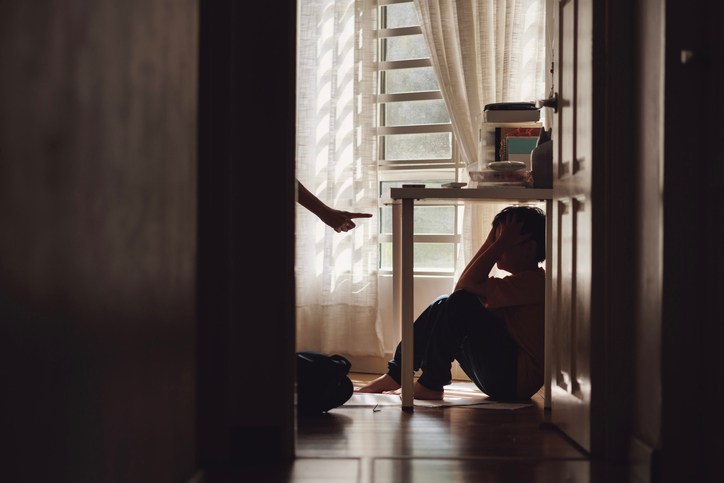
‘Do you know where your children are?’ I remember watching TV in Washington D.C. in 1969 and listening to my parents’ shock at the public service announcement. Who wouldn’t know what their offspring was up to? Did the government really need to remind Mum and Dad of their responsibility?
My parents had just arrived from Italy, carrying with them a host of unspoken but crystal-clear rules about raising children. Within months, they learned that they had been naïve to think these were the norm in urban America. ‘Let them learn from their mistakes’ was the prevailing pedagogy, and violent youths on the rampage made daily headlines. No one seemed interested in the connection between the two trends.
Fast-forward to 2026 here in Britain and the alarm raised by the Children’s Commissioner, Dame Rachel De Souza, this week: a growing number of children are ‘fixated with violence’. As in 1960s America, parenting is to blame.
De Souza points out in her latest report that schools are referring these children to Prevent – and nothing happens. The programme set up specifically to prevent people from being drawn to terrorist violence is failing: teachers claim that their whistleblowing seldom leads to any follow-up, and even when it does, 65 per cent of young people referred to Prevent were sent back to their schools and colleges.
All this does is teach children that their actions have no consequences
This is frustrating and dangerous. Without the right medical or psychological intervention, how many of these troubled children will go on to assault or even kill classmates, family members, or random strangers? De Souza is right to say in her report that Prevent is not doing its job properly. But neither are parents.
Mothers and fathers are as ‘intoxicated’ with social media as their children are. One study published in June with the giveaway title ‘Mommy, do you love your phone more than me?’ found that teenagers were left feeling ‘devalued and dismissed’ by their parents’ constant phone habit. De Souza agrees that ‘Parents have a role to play when it comes to helping children stay safe online’. Speaking to her in person, she told me that parents ‘should put their own phones down; have early, everyday conversations with children about how to respond to risks and establish guidelines and boundaries’.

But the childish addiction to social media is leading many fathers and mothers down sinister paths: addiction to online porn has been growing – a third of adults report regularly watching it – and research shows that the content they view is growing more violent too. Big Tech insists on challenging the view that online violence leads to real-life violence, but Julia Margo, co-founder of Fair Hearing and mentor to more than 250 victims, argues that:
The timeline reflects a clear correlation: the surge in adult viewing of violent porn corresponds with the increase in domestic abuse – more than 90 per cent of the 50,000 cases in family courts this year include allegations of domestic abuse. And there can be no doubt that domestic abuse drives children’s violence: more than a third of children involved in serious violence have experienced domestic abuse in the family.
Childish parents will ignore these claims just as they ignore grown-up rules. Establishing boundaries between what is acceptable behaviour and what is not should be a parent’s duty. Julian Tomkins, a psychotherapist specialising in adolescence, argues it is a parent’s most important duty:
A child acting out in violence is generally reacting to coming up against a boundary – ‘no, you can’t’. They are expressing feelings they can’t explain verbally. A parent’s role is to verbalise that reaction, identifying what gives rise to the violence, so that parent and child, hopefully, can better manage it.
What we have witnessed instead is parents resolved to absolve their child of any mistakes – even crimes. This can seem banal: ‘gentle parenting’ shies away from any kind of scolding, let alone punishment, allowing offspring off the hook, for example, for taking another toddler’s toy. It can, however, escalate: teachers report that some parents will refuse to accept their child can be at fault in any instance. Like overgrown playground bullies, they attack those who dare provide evidence to the contrary.
All this does is teach children that their actions have no consequences. And in some cases, as with that of the Southport killer Axel Rudakubana, parents even become complicit in the crimes of their murderous children, covering up for them (the Chair of the Southport Inquiry found that Rudakubana’s parents downplayed his behaviour and were at times hostile to the authorities). Parents who behave in this way should be prosecuted for their children’s violence.
Simon Bruce, legal director of the Dads House family law clinic, agrees that ‘all parents have a duty to safeguard their children and should be held accountable if they are negligent, reckless or deliberate in their lack of care of children’. But, he argues:
Given the contemporary complexity of online life and influences, today’s parents do need more support. Reforming the Children Act to provide them with the benign support and help of the sophisticated agencies required to deal with the contemporary complexity of online life and influences is very welcome.
Courts in America have set a different, more punitive, precedent. Following a school shooting in Michigan in 2024, the parents of the 15-year-old gunman were each sentenced to up to 15 years in prison. A new law in Louisiana, introduced last month, allows courts to fine parents up to $5,000 (£3,650) if their child is convicted of threatening violence in school.
Should we follow suit? I’m certain this would prove more effective than asking, ‘Do you know where your children are?’





Comments