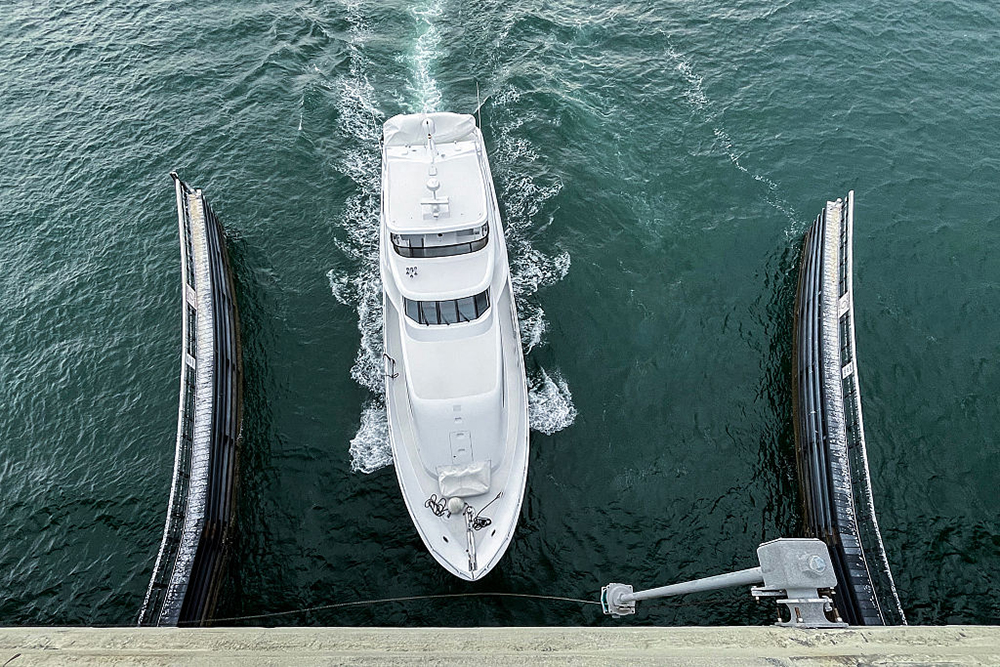

Yacht owners are well-heeled and outgoing types, perfect devotees of good food and wine. Drinking and yachting does not carry the same stigma as drinking and driving. But yachts are not exactly small things so where, exactly, do you put your boat when you stop somewhere for lunch or dinner?
A guide has now been published, telling yacht-owners which Palm Beach restaurants are boat-friendly, how much dock space each establishment has, whether or not there are docking fees, whether “rafting” is sometimes necessary (ferrying people to and from the dining area from the dock), whether overnight parking is permitted (in case you imbibe too much), what is the maximum size of boat accepted, whether table service on the boat is available and for what fee and whether sailboats are permitted.
A guide has been published telling yacht-owners which Palm Beach restaurants are boat-friendly
Some restaurants – such as those at Jupiter, an hour north of Palm Beach – have gotten together to use a common dock, so Tiger Woods’ the Woods, the Jupiter Grill, Pura Vida, Mana Greek Fusion and some other spots, now collectively use the Harbourside Marina. Even so, this marina is often fully booked for months on end, so popular is this new fashion. It’s not all pure perfection. As the practice is still in its early days, many dock-and-dine outlets still operate on a first-come-first-served basis, meaning they often get clogged up early on.
This season is almost over and, a local rag tells us, about 1.5 million “snowbirds,” as emigrating residents are known, are expected to head north in the coming weeks. And people are being advised to look after their PB homes throughout the winter by managing indoor temperatures and, in particular, humidity levels, to prevent mold; to remember to run the pool pump six hours a day and turn off the ice-maker in the refrigerator. (Are Palm Beachers thick enough to need reminding of such advice?) Local police are warning people of a less obvious problem; if they are shipping their vehicles north, to Maine or Newport or the Hamptons, they need to beware of what they call “an on-the-rise scam.” PB Police spokesman Sergeant Michael Ogrodnick says: “Some car carriers that appear to be legitimate instead make off with the vehicles they’ve been entrusted to haul.” There are no actual documented cases of such a crime here, though arrests have been made further north, in which vehicles were delivered to a fake address, where they are stolen “and delivered to criminals.”

One woman who won’t be going north – or anywhere – for a while is the Honda Accord driver (I won’t add to her embarrassment by naming her) who, quite deliberately, ran over 11 ducklings, killing them. She was seen turning her car around “multiple times to purposely hit the baby ducks” one day in late April. Approached as to why she did what she did, she complained that they “made a mess in her yard.” Oh dear. The attack was recorded on video so could not be denied. She was charged with 11 counts of cruelty to animals and jailed.
The latest wildlife to feature in affairs is the opossum, a nocturnal, semi-arboreal marsupial. They are indigenous to the Americas, solitary, non-aggressive and when attacked often “play dead.” But their importance, for now, and this is new, lies in the fact that they are found extremely tasty by the very invasive and unpleasant Burmese python, which Florida and the Palm Beaches badly want to rid themselves of. The new plan, put forward by scientists, is to use the opossum as bait. Ecologists here are fixing direction-finding tracking collars to a number of the marsupials (cost: $190). Pythons are notoriously difficult to locate but python predation “is a notable contributor to opossum mortality.” The idea grew out of a study of raccoon and opossum movement which was continually disrupted by Burmese pythons, who were eating the animals that were the primary study of the ecologists.
In the new study, the opossums are let loose… to be eaten, though the hope is that the pythons will eat the collars as well and therefore ingest the tracking device, making python location that much easier. The collars have a “mortality switch” and once that engages the scientists know when the unfortunate creature is dead. If the collar continues to move, it is almost certainly inside a python. The scientists reject the “bait” analogy, saying they release the opossums back into their natural habitat, to lead a normal natural life. And a data-useful death.




Comments