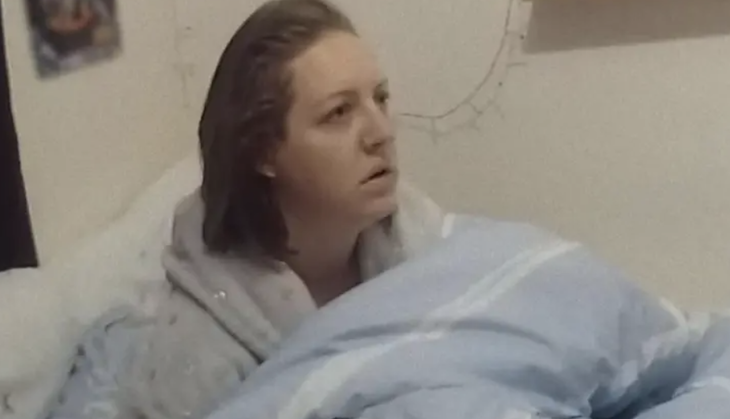
I often tell friends they should read up on the Lucy Letby case because it is not going away. People will be talking about it for decades, possibly centuries. Even if she confesses, some people won’t believe her. A working understanding of the events at the Countess of Chester hospital in the mid-2010s will soon be as essential to social discourse as a rudimentary knowledge of the Premier League table, so you might as well do the prep now.
The lies. The disturbing comments. The gaslighting. The falsification of medical records. The bizarre scribbling
The case is so vast that it can swallow you up. The first trial took ten months and then there was another trial, two attempts at an appeal, and the Thirlwall Inquiry. The Inquiry itself produced more documents than anyone could reasonably be expected to read. No matter how much you learn, it is never enough. The knowledge is dispersed over court reports, witness statements, podcasts, tweets, blogs, books and documentaries. Unhelpfully, some of it isn’t true. The court transcripts are the Holy Grail but they’ve never been available online. Some people have got hold of excerpts. There is a chap on YouTube who reads them out. You can listen to the prosecution’s summing up if you want – and of course I have – but it takes over ten hours.
Scraps of new information and misinformation appear regularly and show no sign of slowing down. So far, the Letby case has been the subject of three episodes of Panorama, two Channel 5 documentaries, one ITV documentary, a feature film shown on Channel 4 and now a Netflix documentary. The latter was released this week, and was pre-empted by a fresh burst of Letby-related publicity featuring Esther Rantzen, Nadine Dorries, her ubiquitous lawyer Mark McDonald and the detective who caught Beverley Allitt. Her PR company – yes, she has a PR company working for her – boasted on X about getting a sympathetic story on the front page of the Sun. There was a sense that her supporters were panicking about Netflix not giving them the easy ride that they have become accustomed to.
Were they right to worry? Not really. The Investigation of Lucy Letby doesn’t give her apologists the free rein they enjoyed in the lowbrow ITV documentary last year, but they get most of the last half hour to themselves. Mark McDonald is not the best advocate for Letby, which is unfortunate for her because he is her lawyer, but he articulates the main Letbyist talking points. Rather than portray his client as the victim of an unfortunate series of coincidences, he takes the bolder and less plausible line that she was made a “scapegoat” for the failings of the hospital. In response, Dr Gibbs, a now retired consultant from the Countess of Chester, gently suggests that framing a nurse for multiple murders would not be the best way of shielding a hospital from negative publicity.
A good deal of airtime is devoted to Shoo Lee, the retired neonatologist from Canada who believes that no murders took place, but the flaws in the explanations put forward by his panel of experts are not discussed. For that, you need to watch the last Panorama documentary about Letby, read Unmasking Lucy Letby, read the victims’ parents’ closing statement to the Thirlwall Inquiry or wait a few years for the Court of Appeal to give its opinion.
The views of McDonald and Lee will be familiar to anyone with a passing interest in the case, having dominated the media’s coverage of this story for the last 18 months. There are tribes untouched by civilisation who have heard that Letby was told to write those strange notes by a therapist, although why this makes a difference remains a mystery, even if it is true (Letby never used this excuse herself). The Letbyist megaphone has been so loud that some viewers might need a reminder of why she was imprisoned in the first place, and in this the new documentary performs admirably.
It is not an easy story to tell in a hour. It would be better suited to one of the box set marathons that Netflix excels at. Aside from the insulin evidence, there is no smoking gun. Instead, there are hundreds of little arrows all pointing at the same person. A vast, circumstantial case that took the prosecution six months to explain to a jury defies a brief summary and is uniquely unsuited to an era of ADHD and social media. But by focusing on the initial police investigation, we are given a decent understanding of how the jigsaw fell into place.
A hospital where an average of two babies a year died suddenly averaged one death per month. Strange rashes that the medics had never seen before and which have never been explained. One nurse always present. The lies. The disturbing comments. The gaslighting. The falsification of medical records. The hoarding of handover sheets. The bizarre scribbling. The obsessive Facebook searches for bereaved parents. The insulin evidence. The cross-examination. The police are probably wasting their breath explaining, for the umpteenth time, that they only noticed that Letby was always at the scene of the crime once the crimes had been identified. Letbyists cannot and will not accept this, but it bears repeating.
The footage of Letby’s multiple arrests at home are needlessly voyeuristic
And there are some new nuggets of information here, none of it game changing, but some of it telling. The footage of Letby’s multiple arrests at home are needlessly voyeuristic and add little to the story, although it is interesting to see how eager Letby was to know whether the police were going to search her house when she was first arrested. Only a few snippets of her police interviews have been made public, but now we can see with our own eyes how strangely forgetful she was about key moments and how often the usually cooperative nurse gave “no comment” answers to crucial questions.
It must have come up in the trial, but I had been unaware that along with the notes saying “I killed them on purpose” there was another note saying “murder”, “murderer” and “no one will ever know what happened and why”. Nor did I know that she not only kept 250 handover sheets at home – which she claimed she had taken accidentally and meant nothing to her – but carefully arranged them in chronological order. In the police interviews, we see her say that she would have shredded these confidential documents if only she had a shredder. We then see a photograph of her shredder.
Letby’s defenders will say that this is all circumstantial and trivial. Perhaps
Letby’s defenders will say that this is all circumstantial and trivial. Perhaps it is. If it were truly important we would have known about it before now. But it is nevertheless interesting, just as it is interesting to hear from the mother of Baby D, the child that we can now call Zoe, and Letby’s best friend, both of whom appear digitally anonymised with some almost-convincing AI. The mother insists that her daughter was getting better when she suddenly collapsed, contrary to the opinion of the Shoo Lee panel who claimed that she deteriorated with an infection that was “out of control”. The best friend insists, contrary to the notion that Letby was a popular and bubbly nurse, that her colleagues had it in for her because she was so shy and quiet.
Who to believe? Watch it and decide for yourself. Letby’s arch-defender Peter Hitchens urges you not to watch it and says he found parts of it harrowing (the footage of Letby’s arrest, that is, not the murders). What better recommendation can you have?



Comments