

What will you do if it all goes wrong? I have a back-up plan: working for Amazon. Its Luton warehouse offers tours to the public, and I went along to see what my future may hold. The vast hangar sits in a field of mega-sheds near the M25, where built-up London peters out into scrub and green farmland. I arrived at a bright-yellow security gate where I was greeted by Amin and Sophie, who seemed thrilled to welcome our party. Six in all. Sophie asked us – or perhaps ordered us – to deposit our phones in a locker whose key she retained during our visit. Amin explained the rules. Follow me. Walk within the blue lines. Ascend staircases on the left. Use the handrail. Off we went.
When the robots get tired, they withdraw to the ‘leisure spa’ to have their batteries recharged
Amin took the lead while Sophie covered our rear to prevent soloists from wandering off on unsupervised adventures. First, we entered a vast cafeteria where a lone diner forked food into his mouth. Next, a rumpus room with scatter cushions, a ping-pong table and a flat-screen TV. The place was vacant apart from two unsmiling men who played pool on a suspiciously new table. Were they actors? Probably not. Onward.
We came to a flight of steps festooned with arrows and instructions. Keep left. Don’t run. Use the handrail. Signage is everywhere at Amazon. Zip up your high-vis jacket. Never text while walking. Alert a co-worker if you feel queasy. As I climbed the steps, I kept my hands by my sides, but I noticed Amin and Sophie were holding the steel banister and I felt churlish ignoring their example. And yet my proud heart rose up against the petty regulations of Amazon. However, as their guest I was obliged to follow their example and I felt calmer and more at ease as my fingers meekly encircled the handrail. At that moment, a part of me joined Amazon.
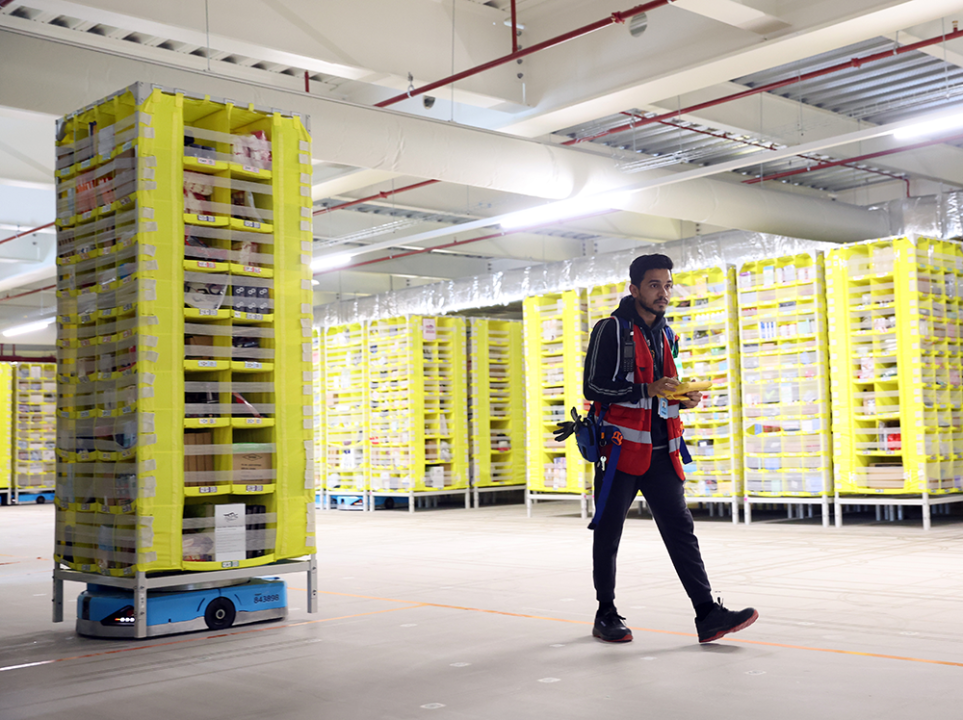
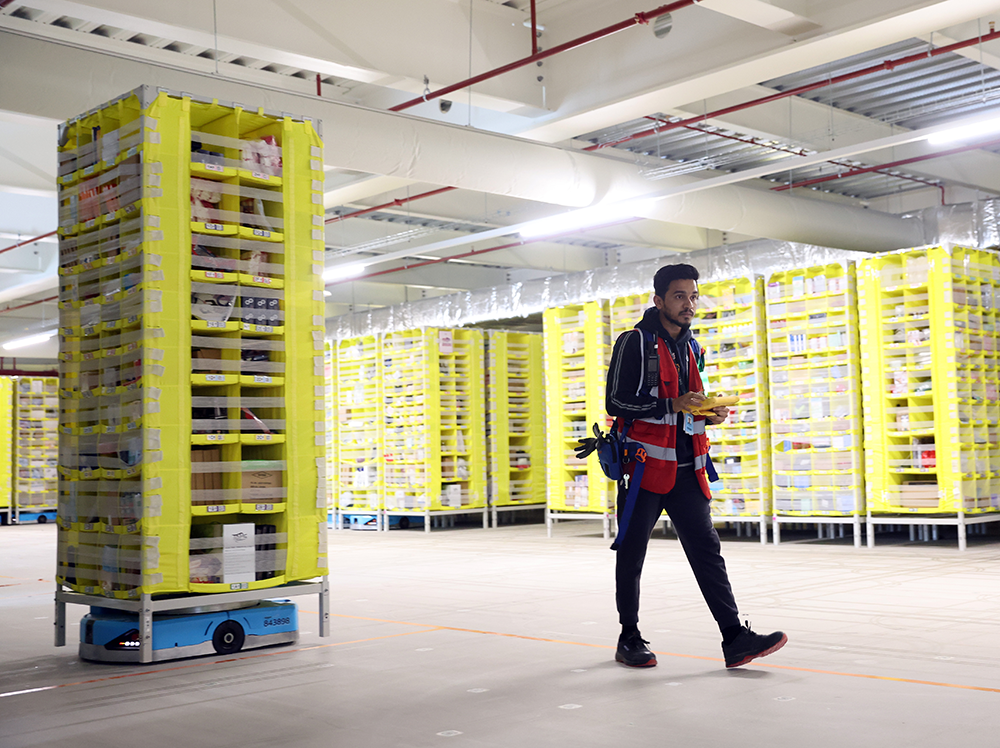
Next, the fun bit: robots. Weird creatures. Very like humans. Each is the size of a Monopoly board and can carry 55kg of shelved goods for eight hours. When they get tired, they withdraw to “the leisure spa,” as the staff call it, to have their batteries recharged. The warehouse has 3,000 robots and as they trundle this way and that, they appear to be enacting a formal dance of enormous complexity and unknown meaning, like a crowd of commuters crossing a train terminal. Their manners are impeccable. Each one, sensing the approach of a fellow robot, halts while his neighbor passes, then moves on. They never touch. A schoolmaster would describe them as “courteous, hard-working but lacking in initiative.” A psychiatrist would call them “autistic.”
Yet they seem to be dangerous. Steel fences separate the robots’ lair from the sections where humans work. If an item topples from a moving shelf, it has to be picked up by an employee who enters the protected area via a locked gate. Relying on a human to tidy up struck me as highly inefficient. Surely Amazon could train a superandroid to correct the mistakes of its worker robots? Then again, the superandroid itself would need a human invigilator and the savings would be nugatory. Watching these machines persuaded me that the abilities of robots are being wildly exaggerated by their designers. They can do one or two things very well, but they have no judgment or common sense. Amending an error is beyond them. They’re as inflexible as chainsaws.
Amin led us to a suite where 20 photographs of beaming staff were on show. These employees, elected by ballot, are appointed to solve disputes between workers and management. “No trade unions?” I asked Amin. “No,” he said sheepishly. Good news. I could never work for a firm infiltrated by gangster socialists. Amin invited us to try packing parcels. I stood at a workstation next to a conveyor belt and picked up a shiny box. I placed it in the right envelope (prompted by a computer) and sealed it with Amazon’s sticky tape, which uses potato starch instead of glue. At eye level, I had a color-coded 18-inch rule-bar to help me measure each item. But the skill quickly becomes automatic. “Our eyes are like rulers,” said Amin.
The staff appeared not to converse with each other as they worked.Is chit-chat banned?
Once I’d sealed the package, I tossed it into a plastic box to continue its journey. The work is physically undemanding but the endless repetition would scramble my brain. And I doubt if I could stand for hours on end like a cricket umpire. Are there stools? I didn’t see any. The staff appeared not to converse with each other as they worked. Perhaps they’re all introverts. Or is chit-chat banned? I found the ambience of the megashed spiritually dispiriting. When I glanced up, I saw nothing but cables, girders and neon lamps glimmering in a shadowless void.
As he bade us farewell, Amin mentioned that Amazon offers generous bursaries to staff who want to graduate and rise through the ranks. That seemed odd. Do incentives work on androids? Can robots dream of going to Oxford? Amazon is clearly planning to hire more humans in future. It’s exactly as I thought. The whole AI thing is a hoax.






Comments