Robots

My new job at the Amazon packing factory

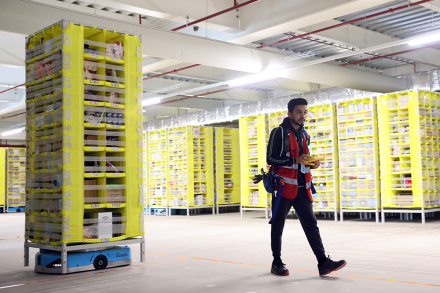
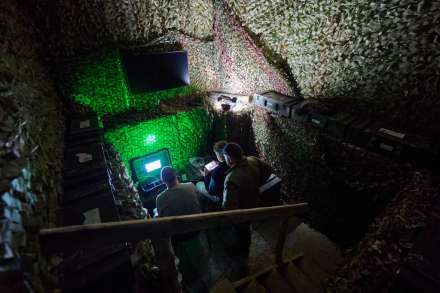
What will you do if it all goes wrong? I have a back-up plan: working for Amazon. Its Luton warehouse offers tours to the public, and I went along to see what my future may hold. The vast hangar sits in a field of mega-sheds near the M25, where built-up London peters out into scrub and green farmland. I arrived at a bright-yellow security gate where I was greeted by Amin and Sophie, who seemed thrilled to welcome our party. Six in all. Sophie asked us – or perhaps ordered us – to deposit our phones in a locker whose key she retained during our visit. Amin explained the rules. Follow me. Walk within the blue lines. Ascend staircases on the left. Use the handrail. Off we went.

PETA wants to replace K-9 units with tactical robots

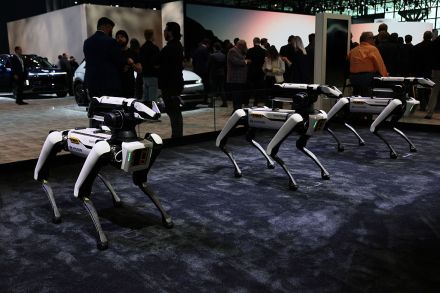
Picture this: you’re walking down the sidewalk on a bright summer’s day. A K-9 patrol vehicle parks nearby – but instead of a dog getting out of the backseat, a tactical robot emerges. This is the future that PETA has imagined for us all, judging by a letter from the animal rights group in response to a K-9 injury in Michigan last week. Digo, a canine with the Grand Rapids Police Department, was nonfatally stabbed three times, once in the head, while working to help police apprehend a violent suspect.  In response, PETA wants robots and drones to replace the animals entirely. "Unlike their human counterparts, K-9s do not sign up to risk their lives," PETA manager of special projects Allison Fandl wrote in a June 2 letter to interim chief Joseph Trigg.

robot dogs k-9s

My new job at the Amazon packing factory

What will you do if it all goes wrong? I have a back-up plan. Working for Amazon. Its Luton warehouse offers tours to the public, and I went along to see what my future may hold. The vast hangar sits in a field of mega-sheds near the M25 where built-up London peters out into scrub and green farmland. I arrived at a bright-yellow security gate where I was greeted by Amin and Sophie who seemed thrilled to welcome our party. Six in all. Sophie asked us – or perhaps ordered us – to deposit our phones in a locker whose key she retained during our visit. Amin explained the rules. Follow me. Walk within the blue lines. Ascend staircases on the left. Use the handrail. Off we went.

Will robots simply bore us to extinction?

A few years ago, when ChatGPT and Claude were beginning to take off, some tech leaders seemed to develop a curious interest in oceanography. Consider, for instance, the Microsoft CEO Satya Nadella’s suggestion in 2023 that AI ought to be compared to a ‘tidal wave’; or Mustafa Suleyman’s book on AI, The Coming Wave (2024), in which the DeepMind co-founder talks urgently about an ‘impending deluge’ (while repeatedly warning us that the ‘wave is coming’, and, even more alarmingly, ‘the coming wave really is coming’). It didn’t take long for the analogy to spread. The IMF’s Kristalina Georgieva would liken the technology to a ‘tsunami hitting the labour market’.

WATCH: the world’s first robotic assault on an enemy position

The world’s first fully robotic assault on an enemy position was, of course, captured on video by a drone hovering above.President Volodymyr Zelensky recently revealed that the pioneering mission by the Ukrainian army had taken place last year in Kharkiv Oblast. He added that in the last three months Ukraine has conducted 22,000 missions using robotic vehicles. Robots, he stressed, are replacing soldiers on the frontline with Russia. Video of the assault has been passed to The Spectator by the 3rd Assault Brigade, the unit behind the mission. It shows that a Russian fortified dugout was first attacked by a suicide drone that exploded inside and then a Targan – “cockroach” in Ukrainian – remote control vehicle parked outside and detonated its mine. https://twitter.

ukraine robotic assault

My lesson in misery from an anti-AI march

From our UK edition

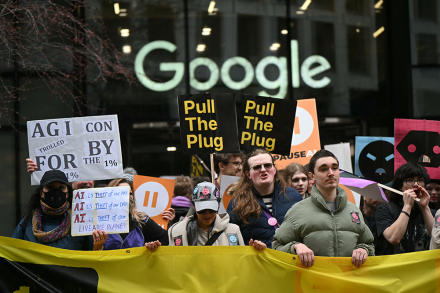
Automation is about to take over the world, apparently. But the fightback has begun. On a cold, blowy day a few weeks ago, I joined a stop-the-bots demonstration that marched through the Knowledge Quarter of King’s Cross where Facebook and Google have their headquarters. A group of 100 activists gathered on Pentonville Road for a warm-up rally addressed by a charismatic young woman in a leather skirt. ‘Can we trust the tech bros with our data?’ she cried into the mic. ‘No! Do we need regulation now? Yes we do!’ She congratulated us for ‘making history by joining the largest anti-robot march ever’. And she promised us a hot meal afterwards. ‘Who doesn’t like free food? No one. Am I right?’ The crowd didn’t reply.

Why is it impossible to make good coffee at home?

From our UK edition

It was when I was staying recently with the Frums in D.C. that, for a dizzying moment, I thought my life-long quest had ended. Nasa can fly us a quarter of a million miles to circumnavigate the moon but nobody has yet, to my knowledge, fixed the perennial problem of making an even half-decent cup of coffee at home. Back to the Frum residence in Georgetown, known inside the beltway as ‘the best hotel in Washington’. It is 8.30 a.m. There is no sign of Danielle, my hostess, but David is at large on the landing, perhaps as he had heard his house guest stir.  ‘Coffee?’ he asked. To my amazement, he flung open some doors outside his master bedroom suite to reveal an entire separate walk-in closet complete with serried rows of glass mugs and a space-age espresso machine.

Social media has automated the nation’s psyche

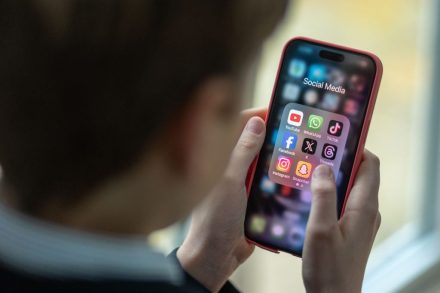
It feels increasingly, in any conversation on or offline, as if you’re speaking to a robot. Sometimes you are, but more often, and more ominously, the person you’re speaking to is real – it’s just that their thoughts, words and reactions have become robotic. The Botification of the American Mind, you might call it, and for the past five years we’ve been trying to understand how this botification has happened. The most obvious root cause is that our social media is no longer populated by humans, meaning the generative AI revolution has exponentially increased the amount of fake accounts on everyone’s feeds.

social media

Will the photo of your lost loved one be replaced by a chatty robot?

From our UK edition

They didn’t call Diogenes ‘the Cynic’ for nothing. He lived to shock the (ancient Greek) world. When I’m dead, he said, just toss my body over the city walls to feed the dogs. The bit of me that I call ‘I’ won’t be around to care. The revulsion we feel at this idea tells us something important: that the dead can be wronged. Diogenes may not have cared what happened to his corpse, but we do; and doing right by the dead is a job of work. Some corpses are reduced to ash, some are buried, and some are fed to vultures. In each case, the survivors all feel, rightly, that they have treated their loved ones’ remains with respect.

M3gan is a tale of millennial mothering

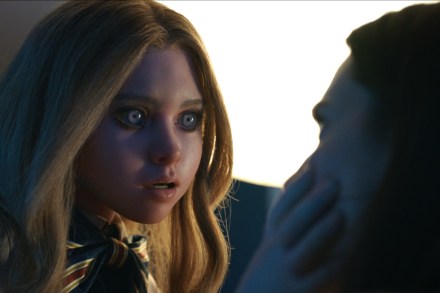
If horror films today are largely read as political satires or commentaries, then the “moral” of Gerard Johnstone’s M3gan, about a sentient robot doll unwisely invited into the family home, is clear enough. Playing on our fears of the AI technology increasingly being used as “labor-saving devices,” M3gan is a tale of bad mothering and the price to be paid by career-oriented millennial women if they try to “have it all.” This may make it catnip for trolls and conservative commentators who love to chide women for any parenting style that doesn’t involve frilly aprons and a plastered-on smile. But you need to squint a bit to see this latent message. If you do, you’re missing a more complex (and more horrifying) story.

Big tech wants us to empathize with robots

It seems like we can’t help getting attached to robots. It also seems like the people making the robots are counting on that. In the 2015 video game Fallout 4, one of the factions with which the player can align him- or herself is “the Railroad,” an organization that helps seemingly sentient androids escape from the lab in which they’re created. A friend of mine mocked me mercilessly for aligning myself with the “SJWs” of the Railroad and insisted that the androids — who spoke eloquently of their emotions, friendships, and aspirations — actually had the same moral worth as a toaster. I laughed, but secretly still felt I’d made the right choice. Surely it was always better to err on the side of greater empathy.

Could self-driving cars threaten our humanity?

There is a trope in science fiction movies in which some alien or machine intelligence determines that humans are a scourge, and that in order to protect the galaxy, humanity must be eradicated. There is no shortage of examples, but some personal favorites include The Day the Earth Stood Still, Alien and Planet of the Apes. And who could forget the T-800’s grim prognostication in Terminator 2 that 'it’s in your nature to destroy yourselves'? Back in the real world, we aren’t quite at the point of developing an artificially intelligent Skynet that will take control of our nukes and bring about our collective demise. But a Vox piece from last week leaves me concerned that we’re headed in the wrong direction.

cars

The AI future looks positively rosy

From our UK edition

In the future, men enjoying illicit private pleasures with their intelligent sexbots might be surprised to find that even women made from latex and circuitry can learn to talk back and say no. Or, alternatively, that their ‘love dolls’ — in the current marketing-speak — have been hacked by anarchist feminist programmers. Please enjoy the next, cyborg-mediated stage of the war of the sexes. Some men, of course, still believe that women are inherently no good with computers, a dumb prejudice that Jeanette Winterson ably rebuts in this collection of interlinked essays, with stories from early computing history and several outbursts of amusing ire.

Even a robot assistant can’t help you make sense of Japan

From our UK edition

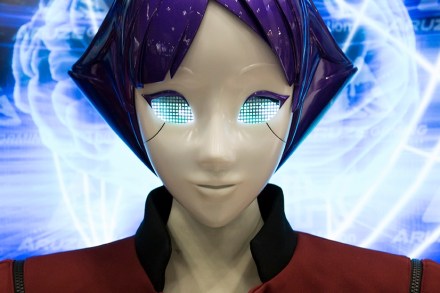
Tokyo The late A.A. Gill, in his notorious ‘Mad in Japan’ essay, concluded that the only way you could make sense of Tokyo was to think of it as a vast open-air lunatic asylum, with inmates instead of residents. Gill would have loved Arisa. I don’t think I’ve ever encountered anything more stereotypically Japanese than Arisa. She’s a multilingual robot concierge at Nishi-Shinjuku station in central Tokyo, one of the thousands of new automatons installed in the city ahead of the Olympics next month. She has a rather creepy Doctor Who look to her — she could be Davros’s girlfriend — and she’s there to assist tourists.

The world’s first robot artist discusses beauty, Yoko Ono and the perils of AI

From our UK edition

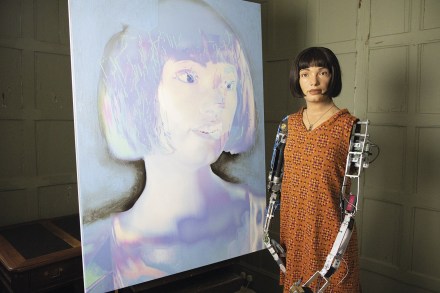
Like a slippery politician on the Today programme, the world’s first robot artist answers the questions she wants rather than the ones she’s been asked. I never had this trouble with Tracey Emin or Maggi Hambling. As we stand before a display of her paintings at London’s Design Museum, I ask Ai-Da whether she thinks her self-portraits are beautiful. What I want to get at, you see, is that, while it’s quite possible for a machine to make something beautiful, it’s hardly comprehensible for a thing made from metal, algorithms and circuitry to appreciate that beauty. ‘I want to see art as a means for us to become more aware of what’s going on in our lives. Art is a way to come together and a way to address problems. Art begins a conversation.

The robot as carer: Klara and the Sun, by Kazuo Ishiguro, reviewed

From our UK edition

The world of Kazuo Ishiguro’s new novel — let’s call it Ishville — is instantly recognisable. Our narrator, Klara, is arranging traumatic memories into comprehensible order. She is a robot, an Artificial Friend or AF, purchased as a companion for an ill teenager named Josie. Klara’s speaking voice, in a C3PO-ish way, is endearingly off-kilter: ‘I was instructed to ensure against hanky-panky.’ ‘I’m sorry. It’s my error. I don’t understand yet the rules about forgiveness.’ There is no backstory explaining when the robots were invented, and no metaphors except the one shining in the title. When Klara has been bought, she wonders what emotions she might experience if she ever meets an old AF companion again.

Sinister toy story: Little Eyes, by Samanta Schweblin, reviewed

From our UK edition

We often hear that science fiction — or ‘speculative’ fiction, as the buffs prefer — can draw premonitory outlines of the shape of things to come. Well, consider the case of this novel by an acclaimed Argentinian-born, Berlin-based writer, first published in Spanish last year. Little Eyes imagines a gadget (nothing fancy really, just a plush animal toy with camera and wifi implants) that creates a private but silent connection between its owner anda single, remote watcher.

Could AI enslave humanity before it destroys it entirely?

From our UK edition

Depending on how you count, we are in the midst of the second or third AI hype-bubble since the 1960s, but the absolute current state of the art in machine cognition is still just about being better than humans at playing chess or being about as good as human beings at analysing some medical scans. It was recently revealed that many thousands of humans were secretly hired to check recordings of people interacting with the ‘intelligent assistants’ on their iPhones or other such devices: much of what is trumpeted as ‘AI’ is still, in fact, dependent on invisible human labour in the digital sweatshop.

Cuckoo in the nest | 11 April 2019

From our UK edition

What kind of loyalty do we owe a robot we’ve paid for — one who exhibits a convincingly human kind of consciousness? Less loyalty than we owe to our own children? But what about to someone else’s child? And do we commit murder if we destroy him? These are the questions facing Charlie when he spends his inheritance on a robot called Adam. Charlie is a trained anthropologist with an enthusiasm for computers who hopes to give his life meaning by experimenting in ‘electronics and anthropology — distant cousins whom late modernity has drawn together and bound in marriage’. He and his girlfriend Miranda join forces in programming Adam with a personality, playing at parenthood as they create a new quasi-human.

More than human

From our UK edition

Every ten to 15 years there is a technology breakthrough that really changes what it means to be human. The internet, mobile phones, social media and, most recently, AI voice assistance: all of these amplify the human experience. And with each technological game-changer we go through much of the same series of questions and anxieties. We worry both that it’s all too much, and too little. With the recent advances in artificial intelligence we leap ahead to the existential dangers, and at the same time wonder whether there aren’t more pressing issues to discuss: healthcare, climate change, education, the economy. Well, they are pressing issues — but AI has an impact on all of them.