
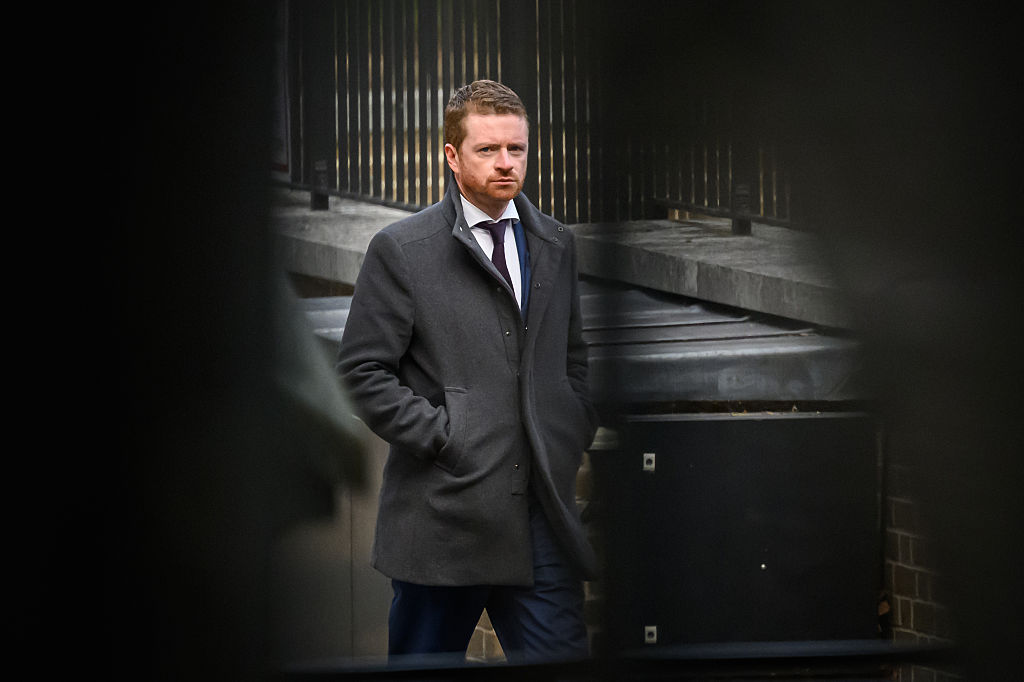
Morgan McSweeney has resigned, which felt inevitable but is still a shock to the government and to SW1 in general. His closeness to Peter Mandelson and his role in promoting him for the ambassadorship in Washington has been exposed as a grave error – though not, I think, one which was as predictable as everyone now claims.
In his dignified resignation statement, McSweeney writes: ‘When asked, I advised the Prime Minister to make that appointment and I take full responsibility for that advice. In public life responsibility must be owned when it matters most, not just when it is most convenient. In the circumstances, the only honourable course is to step aside.’
The problem is that McSweeney was not the only one advising on Mandelson. Jonathan Powell, the national security adviser, Chris Wormald, the cabinet secretary, and Oliver Robbins, the foreign office permanent secretary, were also part of that decision. More importantly, advisers advise and ministers decide. A senior Labour figure who just contacted me said: ‘If Morgan has resigned they should all resign. The advisers should go, not because they gave bad advice, but because they are all implicated in a catastrophic decision. The prime minister did something worse, he made the decision and there is now no purpose to his premiership.’
Morgan is one of the half dozen best political minds I’ve come across in 25 years of writing about politics
This is a ravens-leaving-the-Tower moment. Keir Starmer would never have been Labour leader or prime minister without McSweeney’s counsel and political judgement. He is far from blameless in what has gone wrong since July 2024, but it remains the case that he has always been the person at the top of Downing Street who has done most to try to get Labour to come to terms with the views of the people they seek to serve. Many Labour folk give the impression they would rather change the electorate than meet them where they are.
McSweeney was probably right to resign given the depth of hatred he has engendered in the parliamentary Labour party (PLP), but I doubt even he thinks this is the sacrifice that will save Starmer. In many important ways, even if he could not compensate for Starmer’s many weaknesses, it was McSweeney who prevented even worse decisions from being taken.
Speaking personally, he is one of the half dozen best political minds I’ve come across in 25 years of writing about politics – a rare person who was good with polling and message-making, who was interested in what his opponents were up to and why. He is softly spoken, polite and calm, not universally held characteristics among the political alphas I have known.
His flaw was that he was too slow in opposition to pay an interest in policy-making and, by the time he was in charge of running the centre of government, he had to learn Whitehall on the job when Starmer was already on the back foot after early pratfalls during Sue Gray’s tenure as chief of staff.
Politics is a brutal business and McSweeney–Starmer’s fall from grace has been swift and ugly. I remember talking to Isaac Levido after the 2019 general election landslide he helped mastermind for Boris Johnson. ‘I’m not a genius now,’ he said, ‘and I won’t be an idiot when we lose.’ Nor was he when the Tories’ world imploded in 2024 (indeed the final haul of 120 seats was down, in part, to Levido’s calm under fire and sensible management of resources). I told this to McSweeney and he immediately understood how fickle power and popularity can be.
Now he’s the victim and he is no more an idiot now than Levido was in 2024. McSweeney picked Starmer because he felt he was the best way of defeating the hard left of the Labour party and making them a viable government again – and he was right – just as Dominic Cummings and others decided Boris Johnson was the best frontman to beat Jeremy Corbyn nationally. But it is now very clear that Starmer’s utter contempt for the art of politics itself held back the project. Just like Rishi Sunak, he believed being diligent and working hard and ‘being serious’ would be enough to be a good prime minister. Like Sunak, he was wrong.
McSweeney is not a candidate for sainthood. He was, like many great operators, highly flawed. If Starmer mistakenly believed that preparing to win an election and preparing to govern a country were different projects, delegated to different people, Morgan was too slow to realise he was wrong. He showed far too little interest in policy in the two years before the election and knew little of how to make Whitehall work (though he worked hard to learn once he became chief of staff). It was not long before he was spouting the same observations as Dominic Cummings about what doesn’t work – a civil service which can’t drive change, unaccountable quangos, overmighty judges.
But I also remember clearly that Morgan was very unclear whether he was even going to join the government until a few months before the general election. All that was supposed to have been the purview of Sue Gray, who was removed by Starmer when he realised that the plan for the first 100 days was basically a blank sheet of paper. McSweeney, and most of all Starmer, should take their share of the blame for this, but the recent campaign from allies of Gray, such as David Yelland, to exonerate her of responsibility is absurd.
Even the election campaign was not flawless (none is). McSweeney should probably have prevented Rachel Reeves from making pledges on tax which have hamstrung Labour in power, since they would have won a healthy majority without ruling out rises in income tax, national insurance and VAT.
Similarly, neither before nor after the election win did Morgan ever persuade Starmer that he needed an ism, a project, a plan and a narrative to persuade the public that Labour was taking them somewhere better – and the early efforts to graft one onto Starmer, the missions, targets, pillars and pledges of early 2025, were confused, unclear and, more to the point, led to more talking-shop committees than they did action and change. McSweeney should also have moved hell and high water to prevent Starmer appointing Chris Wormald, a time-serving plodder without any of Sir Humphrey’s ability to get things done.
All that said, there are very few people near the top of this administration who respect the voters as McSweeney does and who dragged Starmer out of his soft-left, legalistic mindset to get tough on immigration or consider welfare reform, and what follows is much more likely to be a wishy-washy Old Labour tax-and-spend trend with Starmer, or whoever replaces him.
There is a parallel here with Theresa May and her twin ‘chiefs’, Nick Timothy and Fiona Hill. After the 2017 general election, where May surrendered David Cameron’s hard-won majority, the cabinet demanded their heads. May was a creation of ‘Nick and Fi’ every bit as much as Starmer was a creature of McSweeney’s design. Removing the aides who gave her a vision and purpose did nothing for May, who stumbled on, disastrously for Britain, for two more years, shorn of purpose or political skills.
Any Labour MP who thinks they are in a better place to win an election or win over the voters now than they were yesterday needs their head testing. One way of replacing McSweeney would be to bring in Jonathan Powell as chief of staff, the role he performed for Tony Blair, but my understanding is he’s happier running foreign affairs.
The preferred solution is to have two chiefs of staff by promoting McSweeney’s deputies. Vidhya Alakeson is well thought of. She would work with Jill Cuthbertson, who served both Gordon Brown and Ed Miliband and blocks much of the naive nonsense being considered in No. 10. Alakeson is more of a policy person, Cuthbertson an expert in operations, but the latter is soon to depart on maternity leave. ‘The job is too big for one person,’ a source said. ‘The structure Theresa May had with two chiefs is better. The problem was the people she chose had the wrong approach and horded all the decisions. That’s not how Vidhya and Jill work.’ Louise Casey has been another name floated, but formidable as she is, that smacks to many of those I speak to of repeating the same mistake as the Gray appointment.
Don’t underestimate what this will do to morale in No. 10 either. Someone who worked for McSweeney: “People talk about Morgan’s talents but it’s his support of his staff those that worked for him will remember. Compare his honourable decision today with those who pushed for Peter’s hiring or tried to block his sacking and will turn up in No10 tomorrow as if nothing has happened.”
It is also the case that, by throwing himself upon the upturned swords of the PLP, McSweeney is vanishingly unlikely to save Starmer either. Once MPs have a taste for blood they are seldom sated by their first taste of it, still less by the blood of advisers, however mightily. Who will be blamed if Labour loses the Gorton and Denton by-election now? Starmer. Who will be in the firing line if Labour performs as badly as expected in May’s elections? Starmer.
As a senior Labour figure who knows them well put it to me last week: ‘I have always known Keir would chuck Morgan overboard precisely five minutes before the ship sinks and he has to walk the plank.’ Morgan walking the plank doesn’t change the general point.
McSweeney was unable to solve the problems of this government, but nor was he to blame for most of them either. His biggest responsibility was to bring forth Starmer in the first place. McSweeney’s tragedy is that he was able enough to ensure that an adenoidal, uncharismatic, self-righteous, pedestrian figure won the leadership of the party and the country – and that neither he, nor anyone else, was able to give Starmer the tools and instincts he needed to be a success.
It may be Mor-gone today but Starmergeddon is now nearer than it was this morning.


Comments