Maggie O’Farrell’s two previous historical novels, Hamnet and The Marriage Portrait, made her a household name. Land marks a return to her Irish roots: ‘Every family has its myths and ours was that my great-great-grandfather had worked on the early maps of Ireland.’
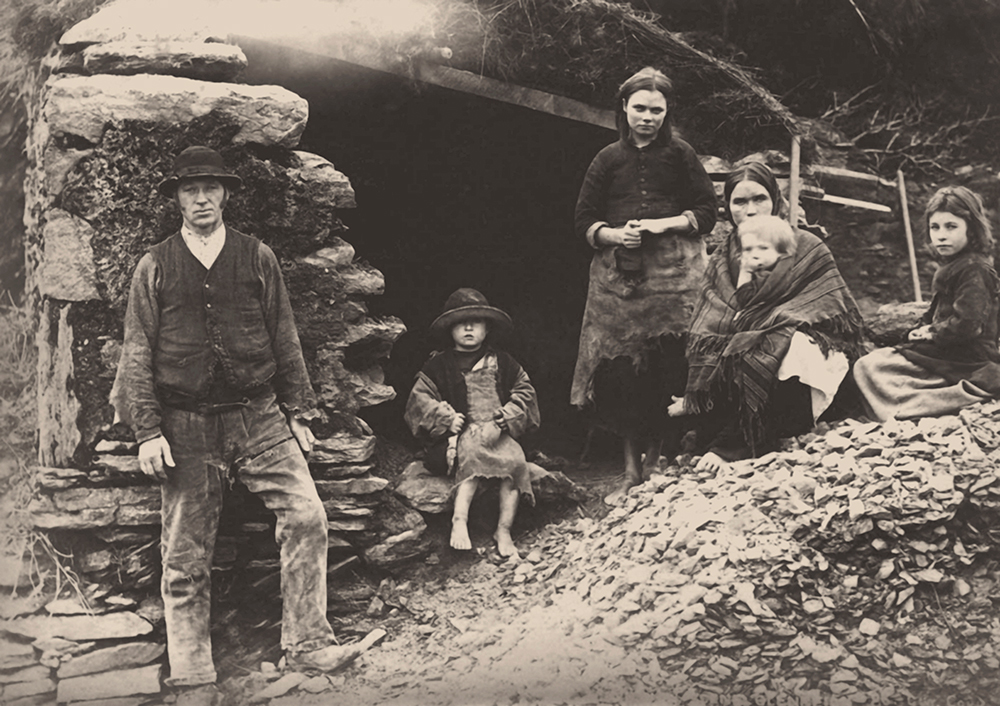
The year is 1865 and 31-year-old Tomás, a mapmaker, accompanied by his ten-year-old son Liam, is in the employ of the English redcoats and tasked with surveying and mapping Ireland from top to bottom, rocky outcrop to drumlin. Tomás’s skill is that of a translator of language as much as land, ‘able to parse a polysyllabic string’ of Gaelic topography into one- or two-word place names, untangling ‘the-crossroads-under-the-bluff-where-once-a-hailstorm-killed-a-cockerel’ to read ‘Bluff’s Cross’ and negotiating between locals and the English soldiers. It’s cold, bleak work, and Liam stands ‘quivering like a wet hound’. Tomás makes a quiet oath to himself: to ink into his cartography the history of the land, its suffering and scars. The Great Hunger is only recently past and its ghosts still haunt him.
But after Tomás drinks from a sacred spring he is changed from a man of few words to a man who babbles in riddles and rhetoric, such as ‘myth is fact and fact is myth’. We return to Tomás’s childhood in the workhouse, where he falls in love with a beautiful waif called Seraphina; we hear of his recruitment by the redcoats as a ‘chainboy’ and the stories of his children: Liam, Enda, Rose, the bright-but-mute Eugene and their wolfhound Bran.
O’Farrell then takes us back millennia, telling, through vignettes, Ireland’s history from the days of human sacrifice to the Romans’ decision not to invade and to the Anglo-Norman invasion of the 12th century, before slipping again into Liam’s story, his interest in the priesthood and the schism between the Catholic Church and pagan mysticism – one myth exchanged for another and claimed as truth. We are shown how one man’s belief looks to another like demonic possession.
Land and language are beautifully connected: a fish’s shape is described as ‘the calligraphy of its body’. Unfamiliar words are refreshing: tobar, azimuth, boreen, corrie. Descriptions, such as ‘the floral scorch of honey’, bring new vividness to familiar sensory images. But some of the prose-poetry goes too far, perhaps: eggs are not just eggs but have a ‘thin carapace, then the white casing, which would yield to a spoon-tip, inside which was the molten yellow core, slightly crystallised at the edges’.
The story gains momentum halfway through when Tomás’s children leave home: Liam, as a Jesuit novice, goes on a mission to Calcutta and then to Rome, while his sister Enda embarks on a journey to Quebec in 1880, dressed as a boy, fiddle in hand, to seek her fortune. But death, disease, amputation, misfortune, crises of faith and perilous voyages are relayed in a strangely passive style. Many of these passages are compelling, but character motivation is curiously unexplained. One scene involving Rose and the redcoats is particularly frightening, and pivotal to the plot, but comes out of the blue.
The book veers dangerously close to being a whimsical representation of the Emerald Isle: hardship, bad priests and cruel English aristos, underscored by a soulful but resilient Irish people, rousing fiddle music, loyal wolfhounds and the occasional ‘faery fortress’. Tomás talks about ‘how maps are acts of colonisation, enemy tools’, and throughout the rich are cruel and spoilt, the poor are honest and downtrodden and the women are spirited or saintly.
Land seems to be a meditation on the decisions we make, such as Liam’s conundrum: ‘the priesthood or the mapping’. It also reminds us that many of our ‘choices’ were thrust on us by our parents, bound by societal or religious expectations – or even by the land itself.



Comments