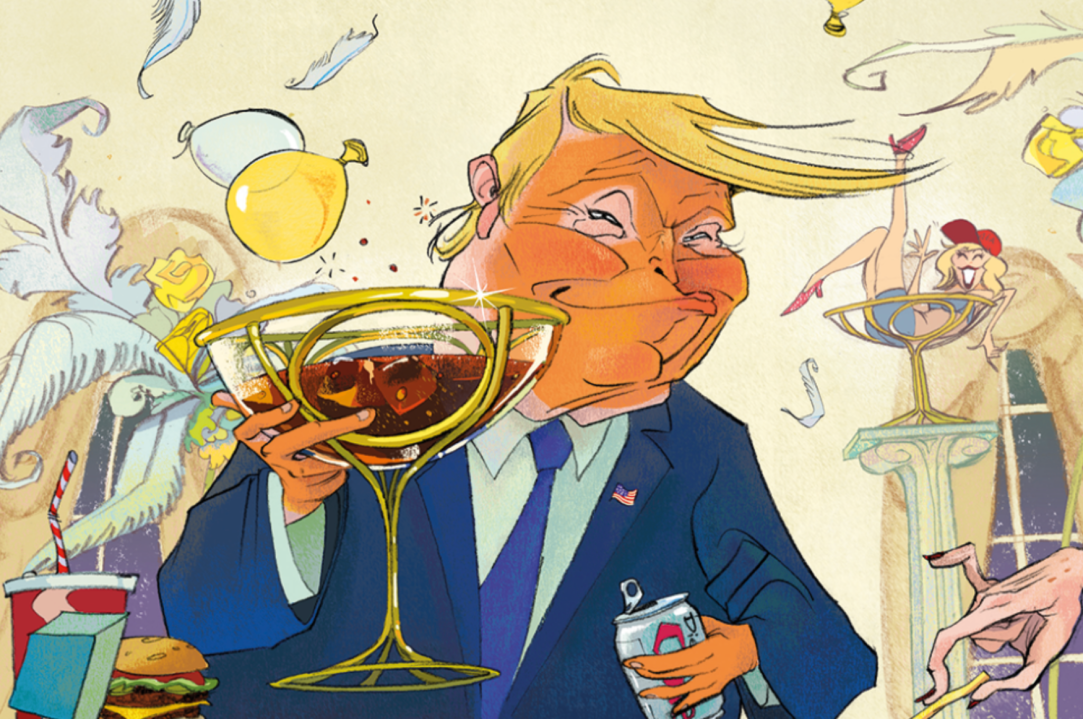
Earlier this month, I wrote a cover story for The Spectator warning that Donald Trump’s increasingly brazen flouting of ethical standards portended a political disaster for Republicans in the midterms. Since then, the corruption news has only gotten worse.
Just this week, the financial disclosure form Trump quietly filed for the first quarter of 2026 revealed his personal account had made an eye popping 3,600 stock trades valued at between $220 million and $750 million (his corporate holdings aren’t subject to disclosure).
Trump believes that following long-standing norms has earned him neither fairness nor credit, so to hell with it
The President insists third party advisors make the decisions on his personal finances while he’s president, but his businesses are actively run and managed by his sons Donald and Eric, two people who are an extension of Trump himself just as much as his own arms.
That’s why it’s relevant that a suspicious number of Trump trades involved major tech and defense firms the President touted in public at the same time he bought them. For example, he bought between $1 million and $5 million of Dell Computer and then nine days later encouraged people to “go out and buy a Dell computer.” A large purchase of Palantir stock was made just before Trump praised it on Truth Social for its “great war fighting capabilities.” There are other examples of presidential praise of firms coming on the very day of their being traded by Trump.
It fell to Vice President J.D. Vance to play the role of White House briefer on Tuesday. Inevitably, he faced questions about the stock trades. Reporter Judd Legum asked how he can “argue to Americans that you’re cleaning up corruption… when the President seems to be talking up stocks that he owns, selling them and enriching himself?”
In response, Vance scolded Legum for not being “objective” and claimed it was “absurd” to suggest his boss was “buying and selling stocks.”
“I am a big fan of banning members of Congress from trading stocks,” Vance continued, “So is the President of the United States.” But, as Legum dryly noted, “Vance did not explain why members of Congress should be banned from trading stocks but not the president.”
Trump’s leveraging of his office combined with family investments in mysterious cryptocurrency ventures that have Middle Eastern ties has helped Trump triple his overall fortune since 2024 – from $2.4 billion at the start of his second term to $6.3 billion as of this April, according to Forbes magazine.
News of the stock trades was swiftly followed by a settlement of Donald Trump’s $10 billion lawsuit against the federal government over a former IRS contractor who illegally leaked some of Trump’s tax returns during his first term. Trump alleged that the IRS failed to properly safeguard the data. With some acknowledgement of the irony, Trump has admitted that as president he was both the plaintiff and the defendant in the case: “I’m sort of suing myself.”
It’s thus no surprise that the sweetheart settlement he just secured more resembles a surrender document. The government will spend an astonishing $1.78 billion to create a “Truth and Justice Commission” that “will have the power to issue formal apologies and monetary relief” outside of the normal legal process to victims of IRS “weaponization.”
Trump’s lawsuit against the IRS isn’t the only legal dispute brewing between the president and his own administration. Trump confirmed last October that his legal team was seeking $230 million from the Justice Department as compensation for previous investigations into his conduct.
Some people who were targeted for prosecution or investigation or political purposes by the Biden Administration will have a good case, but there are also several pending lawsuits from many of the 1,600 January 6 rioters who claim to have been mistreated or overcharged. How is it right that these individuals should avoid the normal legal process to receive payouts from a taxpayer-funded slush fund that Trump appointees will oversee?
The settlement also includes a gigantic, bow-wrapped concession signed by Todd Blanche, the acting attorney general, which says that the U.S. government is “forever barred” and “precluded” from examining the tax returns of Trump, his family, company and “related companies.”
Normally, the federal judge assigned to the case would comb through and disentangle all of this Medusa-haired web of intrigue, but Trump has moved to dismiss his own case and his own Justice Department doesn’t believe the court has jurisdiction or that the settlement needs judicial approval.
Danny Werfel, the former IRS commissioner from 2023 to 2025, says the agreement is truly unprecedented. He says he is “unaware of a single precedent where the IRS has agreed in advance to permanently forgo examination of previously filed tax returns for a specific person or business.”
All of this proved to be too much for one key Trump political appointee to bear. Brian Morrissey, the Treasury Department’s general counsel, suddenly resigned this week only hours before the terms of the settlement were released. He had been on the job for only eight months and declined to discuss the reasons for his departure but associates say they were directly linked to concerns about the settlement.
In one sense, Trump is being completely transparent about his transformation of the presidency into a profit center.
In January of this year, in a New York Times interview, Trump directly addressed his family’s business dealings and conflicts of interest. He said that during his first term he has voluntarily limited his sons and other family members from pursuing international and other sensitive deals: “I prohibited them from doing business in my first term, and I got absolutely no credit for it. I didn’t have to do that. And it’s really unfair to them… I found out that nobody cared, and I’m allowed to.”
Trump believes, then, that following long-standing norms has earned him neither fairness nor credit from adversaries or the media so to hell with it.
But Trump’s blinders-on selfishness is likely to have consequences for not just the integrity of the country’s institutions but the political party he leads and ostensibly claims he wants to do well in the November elections. His base is amazingly tolerant of his brazen behavior but his lowest-ever approval ratings make clear that’s not a majority.
Polls clearly point to a significant part of his 2024 supporters having doubts over Trump’s louche norms and behavior. A Pew poll this month found only 37 percent of Republicans say the level of ethics in government has risen with Trump as president. A new Fox News poll found 63 percent of those surveyed agreed Trump “doesn’t care about people like you.” Most importantly, that included 27 percent of 2024 Trump voters.
The Democrats will campaign hard on the “Trump sleaze factor” and many Americans will respond by simply choosing not to vote. An iron rule of American politics is that many people who vote in presidential years are absent from midterm elections. In 2024, 64 percent of eligible adults voted for president but in the midterms just two years earlier, only 46 percent had participated. That means almost 30 percent of the presidential electorate stayed home, and who those people are will be dictate which party controls Congress after November.
The secret of Donald Trump’s rise to power lay in his ability to convince many ordinary Heartland Americans he would represent their grievances and tear down a system he said was rigged against them.
Americans hate being played for suckers. Donald Trump’s shamelessness increasingly resembles a conman who has been so arrogant and self-confident in his ability to bulldoze through any outrage that he forgets how quickly his fortunes can shift when people catch on to his con.





Comments