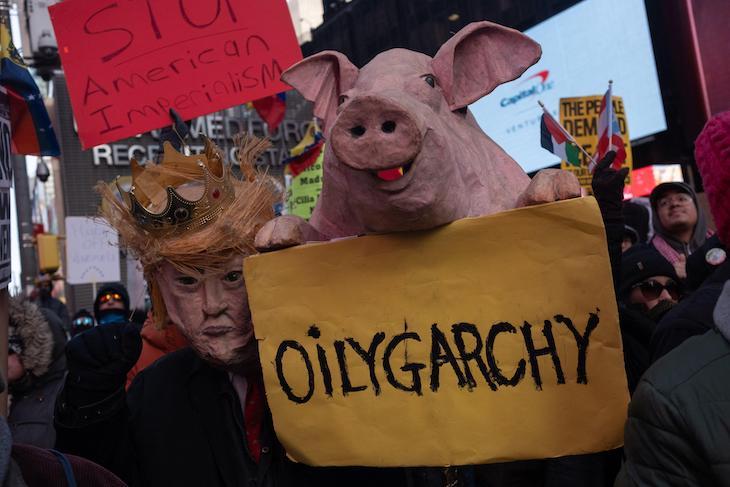
The image of Nicolás Maduro in US custody has inevitably resurrected the ghosts of foreign policy past. For the reflexively cynical observer, the narrative writes itself: a Republican White House, a Latin American strongman, and the world’s largest proven oil reserves. As with Iraq in 2003, the slogan of American imperialism and its ‘blood for oil’ foreign policy circulated on social media before the dust had even settled over Caracas. ‘The overnight strikes on Venezuela,’ declared the Guardian, and Trump’s neo-imperial ‘declaration that the US would run the country and sell its oil, have driven another truck through international law and global norms’. This is a comfortable, nostalgic critique, harking back to the heady days of 2003. It is also dangerously wrong.
Maduro was not merely a socialist pariah; he was a strategic landlord
To view the dramatic defenestration of the Venezuelan regime as a resource raid is to misunderstand the fundamental shift in American grand strategy. Washington did not decapitate the Venezuelan state because it needs more oil; it did so because it is preparing itself for a possible war with China.
The ‘oil imperialism’ theory collapses under the weight of basic data. The United States is no longer the energy-starved giant of the late 20th century. Texas alone now accounts for approximately 43 per cent of US crude oil production and 31 per cent of its refining capacity. America is awash in its own hydrocarbons. The strategic imperative, therefore, is not the seizure of Venezuelan crude, which is heavy, sour, and difficult to refine, but the protection of American infrastructure.
The vast refining and export complexes of the US Gulf Coast, the jugular of the Western economy, sit uncomfortably close to the Venezuelan littoral. In an era of hypersonic missiles and loitering munitions, the Caribbean is no longer a sleepy tourist lake; it is a vulnerable southern flank. The calculations in the Pentagon are straightforward and entirely rational: the distance from northern Venezuela to Houston is roughly 3,300 kilometres (2,050 miles); to the Panama Canal, it is barely 1,100 kilometres (680 miles).
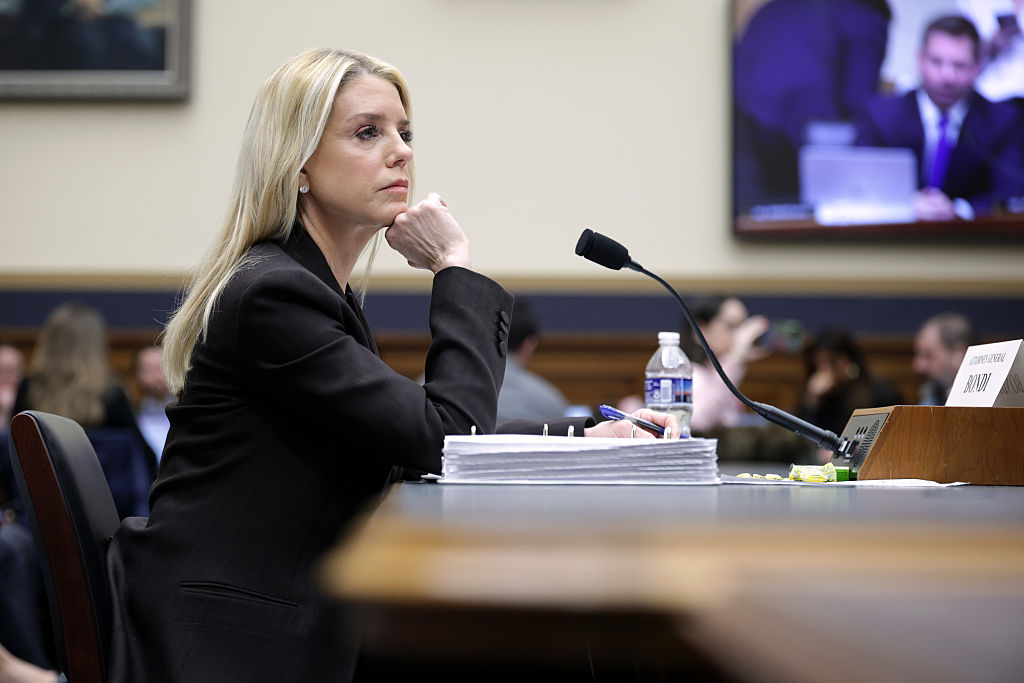
This is where the great power competition with Beijing enters the calculus. For the last two decades, while Washington was bogged down in the Middle East quagmire, the People’s Republic of China has been quietly purchasing loyalty in the Western Hemisphere. The numbers are staggering. In 2024, trade between China and the Community of Latin American and Caribbean States (CELAC) hit $551 billion (£400 billion). More pointedly, Venezuela accounted for roughly 44 per cent of China’s total development finance in the region since 2005.
Maduro was not merely a socialist pariah; he was a strategic landlord. He offered the People’s Liberation Army (PLA) a foothold in America’s backyard. The nightmare scenario for US planners was never a socialist Venezuela, but a weaponised one, a Caribbean outpost hosting Chinese intelligence capabilities, long-range bombers, or missile batteries. If socialism was the threat, why whack Venezuela and not Cuba?
This anxiety is inextricably linked to the future of Taiwan. American war planners understand that a conflict in the South China Sea would not remain local. If the US Navy attempts to blockade the Strait of Malacca or defend Taipei, Beijing’s countermove would be to threaten the American homeland or its logistics to force a negotiated settlement. A hostile Venezuela, armed with Chinese Anti-Access/Area Denial (A2/AD) systems, could hold the Gulf Coast hostage, effectively checking American power before a single carrier group leaves port.
Furthermore, the logistics of a Pacific war rely heavily on the Panama Canal. The commercial encroachments of Chinese firms in Panama have long worried Washington. With various Hong Kong-based entities holding interests in ports at both ends of the canal (Balboa and Cristóbal) the risk of closure during a crisis is non-zero. If the Canal is shut, the US Navy is forced to sail the long way around the Straits of Magellan. By removing Maduro, the US effectively breaks the northern arm of a potential Chinese pincer movement in the Caribbean.
The operation, ostensibly framed as a law enforcement action against ‘narco-terrorism,’ serves a dual purpose. The indictment detailing 25 years of state-sponsored cocaine trafficking provided the legal veneer, but the timing reveals the geopolitical intent. This is the implementation of a new, muscular Monroe Doctrine. It signals a retreat from the role of ‘Global Policeman’ and a pivot toward the ‘Regional Fortress.’ The Trump administration has signalled that it may tolerate chaos in the Donbas or the Levant. Still, it will not tolerate a peer competitor establishing a forward operating base in the Americas.
The fall of Maduro is also a sharp rebuke to the Kremlin, though less strategically damaging to Moscow than to Beijing. While Russia loses a platform for its own power projection and a rhetorical ally who validated Putin’s own authoritarianism, it is China that suffers the material loss. Beijing’s patient, expensive cultivation of influence has been undone in a night.
Ultimately, those seeking the logic of this intervention in ExxonMobil’s balance sheets are looking in the wrong place. This was not about corporate profits. It was about the grand chessboard of the 21st century. The capture of Maduro was a preparatory move, a clearing of the decks in preparation for a longer game of great-power competition. The United States has decided that if it must face the dragon in the Pacific, it will not have it breathing down its neck in the Caribbean.


Comments