


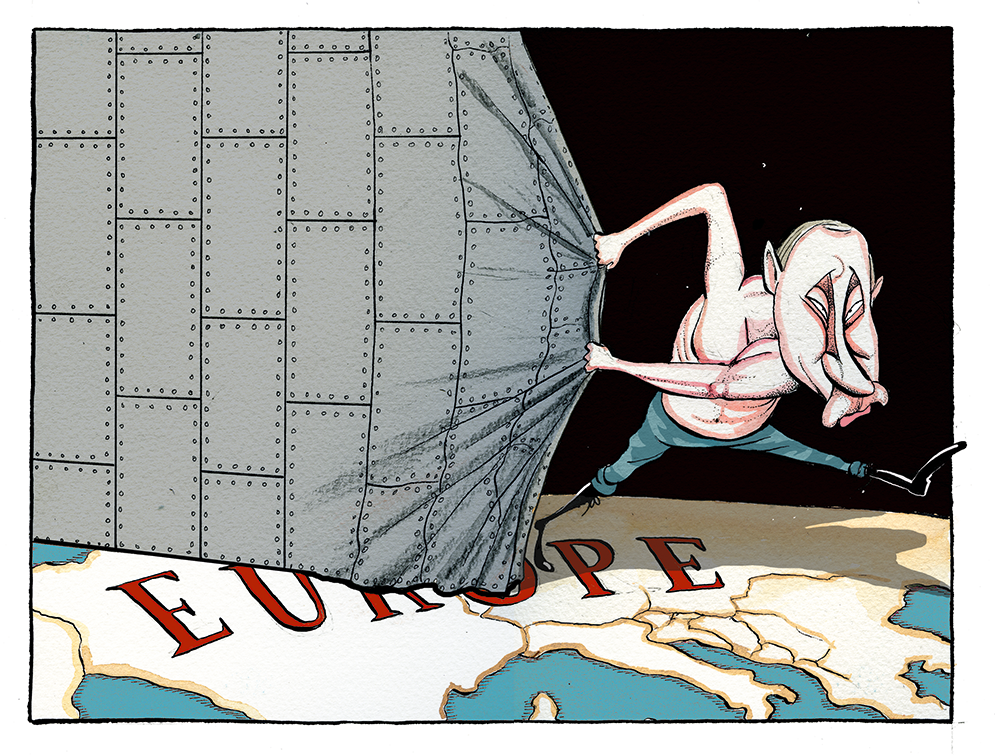
For the Kremlin, the US’s snatching of Venezuela’s President Nicolás Maduro is a humiliation with a silver lining. True, little more than a year after the precipitous fall of Syria’s Bashar al-Assad, Russia has been shown to be completely hopeless when it comes to keeping its allies in power. In Caracas, US airborne forces breezed past Russian-supplied S-300 air defense systems, which were part of a $20 billion package of maybe not-so-great Russian military equipment that Moscow sold the Venezuelans.
The Kremlin has lost a strategic bridgehead in South America which it could, potentially, have used to disrupt and challenge Washington’s regional hegemony – if Moscow weren’t so committed financially and militarily to its war in Ukraine. And billions of dollars in Russian investments in Venezuela’s oil industry could be in jeopardy as US majors move in.
Billions of dollars in Russian investments in Venezuela’s oil industry could be in jeopardy
On the other hand, there are some crumbs of comfort for the Kremlin in Donald Trump’s Operation Absolute Resolve. First and foremost, Trump and Vladimir Putin find themselves in strong agreement that when it comes to dealing with regional threats, might makes right. Trump’s so-called “Donroe Doctrine,” like its 1823 predecessor the Monroe Doctrine, rests on the principle that great powers have the right to intervene with force when confronted with threats in their own backyard. Though the Russian Foreign Ministry has demanded the release of Maduro and his wife and condemned the US operation as an “unacceptable encroachment on the sovereignty of an independent state,” hawkish former Russian president Dmitry Medvedev expressed a grudging admiration. “Team Trump is tough and cynical in advancing its country’s interests,” tweeted Medvedev. “Removing Maduro had nothing to do with drugs – only oil, and they openly admit this. The law of the strongest is clearly more powerful than ordinary justice.”
For decades – even before Putin came to power – Moscow has been decrying US hypocrisy. Washington bombed Belgrade in 1999, invaded and redrew the international borders of Yugoslavia, imposed regime change on Afghanistan and Iraq in 2001-3, encouraged the Arab Spring insurrections of 2010 that ended up in the lynching of Libya’s Muammar Gaddafi and, (as the Russians saw it), orchestrated people-power “color revolutions” in Ukraine, Georgia, Kyrgyzstan and Serbia.
Throughout this period the US and its allies justified their interventions through the disputed “responsibility to protect” principle of ethical foreign policy, or on the grounds of self-protection against terror threats such as al-Qaeda or Saddam Hussein’s (alleged) weapons of mass destruction. But when Moscow tried its own foreign interventions – for instance by invading Georgia in 2008 or Ukraine in 2014 and 2022 – Russia was condemned, sanctioned and made an international pariah by the West.
Trump’s Venezuelan operation was dressed up with far fewer veils, and much less lip service to international law. The US has “demonstrated how a great power should act in the face of emerging threats before they become too serious and insurmountable,” wrote Igor Girkin, the jailed ex-commander of Russia-backed separatists in eastern Ukraine. From the Kremlin’s point of view, Trump behaved in Venezuela exactly as Putin did when he invaded Ukraine.
The difference, however, is that Trump succeeded where Putin failed. First and foremost, the Kremlin’s three-day “special military operation” against Ukraine was conceived as a decapitation strike on the Zelensky regime. Russia’s shock troops were equipped to execute an aggravated coup d’état to place a Kremlin puppet regime in power, not to undertake a long campaign of conquest and occupation. In the weeks before the February 2022 invasion, at least two Russian special forces groups, one consisting of regulars from the Federal Security Service’s Alpha Group and the other of Chechen irregulars, had been dispatched undercover to Kyiv with orders to hunt down and neutralize a kill-list of top Ukrainian officials.
A larger force of elite troops was launched in a helicopter assault on the Antonov military airbase at Hostomel in the western suburbs of Kyiv with orders to seize and secure the landing strip for a second wave of paratroopers and light armored vehicles which were to land in 18 large transport aircraft. This mechanized force was supposed to dash for Bankova Street in downtown Kyiv and capture Volodymyr Zelensky and evacuate him into Russian captivity.
Except unlike Trump’s flawless Caracas operation, Putin’s attempted snatch of Zelensky went badly wrong in its first hours. Unexpectedly fierce resistance from Ukraine’s 4th Brigade and quickly scrambled Omega anti-terrorist units prevented Russian special forces from securing the runway at Hostomel for a crucial 48 hours. A Chechen death-squad was ambushed and gunned down in central Kyiv. When Russian transport planes finally succeeded in landing paratroops and armored vehicles, they were engaged and eliminated on the road into the capital. Unlike in Venezuela, Ukraine’s air defenses and centralized resistance were not destroyed. And perhaps most crucially, Putin failed to co-opt key parts of the Ukrainian elite to his side as Washington seems to have succeeded in doing in Caracas.
According to the pro-Kremlin Telegram channel Dva Mayora, which has close ties to the Russian military, the Maduro raid was “exactly how our ‘special military operation’ was meant to unfold: fast, dramatic and decisive. It’s hard to believe [chief of the general staff Valery] Gerasimov planned to be fighting for four years.” Moscow had reason to “be jealous” of US military might, wrote Margarita Simonyan, Russia’s chief propagandist and the head of Russian state broadcaster RT. “Trump arrested Maduro and seemingly wrapped up his own ‘special military operation’ in the space of a day.”
Humiliating as the arrest of Maduro may have been for Moscow, there have been some consolations for Putin. The raid exactly fits Trump’s revised US National Security Strategy, published last month – a potentially game-changing document that reprioritizes regional trade and military security over America’s traditional postwar role as world policeman. Both Moscow and Beijing will be hoping that this, by extension, means that the US also accepts that other countries have similar security priorities in their own “near abroad.” A newly aggressive US is also likely to strengthen the BRICS group and encourage countries in the global south to seek alliances with China – and, by extension, Russia – both of which have been pushing to make BRICS a closer-knit and more formally aligned group.
Also pleasing to the Kremlin is the fact that Trump’s operations have left Europe tongue-tied
Also pleasing to the Kremlin is the fact that Trump’s operations have left Europe tongue-tied, unable to condemn Trump for reasons of strategic self-interest, even when he behaves in a Putin-like manner. “Let us hear now from Ursula and Kaja, Merz and Starmer about European and British values,” tweeted Putin’s special envoy Kirill Dmitriev, sarcastically relishing Europe’s humiliation. “Their fake values are for sale. Waiting for the scared vassals to speak is like Waiting for Godot.”
Another piece of good news for the Kremlin is that the arrest of Maduro does not necessarily mean that all Russia’s security and business influence in Venezuela, carefully built up over 25 years, is lost. As seems increasingly clear, Washington has chosen to keep Maduro’s corrupt cronies in power rather than risk the civil unrest and upheaval that would ensure if the opposition were to take over. That may be cynical, but it’s also practical from the US point of view.
It’s also likely to leave major Russian deals – such as a $600 million PDVSA-Roszarubezhneft joint oil exploitation partnership that Maduro extended for another 15 years just weeks before his downfall – in place. The major regional spy network that Moscow built up in Venezuela may survive. The prospect of a Russian naval base in the southern Caribbean proposed by Maduro is, however, certainly off the cards – not that Moscow had the money or fleet capacity to maintain such a base. Russia’s overseas force projection has, since the end of the Cold War, been more symbolic than real in any case. The tiny Russian naval base at Tartus near the Syrian port of Latakia was just a glorified fuel dump, too small for any capital ship to come alongside, and its air base at Hmeimim never fielded more than a single squadron of just over 30 operational warplanes.
What’s still in play is Venezuela’s relationship with nearby Cuba and Nicaragua, whose dysfunctional socialist economies have been propped up by Venezuelan oil wealth since Maduro’s political mentor Chávez came to power in 1999.
If the White House follows through on its decapitation strategy and gets the new Venezuelan regime to remove Cuba and Nicaragua from the national payroll, Russia and China stand to lose their last two remaining regional allies on the American continent.
‘The capture of Maduro demonstrates that international law no longer exists – only the law of force applies’
Closer to home, maintaining a good relationship with Trump is vital for the endgame to Russia’s war in Ukraine and a far greater strategic consideration for Moscow than its unconvincing attempts to cosplay as an international superpower in South America. According to Kremlin advisor and foreign policy expert Fyodor Lukyanov, “for all the Kremlin’s sympathies towards Caracas, it is unlikely to upend a much larger strategic game with a critical partner over what it sees as a secondary concern.”
In practice, that puts Russia in pretty much the same boat as the European leaders that the Kremlin has derided. In the face of naked US power, all of them must put up or shut up when it comes to Trump’s international adventures. Doubtless Moscow would like to argue that Trump’s short Venezuelan adventure means that it does not need to compromise on peace talks and can continue to pursue its war objectives on the battlefield. In reality, however, Russia is slowly running out of men and resources in an attritional war of diminishing returns. It’s a war that Ukraine is currently losing faster than Russia is, but the clock is ticking.
Right now, Putin needs Trump to continue pushing Zelensky to compromise – and that means making nice with the White House regardless of Trump’s snatching Russia’s allies from their beds and bundling them into a New York courtroom.
The bigger picture, though, is that the world might very well be a more dangerous place in the wake of Trump’s Venezuelan operation. “The capture of Maduro demonstrates that international law no longer exists – only the law of force applies,” wrote ultra-nationalist ideologue Alexander Dugin – who is sometimes erroneously described as “Putin’s brain” but in fact a freelance Russian imperialist with ideas far more radical than the Kremlin’s. Russian nationalists such as Dugin have long championed a more 19th-century model of the world order where naked power, rather than international law, shapes international relations and the globe is divided into rival spheres of influence.
Indeed the Kremlin has long claimed that the postwar “rules-based order,” until recently championed by Washington, was fatally damaged by the US itself 25 years ago in Belgrade and irreparably broken in 2003 in Baghdad. This new world has just taken a step closer to becoming our reality. One thing, though, should worry Putin about a world divided into spheres of influence – will Russia become part of China’s sphere rather than paster of its own?
This article was originally published in The Spectator’s January 19, 2026 World edition.



Comments