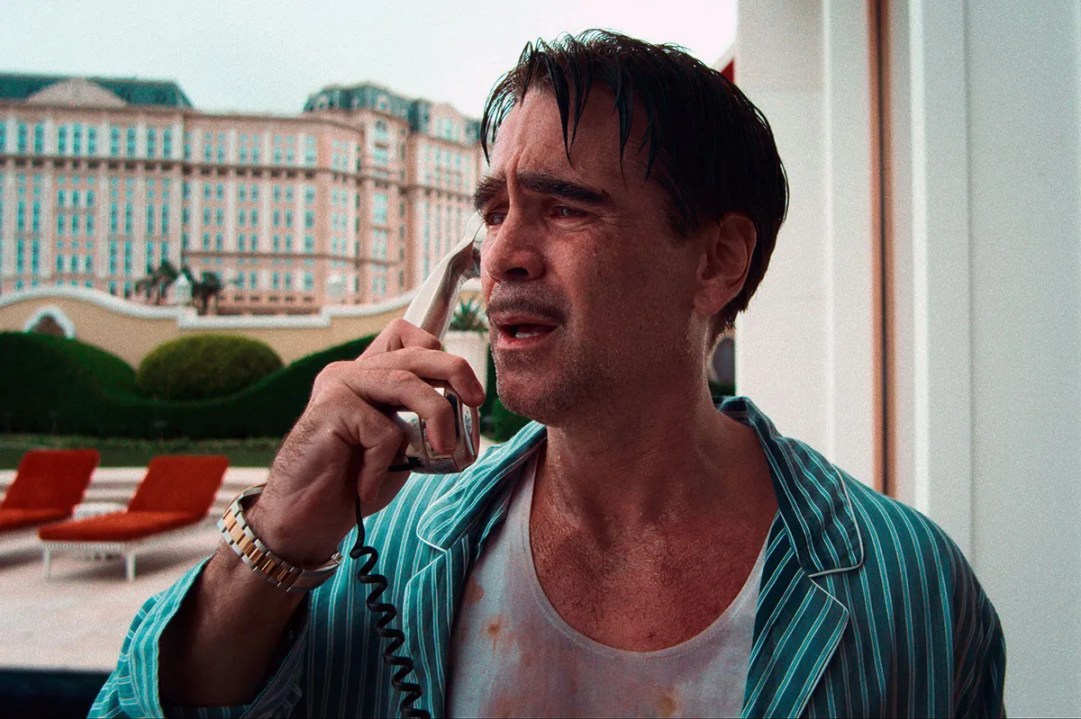
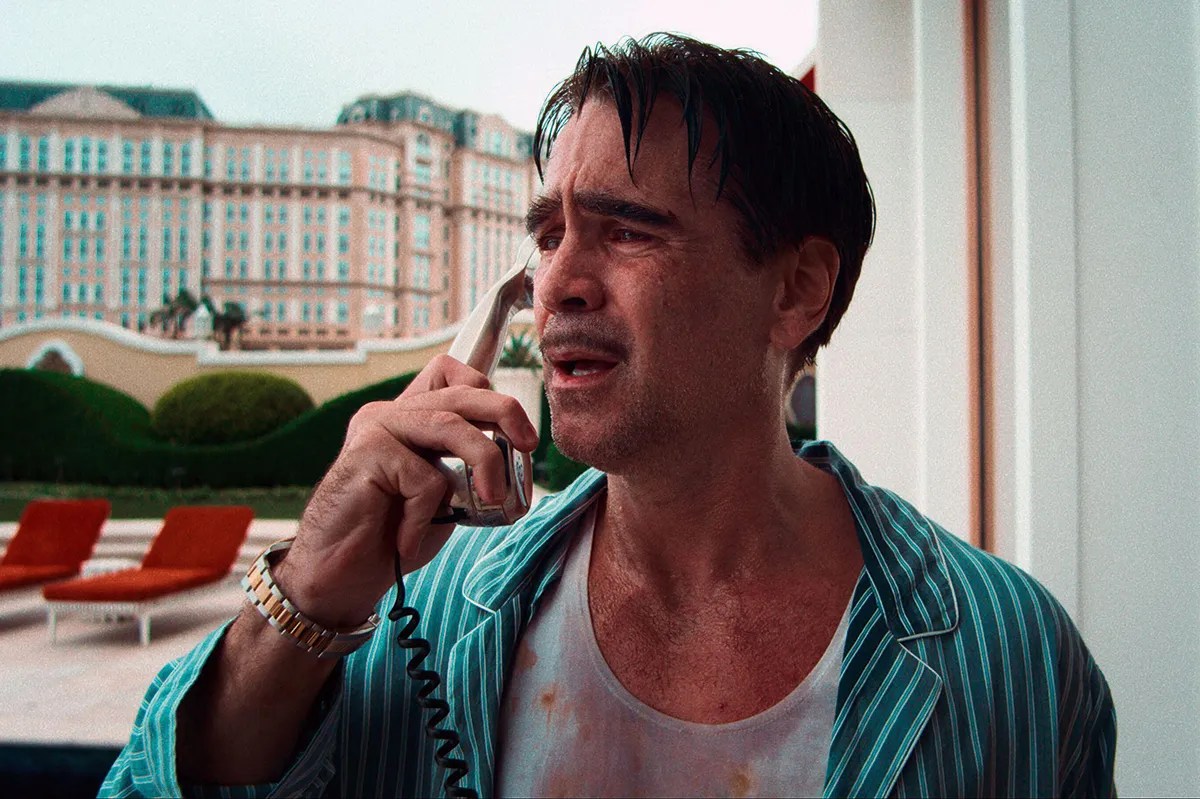
The film Ballad of a Small Player opens with a blast of classical music, a shot of the Macau skyline and Lord Doyle (Colin Farrell) waking up in a hotel suite littered with Champagne bottles, cigarette butts and designer loafers that are starting to show their wear. While he dresses and shaves, a voice-over informs us he has three days to live. A sharp observer might notice he seems to have considerably less than that. Either way, for the next 100 minutes, director Edward Berger (All Quiet on the Western Front and Conclave) treats us to a sumptuous vision of one English con man’s final spree before oblivion.
It will take an even sharper-eyed observer to catch, as the final credits snap past, that they have just watched an adaptation of a Lawrence Osborne novel. Or rather another adaptation of an Osborne novel – and, if Hollywood has anything to do with it, one that will be followed by many more.
With little fanfare, the English novelist has been on perhaps the greatest literary roll of the 21st century. Starting with The Forgiven in 2012, he has published eight novels and a collection of short stories in 13 years. In the process, he has acquired an enviable reputation. Critics are running out of fresh ways to describe his enigmatic novels – thrillers about dislocation, moral crisis and culture shock, as finely crafted and as cruel as bear traps – that are the product of a sensibility which seems to be some combination of Patricia Highsmith, V.S. Naipaul and Graham Greene unleashed on our hyperglobalized world.
Osborne’s books have developed a cult following and Hollywood has come calling. The Forgiven was adapted by John Michael McDonagh into a 2021 film starring Jessica Chastain and Ralph Fiennes. A production company, Java Road, was recently set up with a mission to bring the rest of his novels to the screen. Java Road’s creative executive Sam Lavender, an industry veteran, said that Osborne’s oeuvre is “an exciting prospect for adaptation; cinematic, deeply involving and grippingly told.”

But you will struggle to find Osborne on any prize longlist or mention of his novels in the New Yorker or the London Review of Books. Perhaps it is a matter of form. Literary tastemakers have favored anemic autofiction at a time when Osborne is serving up full-bodied, plot-driven novels. If so, he has no regrets. “Stories are enigmatic things,” he tells me. “Most literary writers have little idea what they are, strangely. Our current literary culture doesn’t really value them highly. It’s mere ‘plot.’”
Osborne’s plots proceed pitilessly. Part of his strategy is to place spots of doubt about moral intent at the center of his novels and then leave the reader to wrestle with the consequences of an inciting incident they only incompletely understand. Events then unfold with an inexorable logic that commands full attention. “The reader should be playing chess with me as an equal partner,” Osborne says, “not lying on his or her back eating peaches.”
Perversely, Osborne has arrived at this outsider status after a long and prosperous period as an insider. “I left England very young to do a ‘Down and Out in Paris’ number,” he says. After Paris he repeated the act in various locales until he wound up in New York in the early 1990s and stumbled into a successful career as a journalist. It sounds like tremendous fun – writing about wine for Men’s Vogue, going to Bangkok for the New York Times and Beirut for Newsweek, filing dispatches from Mexico and Papua New Guinea, writing about deaf children in Nicaragua and forensic anthropologists in Tennessee – and it filled the reservoirs of literary inspiration his novels would later tap into.
But before he could write those novels, he had to ditch journalism. “My mother died in 2011,” he explains, “and at the time I made a kind of pledge to her spirit that I would stop living the footloose life of a journalist, would settle down at a single desk in a single city and write the books I had always wanted to write but previously could not. I simply left New York after 20 years. That city seemed to drain me. I moved to Istanbul after my mother passed and then Bangkok. I found my refuge – and every writer needs a refuge which doesn’t make him or her go slowly broke. For me, eventually, it was Bangkok. There I was able to disconnect and find the time.”
The protagonists of his novels do some variant of the same thing: they go abroad to disconnect from home and the lives they are trapped in. This act of escape holds out the promise of adventure in an exotic setting but it produces something terrifying – an encounter with an alien moral universe. Westerners go overseas thinking they will meet people who are just like them – but with better food. What they discover is that their universalizing moral outlook is profoundly parochial. And they learn this the hard way, through incidents – a car crash in Morocco, an act of charity to a Syrian refugee in Greece, a robbery in Cambodia – that launch them into a realm where their uncomplicated moral formulas have no purchase.
This insistence that different peoples are, in fact, different is the secret engine of all Osborne’s fiction and the likely explanation for why the fashionable literary world has shunned him. His novels are subversive of the moral claims that world has promoted with such fervor for the past 15 years or so.
Again, Osborne is unrepentant. “I think this is how life actually is among real human beings,” he says. “Ideology is a mental world of templates, diagnoses, the long-term belief in the supremacy of ideals. Whereas I see humans as akin to flocks of migrating birds changing direction for reasons which none of them understand consciously.” This is an “animist and in some ways Buddhist” outlook, but vastly preferable to the pat formulations on offer in the West. “If I’m going to be a serf to 19th-century figures,” he says archly, “give me Dostoyevsky or Nietzsche over Marx.”
All that having been said, politics does not really intrude upon the reading experience. Beautiful Animals, published in 2017, is the most interesting rumination on the migrant crisis in Europe that I’ve read, but it’s not “about” the migrant crisis. It’s about humans interacting and the dramatic possibilities that open up. “It’s animal, not intellectual,” as Osborne insists fiction should always be. Besides, chasing after the news cycle is a mug’s game. “A novelist who hopes to endure in the afterlife should always adhere to the stern advice of Salvador Dalí: ‘Don’t try so hard to be contemporary. Unfortunately for you, it’s the one thing you will always be, whether you like it or not.’”
Osborne is more focused on making his novels fun than making them (that awful word!) urgent. And they are fun: filled with drugs and sex and violence and gossip and decadent meals and chapter-length drinking binges. Did his past life as a wine writer help him in that respect? “I suppose so, in that when you are writing about wine you begin to look at the rituals of food more closely. When your characters eat and drink you can certainly observe them with interest. After all, the ritual itself is interesting and telling. It’s like noticing what people wear, which is always revealing even when it’s not intended to be.”
The lushness and material excess of his novels is doubtless part of their attraction to filmmakers. For Osborne, who credits as many cinematic influences on his prose as literary ones, seeing his novels on the screen has a special resonance. “It’s very moving, actually. Different levels in the stories come to light in marvelous and unexpected ways. It’s extraordinary to see these gifted actors breathe new life into characters created for novels. It’s a true alchemy, a mysterious one.”
Ironically, as it has just been given the Netflix treatment, Ballad of a Small Player is the odd one out in Osborne’s corpus: less tightly plotted, more literary, with a smaller cast of characters and a larger serving of introspection. It is a more personal novel, he says. “In the first person you give direct expression to your superstitions and pathologies. The latter in Ballad are really my own.” It’s an interesting acknowledgment given Lord Doyle’s pathologies. Ballad is as disturbing a reflection on addiction as Leaving Las Vegas, but it’s also more than that: a ghost story, a noirish expat novel and a harrowing account of the thirst for annihilation.
It also defies the recurring complaint that Osborne privileges plot over style. While it is true that Osborne’s style is not mannered – he is not a co-belligerent in Martin Amis’s war against cliché – the prose is mordant, tense, adorned with the occasional Chandleresque simile (“The chips came over. Like Soviet tanks facing a defenseless village”) and filled with devastating commentary. “We represent nothing to them whatsoever, except evil ghosts,” one alienated British expat muses to Doyle about Macau. “Scavengers, opium traders and the like. Look around you. They love all this crap, they can’t stay away from it. But they still hate us in some way.”
Unsurprisingly, that line did not make it into the film. And indeed, for all the cinematic flair of his novels, there is an incongruity in seeing these remorseless tales of human folly turned into tidy Hollywood screenplays. In Berger’s film, Doyle achieves a redemption of sorts in the closing scene. There is no such relief in the novel – or in any of Osborne’s novels.
In his fiction the world is complex and callous, and rather than transcending their flaws, his characters are typically destroyed by them. “People can never foresee the end of the chain reaction which their own actions set in motion,” Osborne says. “Never. Therein lies their tragedy. But then you have to ask: ‘Would it not be even worse if they could?’”
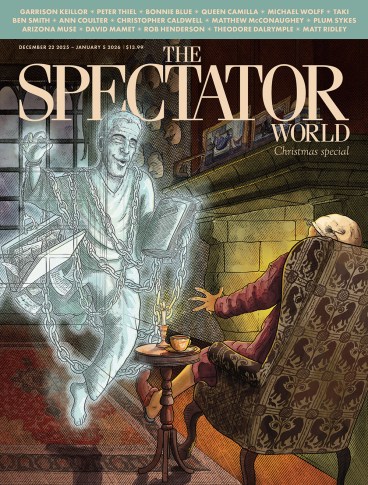
This article was originally published in The Spectator’s December 22, 2025 World edition.




Comments