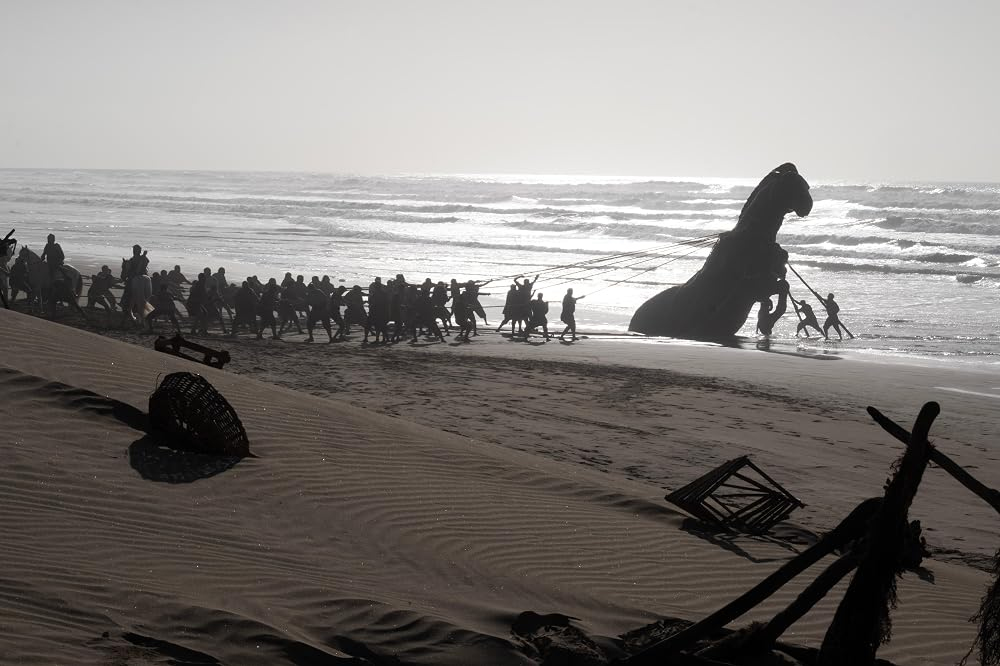
China will inherit Homer, and not because the Communist party has decided to take him. The evidence arrived last week in Beijing, where a doctoral candidate in political theory named Yiyang Zhuge sat down with Christopher Nolan to talk about The Odyssey. She reads Greek and has translated Plutarch’s Moralia into Chinese. She learned her Greek in the United States.
Zhuge told Nolan that the concept of atonement does not exist in Greek culture, in the Greek language, or in Homer’s Odyssey. It is in the film. Then she asked him: “Did you Christianize the Odyssey?” Nolan said he had focused on xenia, the ancient obligation between host and guest. As for atonement, he said it was “what we bring as viewers to the story,” and that he had not intended to Christianize the poem.
Nolan’s answer was less a reading of Homer than a diagnosis of his audience. We increasingly read the classics on the condition that they first become like us.
Zhuge was reading Homer from outside a Western argument about guilt. She could see what Nolan’s audience had brought to the poem because she did not need Homer to settle that argument. China inherits Homer when readers there encounter him without first making him answer the West’s latest quarrels.
She had said as much a year before she met him. Zhuge told the Jack Miller Center, an American foundation that funds the teaching of Western political thought, that ordinary Chinese readers do not see themselves as heirs to the Western tradition. This leaves them “free from the prejudices” and, in her view, “closer to the Greeks.”
People whose traditions were “uprooted and annihilated by materialistic dialectics for a whole century,” she argues, arrive at ancient wisdom already knowing they need it. Dialectical materialism is the Communist party’s official philosophy, its version of Marxism and still taught as a required subject: matter is all there is and history advances through material conflict. Religion and inherited tradition are by-products that will fall away as conditions change.

That hostility to inherited tradition became policy during the Cultural Revolution, a decade-long campaign to remake Chinese society by attacking the old. Its assault on China’s past reached Qufu, the city where Confucius was born and buried and where, for two and a half thousand years, he was venerated in a walled cemetery of cypresses planted by his disciples and their successors. In November 1966, roughly 200 Red Guards traveled there from a university in Beijing with instructions to destroy what they called the Four Olds: old customs, old culture, old habits, old ideas.
The campaign killed some one to two million people, and it was a purge of inheritance, not only a purge of people. Temples, libraries, graves, genealogies and family shrines were destroyed in the belief that a country can only be made new under communism once it stops consulting the past. According to one set of statistics, the students spent four weeks at Qufu and destroyed some 6,618 artifacts and more than 2,700 books. They leveled Confucius’s tomb.
China opened its economy 12 years later. Prosperity followed, but the instructions compiled over generations on how to live well had been lost.
I once spent many weeks interviewing a Uighur woman whom I called Maysem to protect her identity. The Uighurs are a Muslim people in China’s far west, and she had been held in two of the concentration camps that the government built to brainwash a million of her people.
Before her detention, she was a university student in Beijing, where she built a vast private library: political theory, English novels and old Persian and Greek epics bought in local bookshops. She wanted, she told me, to be “a true scholar, a woman of learning.”
One summer she brought the books back home. Her father, who remembered the Cultural Revolution, built a pit of rocks in her family’s yard, piled her books inside, poured gasoline over them and dropped in a match. “Books,” he told her, “will only get you in trouble.”
Her schooling permitted one loyalty: allegiance to the Communist party. Books gave her an inner life the state had not supplied.
The party is afraid not of Plato but of Uighurs, whom it has smeared as terrorists and agitators. What the party actually wants from the ancient Greeks is a pedigree. In November 2024, Chinese President Xi Jinping sent a letter to the first World Conference of Classics in Beijing, urging scholars to “embrace the responsibility of advancing classical studies.” A Chinese School of Classical Studies now operates in Athens. A Chinese translation series of western classics, which includes Plato, Aristotle and Rousseau, has sold tens of millions of copies across a thousand titles over four decades.
The West is putting the same inheritance on trial. In December 2024 the British government moved to end the £4 million Latin Excellence Programme. The program had carried Latin into 40 non-selective state schools, where more than a third of pupils were eligible for free school meals. Education Secretary Gavin Williamson had launched it to stop Latin being reserved for “the privileged few.”
The pressure comes from more than one direction. In January 2026, Texas A&M University ordered a philosophy professor to remove readings from Plato’s Symposium from an introductory ethics course or be reassigned, under a new university policy against teaching “race and gender ideology.”
On the academic left, the pressure is harder to describe. The Princeton classicist Dan-el Padilla Peralta has written that classics was “a cheat code for mastering whiteness.” In that reading, the ancient work must answer our quarrels before it is allowed to tell us anything of its own.
On August 14, The Odyssey opens across most of China’s nearly 800 IMAX screens. More than 250,000 people had registered to see it before tickets went on sale. They probably won’t ask whether Homer needs forgiving. That was always our question, not his.





Comments