
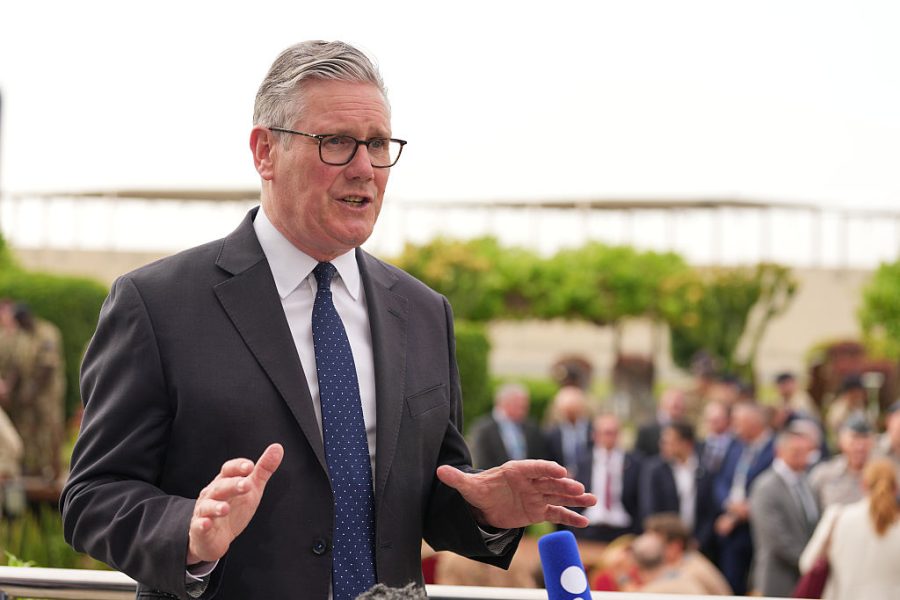
Less than a fortnight ago, Sir Keir Starmer sought to signal that the British government was getting tough on Putin by authorising the Royal Navy to stop, search and if necessary impound so-called ‘shadow fleet’ vessels carrying Russian oil through the English Channel. On Wednesday, the Russian navy brazenly ignored Starmer and sent a frigate, the Admiral Grigorovich, to escort a pair of tankers through the Dover Straits. The British response was to send a Royal Fleet Auxiliary tanker to trail the Russian trio as they passed the white cliffs unmolested. To complete the humiliation, the Daily Telegraph’s acting defence editor Tom Cotterill filmed the whole incident from a hired boat hove-to in mid-Channel.
The Ministry of Defence (MoD), activating its highest spin mode, called a press conference to push back against the Telegraph’s ‘Putin mocks Starmer with warship in Channel’ narrative. Defence Secretary John Healey made the extraordinary announcement that in recent weeks a British warship and aircraft tracked and monitored Russian submarines attempting to survey vital undersea infrastructure in the North Atlantic. According to Healey, the British intervention ensured the Russians abandoned their mission. ‘I’m making this statement to call out this Russian activity,’ Healey warned:
And to President Putin, I say: ‘We see you. We see your activity over our cables and our pipelines, and you should know that any attempt to damage them will not be tolerated and will have serious consequences’.
Russia’s response to a tanker being intercepted and boarded by British forces is likely to be aggressive
Healey’s announcement was apparently aimed not only at pushing back on the humiliation of the Admiral Grigorovich incident but also at explaining another recent British naval debacle: the failure of the Royal Navy to deploy its only serviceable Type-45 destroyer ‘Dragon’ to the Mediterranean to protect the RAF’s sovereign base in Cyprus against Iranian missiles. Healey suggested that the reason that British ships were not rushed to the Middle East was that they were seeing off the Russian threat in UK waters. ‘When a crisis erupts noisily as it has in the Middle East, I understand why there are calls to send assets there,’ he said. But in fact, Type-45 destroyers like the Dragon were not involved in the sub-hunting operations, as that is not their mission profile. Finding, tracking and interdicting enemy submarines is a job for Astute-class submarines, Type 23 frigates and Batch 2 River-class patrol ships.
Spin wars aside, Healey’s announcement revealed a potentially deadly threat not only to the UK’s security but that of the whole Western world. Despite repeated incidents of Russian and Russia-linked vessels surveying and actually damaging undersea cables in the Baltic, no Nato state has yet formulated any feasible defence strategy against such an attack. The internet, electricity, gas and old-fashioned telephone cables are as fundamental to the basic functioning of modern economies as veins and arteries are to the human body. Yet these cables lie unprotected on the beds of the Baltic and North seas, the English Channel and the North Atlantic.
The news that Russia’s Main Directorate of Deep-Sea Research for the Russian Ministry of Defence, known as GUGI, is actively surveying this vital infrastructure is alarming enough. More concerning still is that Andrei Kelin, Russia’s ambassador to the UK, has refused to rule out such a scenario. After Starmer announced on 25 March that the Royal Navy had been authorised to board Russian oil tankers in British waters, Kelin responded that ‘this decision will not go unanswered … appropriate measures are being developed. Let this come as a surprise to the British people.’ Putin’s ambassador also warned Downing Street to ‘think carefully’ about the consequences, including legal ones, of taking action against Russian-linked vessels.
Downing Street seems to believe that Healey’s announcement that British intervention chased off the Russian would-be raiders signalled that the UK is getting tough on Putin. The Ministry of Defence also released a set of satellite images of an Arctic naval base the UK believes is being used by ships of Russia’s GUGI submarine warfare fleet. This base at Olenya Guba on the Barents Sea is thought to be the home port of the Yantar, the alleged spy ship spotted in the Channel.
Declassifying and publishing this satellite information was presumably intended to reassure the public that British military intelligence is across the threat and monitoring closely. One small problem, though – the dropped pin on the MoD map was on the wrong side of the White Sea somewhere near Arkhangelsk, rather than next to the Russian Northern Fleet base at Polyarny on the Kola Peninsula some 600 kilometres away. A communications failure rather than one of actual intelligence, doubtless. But a small, symbolic sign of a deeper un-seriousness in the British defence establishment.
The situation presents Starmer with an uncomfortable dilemma. Having vowed last month to crack down on ‘shadow fleet’ vessels, the British government now faces the challenge of defining what exactly is illegal about tankers carrying Russian oil. The trade itself is not against the law – and though cargoes of Russian oil are subject to EU and UK price caps, the US has temporarily lifted its sanctions on Moscow’s tankers in a bid to keep international oil prices down. More than 600 individual vessels identified as using false flags of convenience or suspected of so-called attestation fraud in a bid to avoid price caps have been targeted by sanctions by the EU, UK and US.
But these ‘sanctions’ apply only if the vessel crosses into European or British territorial waters or tries to dock at a European port. And, crucially, even such narrow waterways as the Danish Straits, the Dover Straits and even the Bosporus are effectively international waters in which vessels enjoy a UN-mandated ‘right of innocent passage’.
As Ambassador Kelin made clear, Russia’s response to a tanker being intercepted and boarded by British forces is likely to be aggressive. The combined Russian Northern and Baltic Fleets have a strength of 35 to 40 submarines and 70 surface combatants – many times more than the depleted Royal Navy. Both the Russian probe of undersea cables and the Admiral Grigorovich are operations by the Kremlin designed to test both British operational capacity and political resolve. It appears that we have been found wanting on both counts.



Comments