
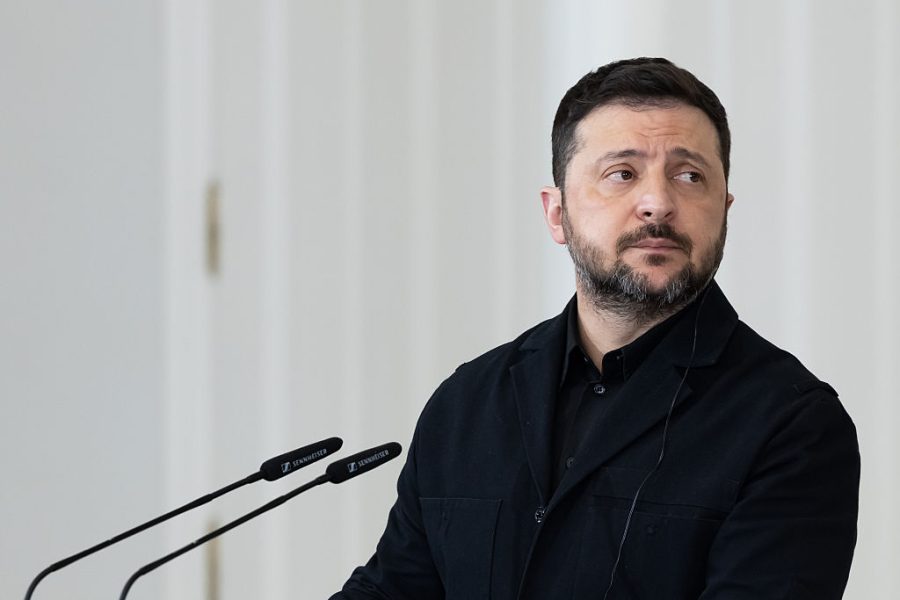
As Ukraine emerges battered but unbowed from the third and most terrible winter of the war against Russia, its people have proved that they can survive and fight on even as Vladimir Putin’s troops destroy swaths of their country’s heating, transport and electricity infrastructure. But one thing that Ukraine cannot survive without is money – and that, the European Union seems critically unable to provide.
On Thursday, a Council of Europe summit once again failed to remove a veto by Hungary’s prime minister, Viktor Orbán, on a €90 billion ($104 billion) tranche of funding for Ukraine. That cash, in the form of a controversial loan raised collectively by the EU, was negotiated last year as an emergency stopgap designed to keep Kyiv’s war economy going in the absence of funding from the United States. Even Orbán was brought, reluctantly, on board. Without the EU’s funding lifeline, Kyiv is expected to run out of money to pay its public servants, buy military equipment and fund its army by the beginning of summer.
But after the Druzhba oil pipeline that carries Russian oil via Ukraine to Hungary and Slovakia was damaged by a Russian drone attack in January, Orbán withdrew his support for the EU loan. Orbán claimed that the Ukrainians were dragging their feet on repairing the pipeline and blamed Volodymyr Zelensky personally for delays in getting Russian oil supplies to Hungary flowing again.
Ukraine has survived a long, cold, dark winter unbroken
The EU has vowed that the continent will wean itself off Russian oil and gas entirely by the end of 2027. Yet Brussels now finds itself in the absurd situation of offering to help repair a Soviet-built oil pipeline in order to restore the supply of Russian oil to Europe. But even the EU’s offer of funding repairs and sending a “fact-finding team” to supervise the Druzhba fix failed to persuade Budapest. Discussions had been “tough; I was under pressure from all sides,” said a defiant Orbán. ‘But they tried this in the wrong place and at the wrong time.’ Even worse for Ukraine, Slovak premier Robert Fico also backed Orbán and added his veto too.
European Council President António Costa blasted Orbán and Fico’s obstructionism as “unacceptable” and an unprecedented violation of a “red line” in European behavior. But Orbán’s very public stubbornness stems from the fact that he has made blaming Ukraine for Hungary’s woes – including rising energy prices – a central plank of his re-election platform. Orbán is fighting for his political life in the run-up to elections on April 12. Weeks ago Hungarian police staged a high-profile raid on a bank van transporting €82 million ($95 million) in cash and gold to Ukraine, touting the operation as evidence of Zelensky’s corruption. Yet despite all these theatrics, there is a strong chance that Orbán will nonetheless lose.
But Orbán is not the only factor jeopardizing Ukraine’s war effort. Some European countries are moving away from their once rock-solid support for Kyiv and towards restoring relations with Russia. “Since we are not capable of threatening Vladimir Putin by sending weapons to Ukraine, and we cannot choke him economically without the support of the US, there is only one method left: making a deal,” Belgium’s PM Bart De Wever told L’Echo.
We must normalize relations with Russia and regain access to cheap energy. That is common sense.
More ominously still, De Wever claimed that:
In private, European leaders agree with me, but no one dares to say it out loud. We must end the conflict in the interest of Europe without being naïve towards Putin.
At the same time a bombshell opinion poll by the respected Kyiv School of Economics last week revealed that 61 percent of Ukrainians would agree to exchanging territory for peace with Russia – as long as Ukraine received solid security guarantees and EU membership in exchange. That undermines Zelensky’s increasingly beleaguered position of insisting that Ukraine must fight on and refusing to cede any more territory to the Russians. Zelensky also faces a looming political crisis in the Rada, Ukraine’s parliament, where the once-commanding majority of his Servant of the People party has slipped badly. Ongoing probes by the Western-backed and funded NABU and SAPO anticorruption bodies are also steadily picking off pro-Zelensky MPs, with 17 lawmakers (including committee heads) hit by summons over the last month.
Operationally, too, Ukraine’s defenses rely heavily on supplies of US-made Patriot missile ammunition, which is now being diverted to America’s allies in the Gulf. Kyiv has offered its own anti-Shahed drone munitions to Gulf countries, along with trained operators, as a cut-price alternative to Patriots. But the fact remains that when it comes to intercepting high-velocity ballistic and cruise missiles, only Patriots will work.
On the diplomatic front, trilateral talks with the US, Russia and Ukraine have been officially suspended. When they resume, the dynamic will have shifted, and not in Kyiv’s favor. Washington needs the Russian oil supply to stabilize international markets and may even call on Moscow to use its longstanding ties with Tehran to help pick up the pieces when Operation Epic Fury ends.
Ukraine has survived a long, cold, dark winter unbroken. Now Kyiv’s challenge is to survive its friends and allies falling away, one by one.





Comments