This glorious historical monument slows, expands and luxuriously stretches to encompass one of the defining moments of change in our history. When David Kynaston began, in 2007, to publish his Tales of a New Jerusalem, of which this is the sixth volume, each book covered a much longer stretch. His chronicle of the postwar Attlee settlement started with six years; the last two volumes have slowed to less than a year, then three years, and now less than 18 months. They are marvellous volumes, but if the excellent Professor Kynaston, who is 75, is to reach his terminal point of 1979, I recommend that he take his iron pills in the morning and altogether get a little bit less Zeno-and-the-tortoise about the project. There is no book I long to read more than Kynaston’s account of the last years of the Callaghan government.
The volumes take a passionately interesting approach. The witnesses to the time are not just the takers of cabinet minutes and statistics of employment, exports and immigration. They are the voices of private citizens in diaries and letters, very often recording what happened to them, even if quite unimportant, telling us what they saw and what they thought. Selected by a reader of the acuteness of Kynaston, they wonderfully evoke the time, even if it is nothing more than a clever teenager, pulled out of school at 16, saying: ‘Tonight I really don’t want to sit down at the table with my mum.’ An observer may have his comments preferred if they are trivial but have acquired the patina of strangeness: a 1968 reporter on eating habits tells us that West Country folk ‘poured [cream] into and over as much as possible like a kind of sacred libation’, including kidney beans.
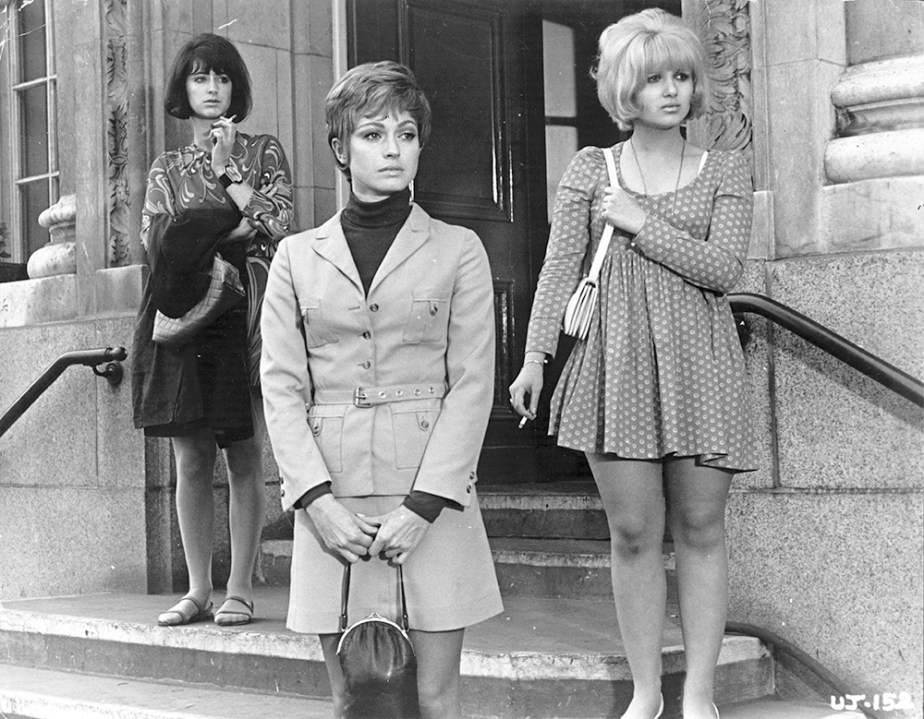
There are two good reasons why this volume justifies its Erzählzeit, or length of telling, compared with brevity of period. The first is that these 18 months undoubtedly show some of the defining moments of the whole period since the war. The parliamentary decisions to support changes in the law relating to divorce, abortion and homosexuality belong to this period. Many of the most celebrated moments in ‘the Sixties’, in a useful cultural shorthand, are here present: Julie Christie, ‘Judas’ being yelled from a Manchester balcony at Bob Dylan, Mary Quant, Up The Junction. These are usefully set against the less groovy phenomena most people preferred – The Good Old Days – and Cliff Richard spent longer in the charts than the Beatles. There are other very Sixties moments, too: the trial of the Moors murderers falls into this period, and Boots subscription library, which had, ten years before, refused to let Kingsley Amis put a rude word in a novel, came to an end. You’d have to buy your books from now on, or mingle with the riff-raff in the public library.
Secondly, many of those defining moments in which public policy changed can’t just be narrated by the diaries and letters of ordinary people but, to a greater extent than in previous volumes, have to be told through accounts of public policy. There are a number of very significant moments of such policy impacts in this period. One, which Kynaston makes no attempt to hide his rage at, is the demolition on a colossal scale of historic towns to make way for expressways and poor- quality high-rise housing. There seems to have been no serious attempt to compare the costs of renovating old building stock with that of building on a colossal scale, let alone the costs of demolition and rebuilding when those new buildings were found to be unusable a few decades later.
The pages in which Kynaston lists the destruction of historic buildings, such as Josiah Wedgwood’s Stoke factory, ought to be compulsorily recited in the Royal Albert Hall by a dragooned chorus of town planners once a year as an act of penance. It is true that a few of these developments proved of worth: I think Kynaston is wrong, for instance, to lump the Park Hill development in Sheffield, a glorious building with a unique relationship to its sloped setting, with the appalling and long–demolished Kelvin estate in the same city, which I remember from childhood as a source of terror and gloom.
The villains are rightly fingered here: Dame Evelyn Sharp, Alderman Dennis Thomas of Birmingham (‘Mr Redevelopment’) and, surprisingly, Keith Joseph, who later repented of his sins. ‘Ours is the city of the future… The sky is forever lit up by chemical plants,’ said one optimistic inhabitant of Middlesbrough.
Similar defining moments are extensively explored, although these were perhaps much more mixed in consequence than the disasters of town improvement. Racial questions started to be examined quite seriously. I think this is the first time that journalists carried out the now-familiar investigation of applying for jobs and accommodation in three personas, a white Englishman, a white foreigner and a black man, with the expected result. The heartrending cruelty of condemning children to a lifetime of failure through the judgment of the 11-plus starts to be succeeded by comprehensive schools, though in my experience a newly rigid system of categorisation started to be imposed through ‘sets’ of ability. At my 1970s comprehensive, kids from the working-class feeder school, especially if they were black or Asian, were automatically placed in the lower sets.
Decisions to support changes in the law relating to divorce, abortion and homosexuality belong here
One reason for going into the public policy dramas of these years, perhaps, is that they have become painfully and appallingly relevant to the public policy decisions of our own time. Until very recently, the Wilson government’s investment in a ludicrous and catastrophic Prices and Income policy, deciding what goods were worth and how businesses might choose their employees, would have been universally regarded as a piece of historic folly. (‘Were they drunk?’, I remember asking an economic historian friend. ‘Well,’ he said, ‘It was George Brown in charge.’) There was, too, the extraordinary madness of the National Plan, announced by a temporarily sober George Brown on television in September 1965. There would be a 25 per cent growth in output by the 1970s. Exports would rise by 5.2 per cent a year. The housing target (familiar?): half a million new homes. And so on. ‘I think [it] will command a great deal of interest and support,’ Tony Benn wrote at the time. The trouble was, then as now, that the government had absolutely no idea how to put its press release into reality. A later historian says that the plan ‘proceeded on the basis of deciding the 4 per cent growth by 1970… and only then deciding on measures to fit round the target’.
This is a wonderfully interesting and enjoyable book, like its predecessors. The one thing I would slightly carp at is that sometimes events are told too much through retrospective witnesses, on occasion many decades later. A recent comparable history, Peter Parker’s excellent account of the lives of gay men before 1967, austerely and very rewardingly limited itself to contemporaneous witnesses. Here, I do think that in some areas, such as the pressure towards the devaluation of the pound that finally took place in 1967, the reliance on wisdom from decades later is nowhere near as interesting as the fewer voices from the time, such as Nigel Lawson in this magazine in March 1966, who wrote accurately and with insight. (The Governor of the Bank of England wrote of similar views expressed by Nicky Kaldor that he felt ‘ashamed to read such a paper on HM Treasury stationery’, a gloriously period dismissal.)
One significant area where Kynaston’s personal enthusiasm has led him to express a particular view through relying on retrospective testimony is football. This period includes the moment when England won the World Cup. I had always rather suspected that it wasn’t such a big deal at the time as mythology has subsequently maintained – my mother and father, rather prone to reminisce about moments of national unity, never mentioned it and had, I think, no recollection of it. Sure enough, Kynaston’s honest account supports this. The television broadcasting timetable wasn’t disturbed in the slightest by the match going on, I discover, into extra time. All sorts of national events and rational entertainments went on without taking the slightest account of what was happening at Wembley. Best of all, a poll was taken by Mass Observation in autumn 1966, a few months after the World Cup: over a quarter of those asked were completely unable to say who Bobby Moore was.
Kynaston loves football and this (I think) is the first volume in the series where he shyly intrudes his memories of something. He also brings up his childhood experiences of being the son of divorced parents, which in the context of this work carry more weight than the memories from decades later of an event much qualified by persistent myth-making. An unforeseen magic is creeping over the sequence as it progresses: though I myself have no memory of any of this (I was born in February 1965, just as this volume begins), it is the first volume that contains the memories of people I know, sometimes quite well, and that casts a spell of unity and sympathy. Most books I get sent to review get dispatched to the charity shop quite quickly; these books of Kynaston’s have remained on a much-cherished shelf.





Comments