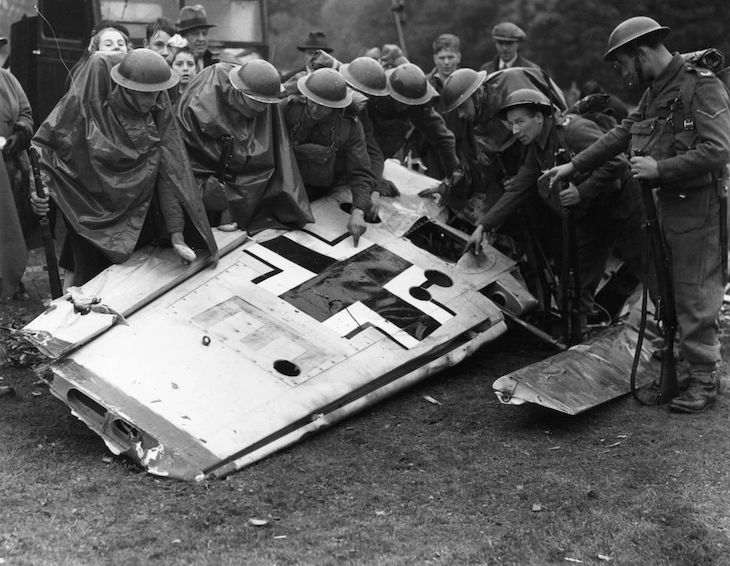
“Vanity of vanities… all is vanity.” Ecclesiastes had a point, but he never met a Luftwaffe fighter pilot. For the young Germans who hurled their Messerschmitts at enemy planes over the Channel, the Reich, and the Eastern Front, there was one object that could make them forget their odds of survival: a small iron cross, worn at the throat, called the Ritterkreuz – the Knight’s Cross. To many, it was worth more than money, more than leave, more than the quiet relief of making it home in one piece. It meant you were the best. And everyone could see it.
The German air force extracted thousands of extra kills from a few pounds of iron and ribbon
The problem facing the Luftwaffe was one that any organization will recognize: how do you keep your best people performing when the cupboard is bare? There were no bonuses to hand out at 20,000 feet, no stock options, no corner offices. The job was deadly, with as many as a quarter of pilots dying each month in the worst periods. Money bought little in wartime. What the Luftwaffe could offer was glory. And glory, it turns out, is a remarkably renewable resource, provided you keep repackaging it.
To earn a Knight’s Cross, a pilot needed to amass a certain tally of aerial “victories”. The quotas were officially discretionary but universally known. Pilots tracked their scores with the obsessive devotion of schoolboys swapping Pokemon. As they crept towards the magic number, something fascinating happened: they got dramatically better.
The numbers, drawn from data on more than 5,000 German pilots during World War II, are striking. In a new research paper, Leo Bursztyn (University of Chicago), Ewan Rawcliffe (Harvard) and I find that as a pilot entered the “zone” – closing in on the victory tally required for the Knight’s Cross – his kill rate surged. The prospect of that medal alone squeezed an estimated six extra victories out of each ace. This in a profession where the average pilot managed a grand total of two to three kills in his entire career. Six extra, conjured from thin air and thick vanity.
Then, inevitably, the slump. Medal pinned on, photographs taken, handshake from Hermann Goring or the Führer himself – and performance dropped like a stone. The prize was won. The hunger vanished. Until, that is, the next prize appeared.
A medal, like a Birkin bag, derives its power from scarcity. Once many officers wear a Knight’s Cross, it ceases to signal what it once did. You might as well be wearing last season’s Hermès. That is why the Knight’s Cross was not a single award. It was a ladder – and the Luftwaffe kept adding rungs. As the war dragged on and the basic decoration became less and less exclusive, the High Command unveiled successively grander variants: first Oak Leaves, then Swords, then Diamonds, and finally – with a magnificence that bordered on self-parody – Golden Oak Leaves with Swords and Diamonds. Each time the regime launched a new variant, the familiar pattern reasserted itself: sprint, medal, slump. Sprint, medal, slump. A hedonic treadmill at 15,000 feet.
The aggregate effect was enormous. The medal system generated somewhere between three and five thousand additional aerial victories – the equivalent of fielding a thousand to 1,500 extra pilots, which a fuel-starved Germany emphatically did not have. As a feat of cheap incentive design, it was breathtaking.
Vanity’s darker cousin is envy. It wasn’t only the formal thresholds that drove pilots to extremes. When a former squadron-mate was singled out for public praise – his name trumpeted in the daily armed forces bulletin, celebrated on the radio, fêted in the newspapers – something uglier took hold. The men who had flown alongside him burned inside.
The best pilots channeled that jealousy productively. Their kill rates leapt by roughly half, without any corresponding spike in mortality. They had the talent to turn resentment into results. The middling and weaker pilots were not so lucky. They felt the same sting, pushed just as hard – and died at rates nearly fifty percent above normal. Envy sent them into engagements they hadn’t the skill to survive. They were, in a grimly literal sense, killed by a comrade’s success. The extra planes they shot down almost certainly didn’t compensate for the pilots lost. Status competition giveth, and status competition taketh away.
There is something tragic about the process – the same fire in the belly that drove the aces consumed the men who tried to emulate them. And all in support of a genocidal regime that brought death and destruction to millions. Remarkably, not everyone was equally susceptible. Pilots who already possessed status – aristocrats, holders of other decorations, officers with family pedigree – barely twitched at the prospect of a Knight’s Cross. They didn’t need it. They already knew who they were, and so did everyone else. The medal treadmill worked its dark magic most powerfully on talented young men of no particular background, for whom these baubles were the only way to earn distinction.
There is a lesson here for anyone who runs an organization, but perhaps not a comfortable one. Employee-of-the-month schemes, tiered loyalty cards, sales leaderboards, the entire apparatus of gamified workplace motivation – they all run on the same psychological fuel that kept Luftwaffe aces climbing into their cockpits. Status rewards are potent, but they depreciate. Hand them out too freely and they become wallpaper. Be stingy, and nobody thinks they are in the running. The trick is to keep medals rare but within reach for top performers, and to keep inventing new distinctions. In this way, the best performers never quite reach the summit. Whether you should want to is another question altogether. The German air force extracted thousands of extra kills from a few pounds of iron and ribbon. It also sent young men to their deaths, chasing glory, driven to ruin by the glittering success of men who once shared their mess table. Ecclesiastes, one suspects, would not have been surprised.





Comments