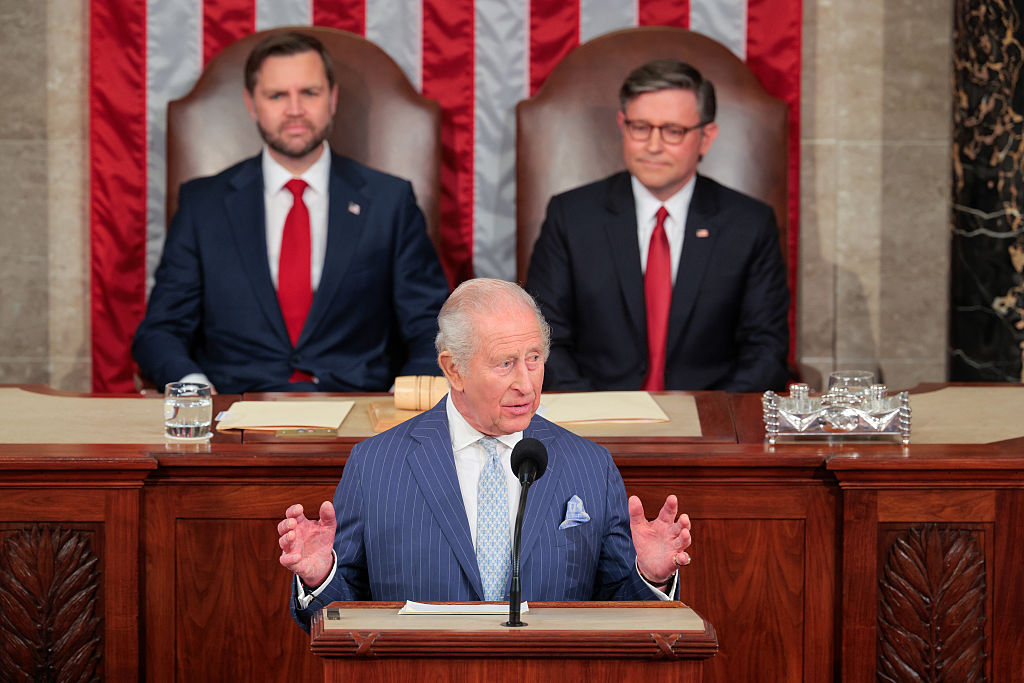
The King’s address to Congress was a rare and authoritative statement of national and international interest, delivered from a position no elected politician can claim. Before a joint session marking the 250th anniversary of American independence, the monarch spoke of an alliance forged in disagreement – yet repeatedly renewed by deeper common ground.
He recalled the shared democratic, legal and social traditions that have pulled Britain and the United States back together after even the sharpest ruptures. He spoke of defense and intelligence ties measured not in years but in decades, invoked the Royal Navy service of his own past, and named the live tests now facing both nations: Ukraine, the Middle East, NATO and the AUKUS pact. He described the relationship as one of reconciliation and renewal, “one of the greatest alliances in human history.”
The words carried institutional weight precisely because they came from the Crown. Only the monarch, standing above the daily grind of votes and party advantage, possesses the status to speak for the good of his nation, realms and beyond. His worldwide standing allows him to address not merely Britain but the special relationship and the wider democratic world with equal authority.
Delivered at a moment when relations between Downing Street and the White House have plummeted over Iran, the speech was more than ceremonial courtesy. It was a reminder that alliances endure not through constant agreement but through the realism that refuses to let disagreement become divorce.
In 30 carefully crafted minutes the King restated what generations of British statesmen once took as self-evident: the Special Relationship is not a sentimental attachment but the strategic foundation on which British security has rested since the early 20th century. No minister could have uttered those truths with the same unanswerable legitimacy.
That legitimacy exposes the weakness now visible in London. Keir Starmer’s administration has allowed the Special Relationship to drift into something thinner and more conditional. On Iran, the government’s response has been notably guarded: no clear commitment to enhanced naval presence in the Gulf, no swift alignment on basing or intelligence priorities that Washington has signaled it expects from its closest partner.
On NATO, Britain still falls short of the spending tempo a Trump administration demands from its allies, even as the eastern flank of Europe faces sustained pressure. The lingering instinct to frame every security question through multilateral lenses, even after Brexit, reveals a deeper hesitation.
Labour treats the transatlantic bond as a legacy asset to be managed rather than a strategic necessity to be reinforced. Each of these choices reflects the same governing reflex: a preference for European-adjacent forums and NGO-endorsed consensus over the clear-eyed bilateralism that once defined British foreign policy at its most effective.
These choices are the product of politicians whose primary concern is electoral arithmetic rather than the protection of the civilized way of life the alliance has long safeguarded. The same circles that once viewed EU membership as indispensable now reach instinctively for European consensus or activist-approved multilateral forums before they consider bilateral clarity with Washington.
The BBC and the network of NGOs that shape so much of the public conversation amplify the notion that any decisive tilt toward American realism somehow betrays sophistication or risks being labelled hawkish. The result is a policy posture that speaks warmly of the alliance in public while hedging in private, always with one eye on the next opinion poll or focus group.
The King’s speech, by contrast, offered no such calculation. It described a partnership whose value is measured in security and prosperity delivered to both nations and to the wider world. Labour’s record simply does not match that description. Where the monarch spoke of renewal born from realism, ministers have offered little more than polite continuity and tactical caution dictated by domestic political convenience.
Britons have every reason to view this gap with alarm. A genuinely sovereign United Kingdom, free of residual European reflexes, gains tangible advantages from unambiguous alignment with a Trump-led America. Sharper leverage on trade negotiations that could finally deliver the post-Brexit dividends long promised, accelerated technology transfer and submarine collaboration under AUKUS, energy security unencumbered by the net-zero dogma and credible conventional deterrence against revisionist powers in the Indo-Pacific and the Middle East.
The progressive establishment’s habit of framing Atlanticism as somehow gauche or dated is the familiar cant of a class that prefers moral signaling and vote-chasing to national advantage. Patriotic Britons have never fallen for it. The monarchy’s example of continuity above party politics only underscores the elected government’s failure to provide the same.
Through his words in the Capitol, the King reaffirms his constitutional role with characteristic dignity. He gave voice to the permanent interests of the British state at the precise moment those interests required restating.
Ministers should treat the speech not as a polite photo opportunity, but as the marching orders it effectively was. An independent Britain that matches this rhetoric with decisive policy and leadership is the only posture that honors both the Crown’s example and the hard strategic lessons of the past century. The alliance, history shows, survives governments that test it.



Comments