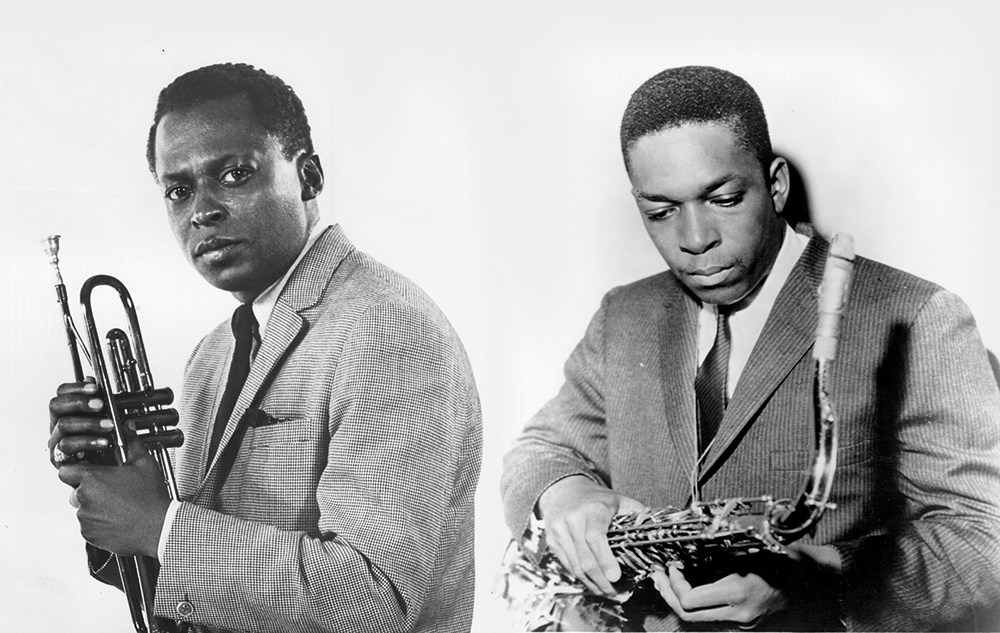
Why does the jazz world still feel so bedazzled by trumpeter Miles Davis and saxophonist John Coltrane? This year marks the centenary of their births, and even those who consider jazz marginal to their interests are likely to know Davis classics such as Sketches of Spain and Kind Of Blue, while Coltrane has almost become deified: there’s even a fully functioning Saint John Coltrane African Orthodox Church in San Francisco.
The jazz industry, meanwhile, is gorging on their centenaries with recordings, new and reissued, and books, new and repackaged. Throughout this year Ravi Coltrane – John’s son and a fine saxophonist himself – and trumpeter Terence Blanchard, a Davis protégé, are touring together, performing exclusively music by Davis and Coltrane, while at the Hollywood Bowl this month, trumpeter and composer Wynton Marsalis will present his orchestral reworkings of Coltrane’s music.
And yet this rush to commemoration exposes an uncomfortable paradox. There are those who argue that jazz has never managed to move on from Davis and Coltrane, that their pervasive influence has boxed in subsequent generations of jazz musicians rather than liberating their imaginations. Coltrane and Davis are admired for their astonishing ability to restlessly reinvent the basis of their music. Opting to celebrate this spirit of continual quest by reissuing the same, admittedly classic, recordings, and by presenting their work as music-in-repertory might seem like an odd way to proceed.
Coltrane’s music consisted of vast, free-flowing collective improvisations
Both musicians were products of the 1940s bebop age. Davis joined Charlie Parker’s group in 1944, long before he had the technique, by his own admission, to keep pace with Parker’s breakneck improvisations. Coltrane hailed from a generation of saxophonists – including Sonny Rollins, Lee Konitz and Paul Desmond – who picked up the pieces after Parker had roared through jazz like a tornado, smashing the existing landscape, before dying, aged just 34, in 1955. The rhythmic and melodic complexity of Parker’s work threw down the gauntlet. Matching his intensity and perfecting the techniques of his music was not enough. Parker upped the ante constantly, never settling for the songs he’d already worked out how to play.
Davis and Coltrane had been aware of each other during the early 1950s, but properly entered each other’s orbits in 1955, when Coltrane auditioned for a quintet Davis was organizing. Davis had quit Parker’s group just before Christmas 1948, finding himself increasingly unwilling to deal with the saxophonist’s self-destructive addictions. In that spirit of renewal, Davis’s antidote to four years of improvising around Parker’s high-tempo melodic obstacle courses was to start a nine-piece ensemble in collaboration with arranger Gil Evans and baritone saxophonist Gerry Mulligan, which favored instead airy and spacious arrangements, heavily influenced by the perfumed delicacy of the French composers Maurice Ravel and Claude Debussy. If Parker’s music had been “hot,” this group leaned toward the “cool” – and the records they made would be subsequently anthologized as Birth of the Cool.
Coltrane passed his audition and Davis’s new quintet aimed to fuse hot and cool. The titles of the four albums they recorded in 1956, Cookin’, Workin’, Relaxin’ and Steamin’, tell you something of the emotional palette the group encompassed, from “When I Fall In Love,” an early taste of the cut-glass fineness of Davis’s approach to playing a ballad, to their stampeding reboot of Sonny Rollins’s “Airegin.” With its emotional range and the space Davis was prepared to give his musicians to develop their improvisations, his quintet surpassed even Parker’s work. But in 1957, Davis let his saxophonist go. Coltrane had cultivated a debilitating drug dependency – and having recently shaken his own habit, going cold turkey, Davis recognized the dangers and knew Coltrane had to get himself clean. The Davis/Coltrane mythology properly began when the quintet reunited a year later. Classic album followed classic album, each fresh installment apparently compelling the music to follow a radical new direction. Milestones, from 1958, used hectic compositions to kick-start muscular, finger-popping improvisations. By comparison, Kind of Blue, recorded a year later, was strikingly sparse and introverted.
After Coltrane left Davis’s group in 1960 to form his own quartet, he couched his music in increasingly spiritual terms, dedicating his compositionally refined 1964 album A Love Supreme as a “humble offering” to God – before seemingly throwing any semblance of organization overboard with Ascension, Meditations and Kulu Sé Mama, a sequence of records that journeyed unapologetically beyond the frame of music as it was understood. His quartet fractured; new musicians came and went. Coltrane’s music then consisted of vast, free-flowing collective improvisations played against churning, dislocating rhythms. It was symbolic of how far he had left conventional notions of “music” behind that he was seen at concerts putting his saxophone down and hollering into his microphone, beating his chest to further amplify the sound.
By the time Coltrane died, aged 40, at the end of 1967, Davis was inching toward reinventing his music all over again. He was in the midst of a whole new quintet, with musicians considerably younger than himself who were able to deconstruct the Tin Pan Alley standards and original compositions they played. Each musician – including drummer Tony Williams and bassist Ron Carter – was at liberty to steer the conversation in another direction.
Around 1969, Davis noticed he was playing to dwindling audiences who worshipped Jimi Hendrix and had abandoned jazz in favor of supergroups such as Blood, Sweat & Tears and Earth, Wind & Fire. Davis responded by going electric, with guitars and keyboards throbbing over rock grooves. It was a period of heady experimentation that climaxed with his labyrinthine double album Bitches Brew, released in 1970, on which long-form, blues-drenched improvisational psychedelia was edited together after the recording sessions.
Davis took an extended sabbatical during the early 1970s, during which he slowly recovered from a comprehensive mental and physical breakdown. He made a comeback in 1981, eventually playing jazz-tinted pop, collaborating with Prince and becoming hipper than hip. He died in September 1991, aged 65.
Jazz has remained in hock to Davis and Coltrane because their sense of what they needed music to be resulted in unsurpassable albums such as A Love Supreme and Bitches Brew. Since Louis Armstrong and Duke Ellington first made their mark in the 1920s, such lodestars had given jazz its sense of direction and identity. From Armstrong’s creation of the idea of the jazz solo in his Hot Five recordings to Parker pursuing it to new heights two decades later, the story of jazz had charted the relentless pursuit of the next technical innovation, whether the public was prepared to come along for the ride or not. This became the message from both Davis and Coltrane: monuments exist to be toppled and as the music becomes certain of its direction, that’s when you must pull the rug from under its feet.
As the music becomes certain of its direction, that’s when you must pull the rug from under its feet
As part of its centenary celebrations for Davis, Sony Music, which now owns Davis’s lucrative Columbia Records back-catalogue, have made available, for the first time in 30 years, the musician’s totemic The Complete Live at the Plugged Nickel boxset: eight CDs documenting, note-by-note, a 1965 residency by Davis’s second quintet in Chicago. Some nights, the group works its material to the very point of disintegration, catching the pieces in freefall. Davis himself turns in radiant, blazing solos. But on other evenings, notes crack and he proceeds with uncertainty, wrestling with the forms: it is the laboratory of jazz.
Coming imminently is John Coltrane: The Tiberi Tapes, a release, at the time of writing, still shrouded in mystery. Saxophonist Frank Tiberi obsessively followed Coltrane around clubs from 1961 to 1965, recording device in hand. These recordings disappeared into private collections and their existence was even denied for a while – but his bootlegs will surely be revealed as one of the great treasure troves of modern jazz.
Fully appreciating the impact of Davis and Coltrane means taking yourself back to a time when each new album reset the dial, outraged the critics and challenged fans to keep up, rather than pandering to what they already liked. Published also this year is a centennial edition of Davis’s notorious 1989 memoir, Miles: The Autobiography, in which his stubborn reluctance to look back at or engage with his earlier records becomes a constant refrain. The only person involved in jazz, you feel, not to own copies of Kind of Blue or Sketches of Spain was Davis.
Another way to engage with the legacy might be to read Cosmic Music, Andy Beta’s fine biography of Coltrane’s wife Alice, who played piano in his final groups and carried her husband’s legacy forward after his death. Her struggle not just to capture the past glories, but to genuinely reimagine how her husband’s spirit and example could be applied to new times was the best response of all – don’t repeat, but renew.






Comments