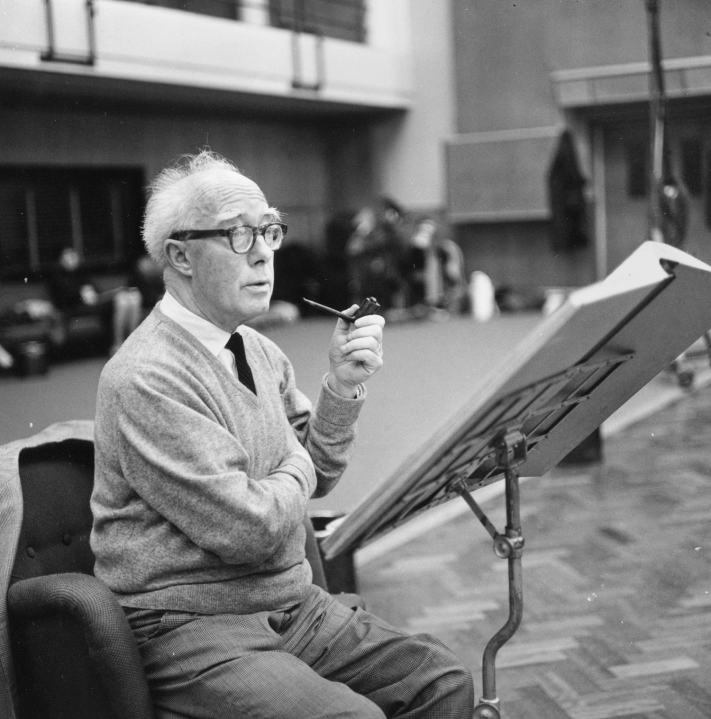
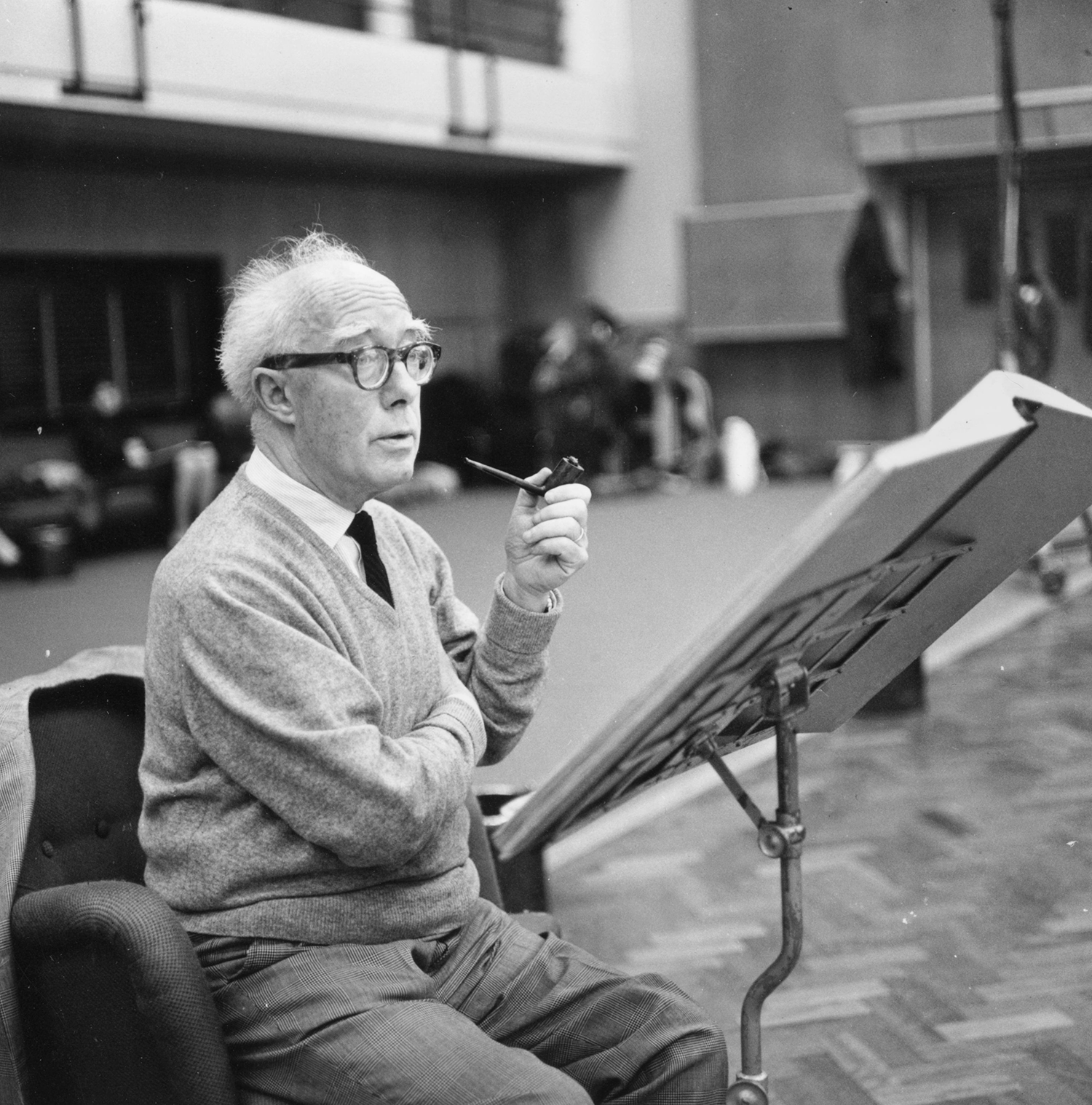
Elsewhere in British music in 1960: William Walton was writing his Symphony No 2, Benjamin Britten his opera on Midsummer Night’s Dream and Michael Tippett was about to start King Priam. Meanwhile in Cambridge, an ex-pat composer from Catalonia, Roberto Gerhard, was puzzling out how to knit together a new large-scale piece for orchestra and electronics.
Simon Rattle and the London Symphony Orchestra are about to give that work, Gerhard’s Symphony No. 3, Collages, a rare outing at the Barbican on 21 May. It’s a mind-stretching piece, both very much of its time and of the future. Gerhard’s electronics gurgled, bleeped and cracked their knuckles, as he atomised the orchestra, finding a kaleidoscope of inventive ways to cement its working parts back together.

One recurring marker never fails to thrill: his habit of thrusting the orchestra into overdrive until it’s thrown off a cliff edge, leaving the electronics, apparently, to cruise weightlessly through mid-air. The piece came to him while sitting on an airplane, where the spectacle of a sunrise, he recalled, blazed like ‘the blast of 10,000 trumpets’. Trumpets open the symphony, with layers of electronics bobbing nonchalantly in the distance, like cloud forms on the move.
Listening to the symphony (there’s an excellent performance by the BBC Symphony Orchestra and Matthias Bamert on Chandos), you realise just how in exile Gerhard was: both from his native land and from prevailing compositional trends in the UK. Born in 1896, he had been the only Spanish pupil of Arnold Schoenberg, with whom he studied in Vienna between 1923 and 1928. Humphrey Searle, the only British student of Schoenberg’s star pupil Anton Webern, and Elizabeth Lutyens, another devoted British 12-tone composer, both kept the lights on by writing film scores. Two years following the death of Ralph Vaughan Williams, and a whole decade prior to Pierre Boulez taking the helm of the BBC Symphony Orchestra, there was no instinctive love in Britain for 12-tone modernism. Gerhard’s First Symphony had been Stravinskian in its clarity, his Second was hardcore atonality. His Third not only grappled with electronics but also contained fresh thinking about how sound could be projected around concert halls – both hot compositional potatoes in 1960.
All works pairing orchestral forces with electronics owe something to Edgard Varèse’s Déserts, the piece he made in 1954 out of his fascination with the suspended motion of foghorns in New York – sounds that are vividly present in the city but go nowhere fast. Varèse wedged electronic episodes between instrumental blocks, but Gerhard was inspired to push further, by integrating electronic and orchestral sound. He had the BBC Radiophonic Workshop at his disposal, but surely also learnt lots about propelling sound through space from Karlheinz Stockhausen’s Gruppen, completed in 1957. Stockhausen envisioned a piece in which sound jumped between three separate orchestras while staring at the Graubündern alps in Switzerland.
Titled Collages at its first performance in 1961, Gerhard made it his Third Symphony only in 1967 when the piece was picked up by the Proms. Best to think of it, I reckon, as a symphony and collage operating on equal terms. It belongs alongside Messiaen’s Turangalila, Bernstein’s Third and Tippett’s Fourth – works that posed fundamental questions about what symphonic form could now be, finding fresh creative juice by stress-testing its assumed boundaries.
Twelve-tone symphonists had a big obstacle. Symphonic form, at least as understood from Haydn to Mahler, had been predicated around the push and pull of tonality: tension and release levers that 12-tone composers – who have abandoned keys – couldn’t pull. Gerhard’s symphonic form-by-collage turned out to be a winning solution. Those scene-setting trumpet sounds dissolve, leaving a carpet of constantly percolating electronics upon which sounds can float – a tease of what’s to follow. Percussion outbreaks, woodwind running amok, ominous rumbles from the bass of a piano and supersonic high violins might seem detached from any wider picture, but they are pulled inexorably inside an ever-deepening field of vision. As Gerhard rapidly rejigged all those textures and rhythmic modules, the music accumulated a fluid, mobile slipstream of sound.
After Gerhard, witnessing the emergence of the likes of Harrison Birtwistle and Michael Finnissy feels more like a continuation than a rupture: their fascination with fracture and layers of time dragging in different directions already latent in Collages. In the recent mad rush to canonise featherweight no-hopers like Ruth Gipps and William Alwyn, figures such as Gerhard have all but been airbrushed away. But on 21 May there’ll be no better opportunity to experience this music where it can properly speak: live in a concert hall. Music that sends electronic sound ricocheting around halls can only ever be second best listened to at home. Good on Rattle for bringing the abandoned thrill of this slice of British modernism back to where it belongs.
The London Symphony Orchestra, conducted by Simon Rattle, will perform Roberto Gerhard’s Symphony No. 3 on 21 May at the Barbican.




Comments