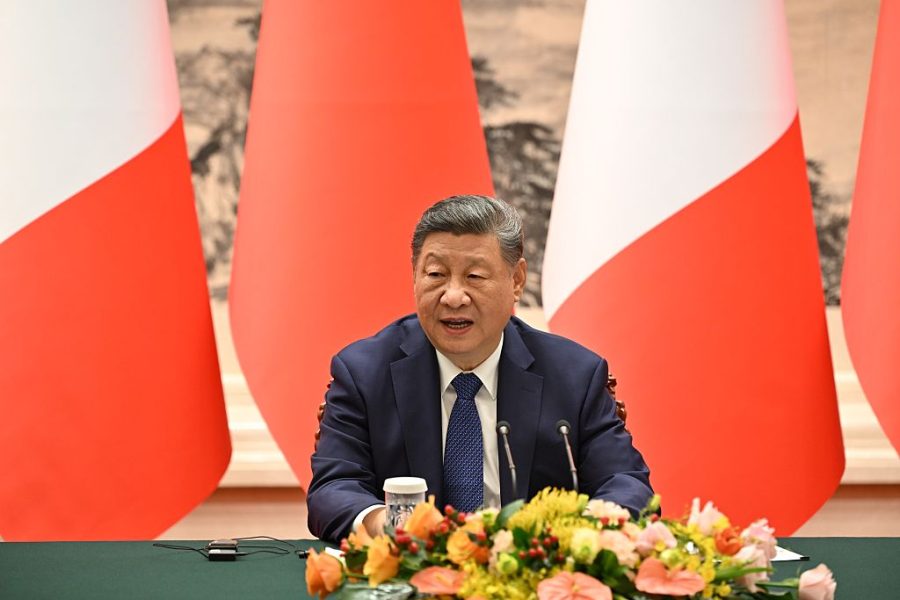
According to unconfirmed reports, General Zhang Youxia, China’s vice-chairman of the Central Military Commission (CMC), sent a company of troops (over a hundred or more) to the government’s Yingxi Hotel in western Beijing on January 18. Their mission was to arrest Xi Jinping. A few hours before, the Chinese president – alerted by an informant – set in motion countermeasures. Troops under the command of Cao Qi, head of Xi’s Central Guards Bureau, ambushed Zhang’s soldiers. In the ensuing gunfight at Yangxi Hotel, nine guards were reportedly killed along with dozens of Zhang Youxia’s soldiers.
Throughout China, military movements have been banned and troops and officers have been confined to barracks. This is the bloodiest of a blizzard of rumors that have swept the internet over the weekend. If true, this is the most dramatic military scandal since the death of Mao Zedong’s army chief Lin Biao in 1972.
Without explicitly mentioning a coup attempt, it was reported by state media that Zhang and another member of the CMC, Liu Zhenli, had been arrested for “serious violations of discipline and law.” The accuracy of the internet rumors would seem to be supported by the exceptional speed and severity of the announcement in the People’s Liberation Army (PLA) official newspaper, which confirmed Zhang’s arrest for “seriously betraying the trust placed in them by the party and the Central Military Commission.” The national defense department confirmed the purported crimes they were being investigated for. Conspiracy was not mentioned but corruption was; not a difficult charge to substantiate, as all senior Chinese military officers and politicians can be assumed to have their snouts in the trough – Xi and his family included.
Zhang, like Lin, began to fear that having helped Xi to gain power, he would himself be purged
What is the background to this dramatic story? Firstly, coups, assassinations and murder are not new to the Chinese Communist party. At the end of the Long March, the CCP’s year-long trek between 1934 and 1935 to escape the chasing Kuomintang (nationalist) forces of the Chinese Republic’s dictatorial leader Chiang Kai-shek, Mao Zedong led so-called “struggle sessions.” Senior party members were forced to confess ideological crimes; the consequences were usually imprisonment and execution. For Mao, the purpose was to centralize and strengthen the party as well as rid himself of “foreign dogmatism,” notably Moscow-trained Wang Ming, the leader of the “28 Bolsheviks.”
Similarly, the quiet period of the second Sino-Japanese war from 1942 to 1945 was enabled by Mao’s “standstill” pact with Japan that allowed Emperor Hirohito’s armies to focus their attention on defeating Chiang Kai-shek. During this time, Mao embarked on a purge known as the “Ya’nan rectification campaign.” Aimed at ideological purity around a non-Soviet nationalist agenda, the campaign embedded Mao Zedong’s thoughts and his personality cult in the CCP.
The closest comparison to Zhang’s failed coup, however, is the example of the People’s Liberation Army (PLA) chief, Lin Biao, who rose to military leadership after his vicious verbal attack on senior general Peng Dehui at the Lushan conference in 1959. Lin burnished his credentials as a loyal Mao acolyte by championing the publication of Mao’s Little Red Book, a breviary of his sayings which became a mandatory educational text. When Mao came under attack by his colleagues following his catastrophic collectivization program, the Great Leap Forward, which starved to death 30 to 50 million Chinese, he launched the cultural revolution to stay in power. Lin was called from his sickbed by Mao to put military muscle by his side at this critical juncture.
Somewhat similarly, before the 20th national congress in 2022, where he sought an unprecedented third term as CCP general secretary, Xi secured the support of Zhang – a fellow “princeling” and the PLA’s senior general. Xi even persuaded him to extend his service beyond the normal retirement age. Apart from his princeling status, 75-year-old Zhang commanded unique respect within the armed forces as one of the few army leaders with fighting experience in the Sino-Vietnamese war of 1979. As with Lin, this honeymoon relationship did not last.
In Lin’s case, a paranoid Mao began to suspect that his army chief’s at times unhinged sycophancy was cover for personal ambition. Lin, himself a paranoid figure who was both photophobic and aquaphobic, began to fear that Mao was out to purge him. Eventually Lin commandeered a plane for himself and his family and headed for Russia; they were killed when his Hawker Siddeley Trident aircraft ran out of fuel and crashed in Mongolia.
Zhang, like Lin, began to fear that having helped Xi to gain power, he would himself be purged. As his third term started, Xi – another paranoid would-be dictator who has attempted to build a Mao-like personality cult during his three terms of office – set about purging the army and replacing senior generals with his Fujian clique supporters. To consolidate his power within the military, Xi even installed his wife, Peng Liyuan, in a position to control promotions and appointments within the military.
It was against this background that Zhang reportedly launched a coup within the army when Xi fell ill at the third plenum of the 20th national congress in 2024. Zhang purged Xi’s high command supporters in the CMC; General He Weidong and Admiral Miao Hua were abruptly “disappeared” last year. Neither has yet reappeared.
At the same time, powerful figures among the Chinese “elders,” such as CCP general secretary Hu Jintao and former premier Wen Jiabao, alongside princelings such as retired general Liu Yuan (son of former Chinese president Liu Shaoqi) and Deng Xiaoping’s son, sought to rein in Xi’s power. By centralizing power around his own person, Xi stirred a backlash. Collective decision-making had become the norm under paramount leader Deng and the “eight immortals” who ruled China from 1982 to 1992. Subsequent general secretaries, including Jiang Zemin and Hu, ruled in this collegiate fashion, albeit controlling politburos riven by factional rivalries.
In addition, the anti-Xi factions were moved to act by obvious economic and foreign policy failures. An economic slowdown from almost double-digit growth in the 2010s to a real GDP growth estimated by some analysts to be as little as 2 to 3 percent today undermined Xi’s authority. Policies such as the Covid lockdown, the crushing of high-profile tech entrepreneurs, and the curtailment of civil liberties have combined with a property crash (now in its fifth year) to create a level of urban discontent not seen since the Tiananmen Square demonstrations of 1989. Youth unemployment has soared and middle-class savings, largely invested in property, have been wiped out. The economic cost of China’s single-child policy and the depopulation that it is now causing has added to the economic and social malaise. As a result, Xi is often dismissively referred to as the “village headman.”
The 80 percent fall in foreign direct investment into China since its peak in 2021 is also blamed on Xi’s overly aggressive “wolf warrior” foreign policy – a far cry from Deng’s “softly-softly” approach to establishing world power. As for Xi’s global “Belt and Road” policies, they have proved to be an unmitigated disaster. With the Chinese government now facing extreme budgetary constraints, “Belt and Road” is – to all intents and purposes – dead.
Diplomatically, Xi’s expansionary foreign policy has left China isolated. Contrary to the implications that the country’s 80th anniversary celebrations last year of the defeat of Japan in the second world war were a triumph, the paucity of the attendance of western and Asian leaders demonstrated how much of the world has come to see China as a pariah state.
So why was Xi not removed from power, as some China watchers – me included – had expected at the 4th plenum of the national congress last October? Hu’s indecisiveness is largely held responsible. His faction believed that the abrupt removal of Xi would undermine the authority of the CCP. Hu supposedly wanted an orderly transfer of power at the 21st national congress in 2027.
Allowing Xi to continue as a semi-defenestrated figure has, however, proved disastrous. Zhang Youxia is also blamed by some for indecision. The result has been that Xi was given the space to make a comeback. Zhang’s military coup, perhaps initiated after a reported assassination attempt against him on his return from Moscow in December, was too late.
Unless the anti-Xi factions and the PLA make a fightback – which, given Xi’s lack of popularity, is not an impossible scenario – the result is likely to be fatal to those political and military figures who conspired against the Chinese premier. From a global perspective, the consequences are likely to be deleterious. Zhang was strongly opposed to Xi’s plan to invade Taiwan. Xi may see war with Taiwan, particularly considering President Trump’s actions over Venezuela and Greenland, as a timely means to firmly re-establish his authority and unite the country. In the short term, the unprecedented purge of army generals since the start of Xi’s third term may require a period of reorganization. But, nevertheless, if Xi is back in full command of the PLA, the likelihood of an attack on Taiwan has substantially increased.





Comments