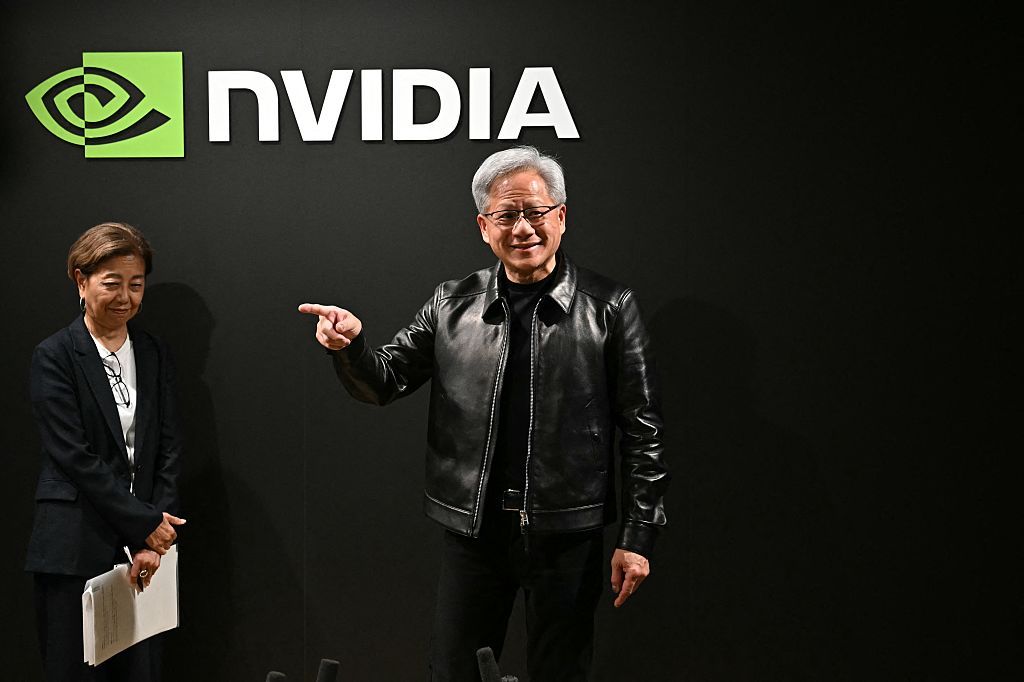
Last night revealed another set of outstanding results from Nvidia. Its quarterly revenues were up by 105 percent year-on-year, comfortably ahead of expectations. Its earnings per share doubled. Its gross margin remained at an impressive 75 percent. And its guidance for the third quarter was for another significant rise in revenues. The chip manufacturer’s founder Jensen Huang bullishly declared that the Artificial Intelligence industry had reached its “golden age” without risking ridicule.
Nvidia’s share had been flat-lining for much of the past few months, and rival chipmakers have been crashing, as investors started to doubt whether the massive investment in AI, and the data hubs that power it, could be sustained. And yet, once again, the company proved its critics wrong. It is still growing at an extraordinary rate. Wall Street had been waiting anxiously for the results. And yet, it need not have worried. On this evidence, America’s AI-fuelled investment boom is as strong as ever. Indeed, it may just be getting started.
Sure, there are challenges ahead, as they are for any company, especially one that has grown as quickly as Nvidia. It relies very heavily on a handful of hyper-scalers, the huge cloud-based providers of raw computing power spread across the globe, such as Amazon, Google, Microsoft and Meta. They account for up to 70 percent of Nvidia’s revenue, making it very reliant on a small group of customers, some of whom may also turn into competitors as they start developing their own chips, or looking for alternative suppliers. That could certainly turn into a weakness one day. Likewise, Nvidia’s circular financing deals, or “vendor financing” as it is more politely known, means that it sometimes provides the money to AI start-ups that then buy its chips. It is all very reminiscent of the telecoms and broadband boom of the late 1990s. That ended in a crash, and it is certainly possible that this one will as well.
Nvidia is now so embedded in the global economy that it is not likely to slow down any time soon
Nvidia is also heavily reliant on China and Taiwan. Export restrictions mean that China accounts for a falling percentage of Nvidia’s revenues, but it is critically dependent on China’s manufacturing expertise, as well as Taiwan’s, where the bulk of its chips are made. Nvidia is building plants in the United States, partly to keep the Made In America crowd in Trump’s White House happy, but it will take a long time to bring those on stream, or to match the quality and price on the other side of the Pacific. A war between China and Taiwan would be catastrophic for the company.

The trouble is, these challenges are all wildly exaggerated. The critics of the world’s biggest company need to dial down the pessimism. In many ways, Nvidia is starting to look a lot like Apple a decade or more ago. After the death of its founder Steve Jobs, there were plenty of people who were confident that it would quickly run out of steam. We were told that Android would overtake it in smartphones (which it did, but it didn’t matter), or that it couldn’t keep up the flow of new products (which it couldn’t, but it didn’t matter), or that it was too reliant on China and Taiwan (which it was, but it didn’t matter). If you had decided that Apple had peaked in 2013 or 2014 you would have missed out on one of the most extraordinary growth stories in industrial history. Since Tim Cook took over, its market value has risen more than ten-fold, its revenues have grown four-fold, and its profits close on four-fold. It was already very big, of course, but there was a huge amount of growth still to come.
It might be an exaggeration to argue that Nvidia can repeat Apple’s performance. If it did, its market capitalization would reach an extraordinary $50 trillion by the end of the 2030s, and that seems like a stretch. The important point, however, is this: Nvidia is now so embedded in the global economy that it is not likely to slow down any time soon. It can expand into new markets. For example, it is already reported to be in talks to buy the AI platform Hugging Face for $12 billion-plus. With similar deals, it may well be able to diversify its revenues away from its reliance on chips, in much the same way Apple has with its app store and its television unit. Governments around the world are starting to put serious cash into building their own “sovereign” AI infrastructure, and if they do, they will need lots and lots of Nvidia chips to power it all. And perhaps most of all, AI is merging with robotics to create a new range of industrial and indeed domestic machines that can carry out thousands of simple tasks. Again, that will mean lots more top-of-range chips will be needed to run them all. The list goes on and on.
Sure, Nvidia may run into trouble one day, and the AI boom will almost certainly deflate at some point. But that could still be a long way off. As each quarterly earnings statement rolls around, its critics will be waiting to pounce – but the chip maker will almost certainly keep on proving them wrong.






Comments