
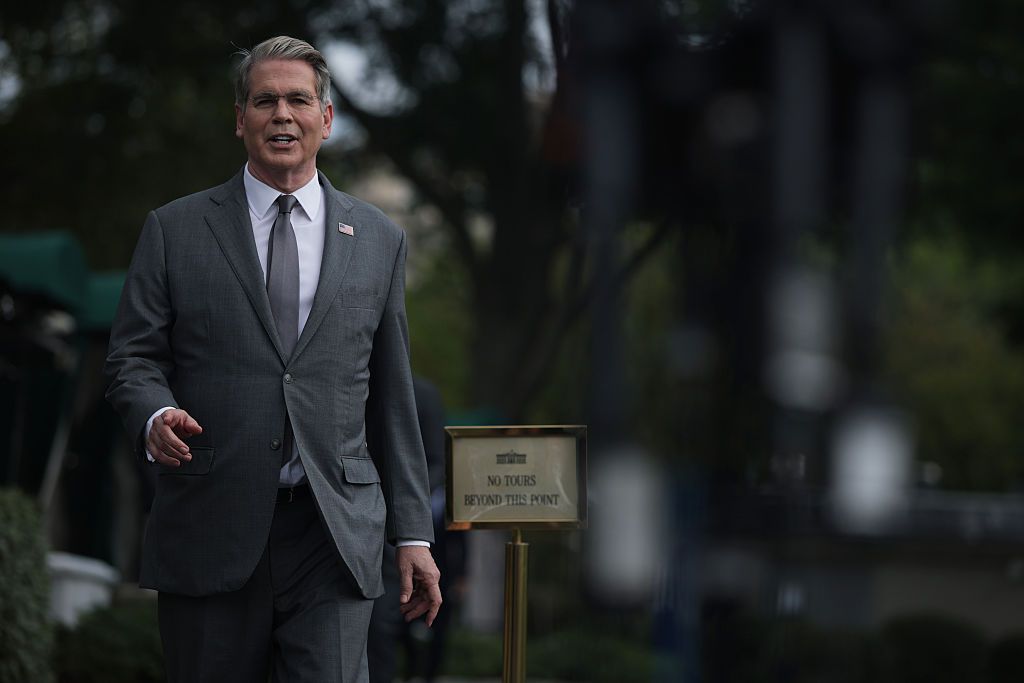
At a much-anticipated press conference Monday, Secretary of the Treasury Scott Bessent minced no words. The United States, he said, is now imposing unprecedented sanctions not only on Iran but on every country, corporation, bank, and shipping company that does business with that regime.
Thanks to these US policies, Bessent said, all Iran’s facilitators must now choose between economic ties with the US and those with the Islamic Republic of Iran. Do business with Iran and you will be severed from the US market and the entire dollar-based trading system, the centerpoint of the world economy.
That policy can be summed up in two words: “economic asphyxiation.” Bessent actually used those words.
Don’t expect to hide your transactions, either – a longtime tactic of Tehran. The Treasury Department has developed a comprehensive map of every entity that does business with Iran. It can map current transactions. “Stop now,” Bessent declared, or expect harsh consequences.
Since Beijing is Iran’s biggest enabler, reporters naturally asked if those sanctions – and consequences – applied to Chinese banks and companies. Bessent effectively said “yes” without directly mentioning China or any other country. His tough language, however, made clear that everyone was included and none were beyond the reach of US sanctions.
How quickly will the sanctions be implemented? Right away, although Bessent declined to specify a timeline. A reasonable assumption is that countries and companies might have a week or two, at most, to unwind their connections and comply with US demands before the hammer falls.
The Treasury could act even sooner to make an example of at least one or two high-profile violators. The aim, to paraphrase Dr. Samuel Johnson, is that “to clear a man’s thoughts, there’s nothing like a hanging in the morning.” Expect a hanging or two to clarify everyone’s thoughts. That prospect is good advice for Chinese banks, global shipping registries, and Pakistan, Afghanistan and the countries of Central Asia, which have provided trade routes from Iran to China and Russia.
America’s sanctions are not limited to the Treasury Department. They are an “all government” effort. We already know the US navy has blocked shipments from Iranian ports and is secretly escorting ships through the Strait of Hormuz. Bessent added that Trump was currently phoning world leaders to make sure they understood America’s tough, new sanctions policy and the onerous price they would pay if they tried to evade it.
The threat Secretary Bessent leveled is completely credible. But will it work? That seemingly simple question is really three-in-one.
The first question is whether “working” means toppling the regime or forcing them back to the negotiating table. Bessent didn’t say. It is particularly significant that he did not mention the old aim of reaching a diplomatic agreement. Reports are that Trump now believes the IRGC, which controls the government, doesn’t want a deal and, if it made one, wouldn’t adhere to the terms. So why bother?
The second question is whether the sanctions are likely to be enforced effectively – or can Iran slip through some major gaps? The short answer is that there will be damn few gaps, and Iran’s partners shouldn’t count on them. The Treasury has all the tools it needs to isolate Iran economically.
The third question is what effect the sanctions are likely to have. That is the biggest question of all, and the hardest to answer.
The basic issue is not whether the Iranian economy is sinking into the abyss – it certainly is – but whether the regime will collapse along with the economy.
The clearest measures of the economy’s downfall are Tehran’s inability to export, its now-worthless currency and the hyperinflation pummeling ordinary citizens. The Iranian Rial, which traded at about 72 to $1 when the Islamic regime assumed power, now trades at over 2 million to the dollar. Hyperinflation is paired with severe shortages of basic goods. Ordinary Iranians can no longer buy the food and fuel they need. Even more important for the regime’s survival, it cannot pay its armed forces, paramilitary and police.
Even so, economic devastation does not lead inexorably to political collapse. After all, Cuba’s communist regime has survived for over six decades. North Korea is even poorer and has survived even longer.
The pressure on the Islamic regime is unprecedented – and it is getting worse. What impact will that pressure have on the regime’s survival? The most immediate impact is the difficulty the IRGC faces in finding foreign revenues (good luck with that) and in paying its forces of repression (they can’t).
The regime survived for decades thanks to a continuing flow of export earnings, sources for vital imports, shipping companies willing to do business and foreign banks eager to handle trade. With all those gone, regime will have to adapt quickly. It is far from clear it can do so.
It will have no chance of adapting if, as seems likely, Bessent and Trump manage to coerce third parties involved in Iranian transactions.
That leaves only the big question of whether a seriously wounded regime can be brought down without “kinetic action,” meaning violent riots and a hail of bullets from rebel groups within the country, resistance from ordinary citizens and a regime unable to suppress its domestic opponents. The bad news is that the regime is decentralized and resilient. The good news is that we are already seeing significant splits within the regime.
What we don’t know yet is whether the CIA can manage to smuggle arms into insurgent groups, whether the IRGC has the resources to continue paying the forces of repression and whether the troops will continue to murder fellow Iranians on the street, as they did earlier this year by the tens of thousands. We can be certain, though, that the regime’s most devoted adherents will fight to the death. They have no alternative. They know they will be killed by an enraged population if the regime falls.
This fight for the regime’s survival is the real “end game” Secretary Bessent alluded to, without saying so directly. The fight will culminate over the next few weeks. The future of Iran, the Persian Gulf, Lebanon and Israel all hang in the balance.





Comments