

Napoleon is supposed to have defined strategy as “on s’engage, et puis on voit,” loosely translated as “get stuck in and then see what happens.” Donald Trump is not normally deemed Napoleonic, yet in his approach to strategy he appears to have taken the great general’s precept to heart, launching initiatives without much forethought regarding consequences or further steps in the light of unexpected developments. When the consequences turn out to be unwelcome, he swiftly readjusts, discarding the initial scheme in favor of an alternative course of action, as often as not headlong retreat. Thus the swingeing Liberation Day tariff regime unveiled with much fanfare in April 2025 was swiftly suspended in the face of crashing markets. His war against the Houthis, who proved resilient in the face of the US Navy’s bombs and missiles, was terminated with a declaration of victory and a speedy withdrawal. Draconian tariffs inflicted on the Chinese were promptly cast aside once Beijing showed who had the whip hand by cutting off supplies of critical minerals.
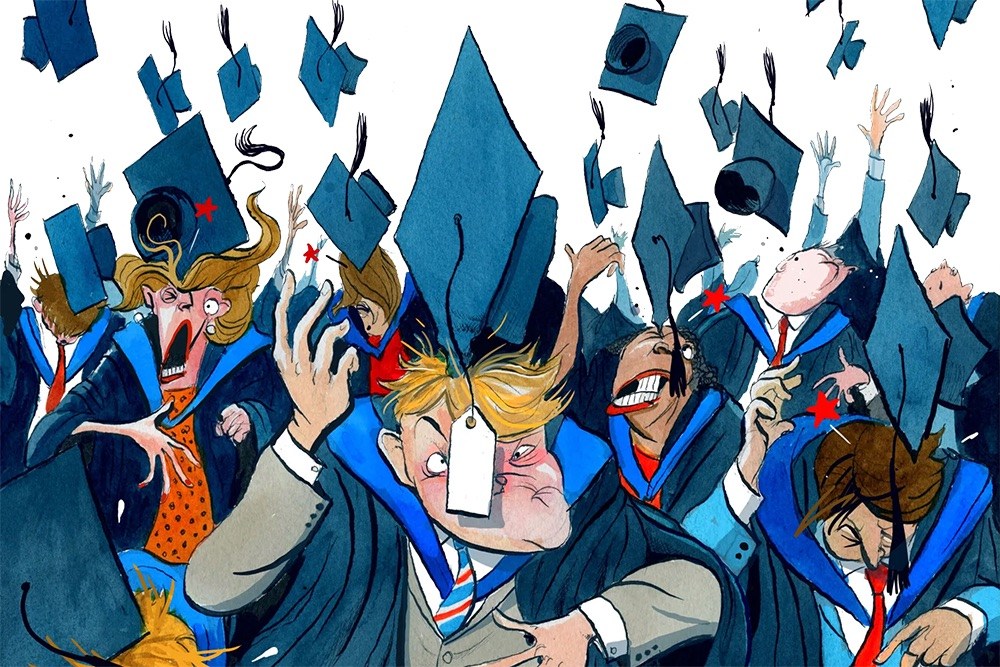
To date, this Napoleonic approach has proved remarkably successful. Changed courses and abandoned policies have done little to loosen his grip on the Republican party, while the attack on Venezuela and the kidnapping of its president – an obviously high risk initiative – passed off with a casualty-free victory.
Trump has announced that his Iranian war could last four or five weeks, maybe less, maybe more, “or whatever it takes,” but with no explanation of what “it” might be, leaving plenty of room for a definition adjusted to match current realities. There has been much unkind commentary about the grab-bag of justifications proffered for the war, ranging from the threat of a chimerical Iranian nuke, the Mullahs’ alleged intercontinental ballistic missile program, or purported Iranian interference in the 2024 election or a desire to relieve the Iranian people from the yoke of clerical oppression.
It is not clear whether Trump himself believes any of these or even cares if they are true. The point is to provoke a reaction, as with the fictitious statistics he likes to reel off in his rally speeches. Pronouncements are gauged by the effects they produce on the audience. Asked by a visitor whether he really intended to run for a third term in 2028, a possibility that evokes furious denunciation from Democrats, he replied “of course not!” Why then, asked the visitor, did he keep bringing it up? “It gets them so excited!” chortled the chief executive happily.
Since the truth is unimportant, facts can be discarded at will. Big lies (“no more foreign wars”!) are more useful than small ones. Comparisons between Trump and Adolf Hitler are overdone, but should the 47th President have ever taken down the White House copy of Mein Kampf for some bedtime reading, he may well have underlined this passage:
In the big lie there is always a certain force of credibility, because the broad masses of a nation are always more easily corrupted in the deeper strata of their emotional nature than consciously or voluntarily, and thus in the primitive simplicity of their minds they more readily fall victims to the big lie than to the small lie, since they themselves often tell small lies in little matters but would be ashamed to resort to large scale falsehoods. It would never come into their heads to fabricate colossal untruths, and they would not believe that others could have the impudence to distort the truth so infamously.
A succinct explanation of why the MAGA faithful so blithely ignore Trump’s serial falsehoods.
But the war Trump has now launched in the Middle East looks likely to have consequences impervious to mendacity, however gross. The anti-war Republican right is already furious at the flouting of erstwhile pledges to avoid any and all such adventures. The current war has already yielded some unpleasant surprises for the Oval Office: the ferocity of Iranian retaliation against America’s Gulf allies and its willingness to cut the jugular of global oil flows by closing the Straits of Hormuz, as well as the determination of the regime to continue functioning and fighting despite the massacre of its upper ranks. (Trump has told a reporter that the attack that killed Ayatollah Khamenei “was so successful” it also killed all of the officials he had planned to install as rulers of a postwar Iran, indicating that Trump actually believed his bombers would deliver as neat and painless a resolution as the kidnap team had in Venezuela.)
Absent the unlikely eventuality of the Iranians offering something that can be dressed up as a Trumpian victory, it seems apparent that events will continue to spiral out of control, inexorably heading toward Waterloo.




Comments