
If you read the New York Times or watch the foreign policy establishment’s “best and brightest,” you will be told, with imperious certainty, that America is losing the war in Iran and was stupid to begin it. The conspiratorial wing on both the right and left add that it is all the Jews’ fault, although they usually remember to mutter they mean “Israel” instead of all Jews, a gossamer cloak over what they really mean.
If, on the other hand, you watch Fox News or read blogs by conservatives or military analysts, you will be told with equal certainty that America and its ally, Israel, are actually winning – and winning decisively.
So, who is right?
The answer, of course, is Carl von Clausewitz. What that old Prussian says goes to the heart of the issue.
Writing two centuries ago, in the bitter aftermath of the Napoleonic wars, Clausewitz made the essential point that “war is the continuation of politics by other means.”
What does that aphorism mean for today’s Middle Eastern wars, fought with technology and spycraft beyond Clausewitz’s wildest imagining? It means we have to look beyond all the modern tools – the planes, drones, precision bombs, satellites, and AI technology – to assess the war-fighting in terms of the combatants’ political goals. What do they want? What does “victory” mean for each of them? Are they achieving those goals or failing? The answers depend, obviously, on the battlefield assessment – but they go well beyond it.
The easiest goals to specify are those of Iran. Saying “Iran” is actually a misnomer since the goals are not those of the nation, but those of its ruling regime, a toxic mix of Islamist clerics and Revolutionary Guard members. Their irreducible goal, like that of all regimes, is to sustain itself in power. That’s getting harder for them these days.
For the Islamic Republic of Iran, self preservation means overcoming formidable challenges at home and abroad. They must preserve the regime’s leadership structure, under continuous lethal attack,, and keep paying the essential instruments of repression, the Revolutionary Guard and Basij militia who have been killing off (and deterring) protesters and other rivals to the regime’s power.
At the same time, the regime must defend itself against prolonged bombing by United States and Israel, as well as clandestine attacks, some of them homegrown, some aided by the regime’s foreign foes.
To make matters worse, the United States has recently stepped up its economic warfare against the regime, making it increasingly difficult for them to pay their soldiers and thugs (local and imported) and meet the population’s minimum needs for gas, food, and water.
The regime’s secondary goal, which it has pursued at great expense since 1979, is to assert itself as the region’s dominant power, militarily and ideologically. That has meant building, guiding and arming an extensive network of terror groups to surround (and preoccupy) Israel and project the regime’s power across the region.
How is that effort going these days? Not well. Not well at all.
The regime’s regional power network has been decimated in Syria, Iraq, Lebanon, Yemen and Gaza. Efforts to coerce the smaller states of the Persian Gulf have backfired, pushing them into alliance with the United States and Israel. The key question now is whether that tactical alliance between Israel and the Gulf states, meant to confront an immediate threat, can be transformed into a longer-term strategic partnership.
More wreckage is piling up around the regime’s basic military strategy, which was to build a massive network of middle- and long-range missiles and enrich uranium for nuclear bombs. That wreckage, vast as it is, is still not total because the US has not located and removed the enriched uranium. The right to do so is a major issue in the current negotiations, being mediated by Pakistan.
Those talks have excluded one major protagonist in the war: Israel. That’s hardly surprising. Pakistan has said Israel should be wiped off the map; the Islamic Republic won’t even say the name of the Jewish state.
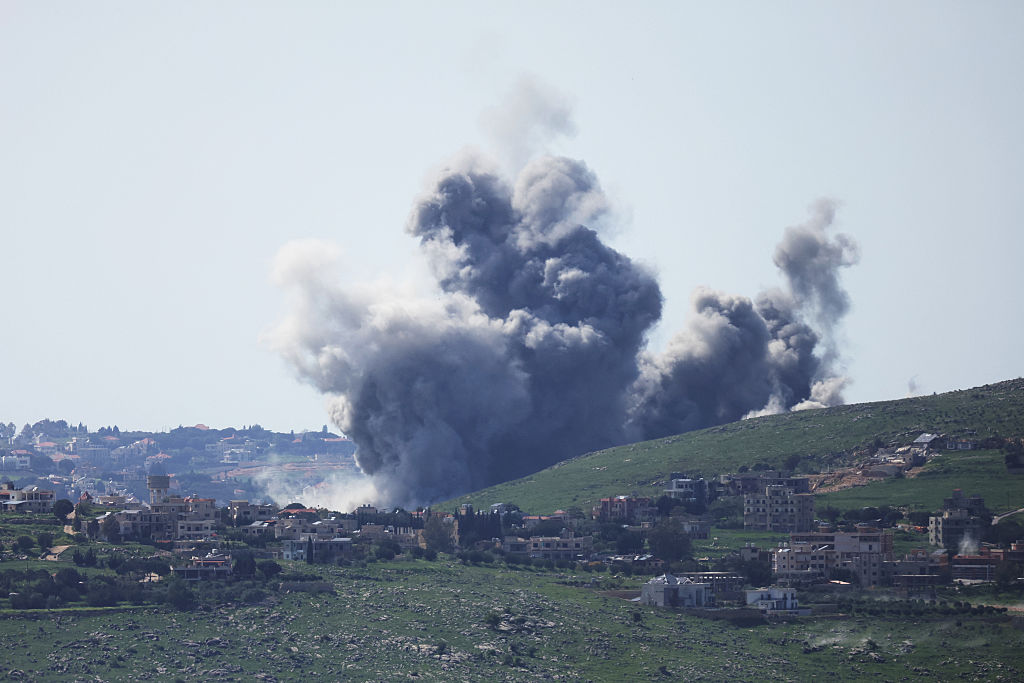
Even so, Israel has already achieved many of its core goals, though not all. It has suppressed, in deadly methodical sequence, the lethal groups Iran established to surround Israel and terrorize its citizens. The most pressing battle now is to push Hezbollah out of southern Lebanon, where it has used Iranian rockets to terrorize, kill and displace civilians living near Israel’s northern border.
The government of Lebanon is too weak to secure that region itself. The government in Beirut lacks the essential requisite of sovereignty, the monopoly of legitimate force within its borders. So, Israel is doing the job. Beirut’s tacit acceptance of Israel Defense Forces within its territory indicate it is more threatened by Hezbollah than by the neighboring Jewish state.
What is the IDF doing in Lebanon? Pushing Hezbollah’s terror army off of the high ground just beyond Israel’s border and moving them north, beyond the Litani River. The ceasefire announced Thursday by Israel and Lebanon, mediated by the Trump administration, follows both the IDF’s military success and its diplomatic achievement in holding direct talks with its longtime foe, the government in Beirut.
In fact, Israel’s military success across the region since it was attacked on October 7, 2023, has made clear it is now the dominant power in the Middle East. Its Mossad intelligence unit is unrivaled. Its Air Force is the only one in the world sophisticated enough to operate seamlessly alongside the United States.
Israel’s military success, its close coordination with the US military in two campaigns against Iran, and its technologically advanced economy have given it command of the region and made it an attractive partner in both economic and security affairs. That attractiveness is amplified by the threat Iran poses to governments across the Middle East. That threat, and Israel’s strength, are the basis for the Abraham Accords, which could be extended to include Iran if there is regime change there.
Ah, regime change. That is the question. Americans are reluctant even to mention it after a series of dismal experiences in Iraq, Libya and Afghanistan. Normally, the Israelis wouldn’t mention it either. Their foreign policy is more pragmatic than America’s idealism, and they are well aware of their limited ability to effect fundamental change in Muslim states.
What is different this time is that Israelis simply don’t believe it is possible to coexist peacefully with the current Iranian regime, ruled as it is by the religious zealots. They doubt Iran will make any serious bargain with Washington and, if it does, it will cheat.
That somber view is shared across the Israeli political spectrum. They watched what the mullahs and IRGC did after their defeat in the 12-Day War. They immediately began rebuilding their stock of missiles and their capacity to enrich uranium, well beyond any level needed for peaceful use. In short, the regime remained wholly committed to its decades-old millenarian strategy, which poses an existential threat to the Jewish state.
The Trump administration certainly sees the current Iranian regime as a danger to American interests throughout the region. But they have not consistently deemed it an existential threat that requires regime change. In fact, President Trump has publically called Iran’s current leaders a welcome “change of regime” from that of the late Ayatollah Ali Khamenei.
That’s wishful thinking.
What has really happened is that the IRGC has supplanted rule by a single cleric, a process that was underway during Ayatollah Khamenei’s declining years. The negotiations in Pakistan revealed something else. There are deep internal splits within the regime’s current leadership about the best way to sustain itself in power.
The Trump administration has hinted It was close to an agreement with one faction of that leadership regarding Iran’s nuclear stockpile and enrichment capacity. When the hardline faction in Tehran learned of that potential compromise, it called off the talks and brought the delegation home. Since then, mediators have tried to restart the talks, but the essential question is whether the Iranian regime is willing to pause its current program to enrich uranium, to do so for an extended period and to permit intrusive, on-demand inspections by the United States to ensure compliance. Anything less is a tissue of lies.
What seems more likely is that the IRGC will either refuse to suspend its nuclear program or pretend it will do while it secretly working to rebuild its nuclear capacity, hoping to cheat on a naive partner. Whether to offer that bargain is the political question facing Iran. Whether to take the deal, if Tehran floats it, is the question facing President Trump. Those political questions – the ones posed by Clausewitz long ago – loom over any negotiations. They are life-and-death questions for the beleaguered people of Iran.





Comments