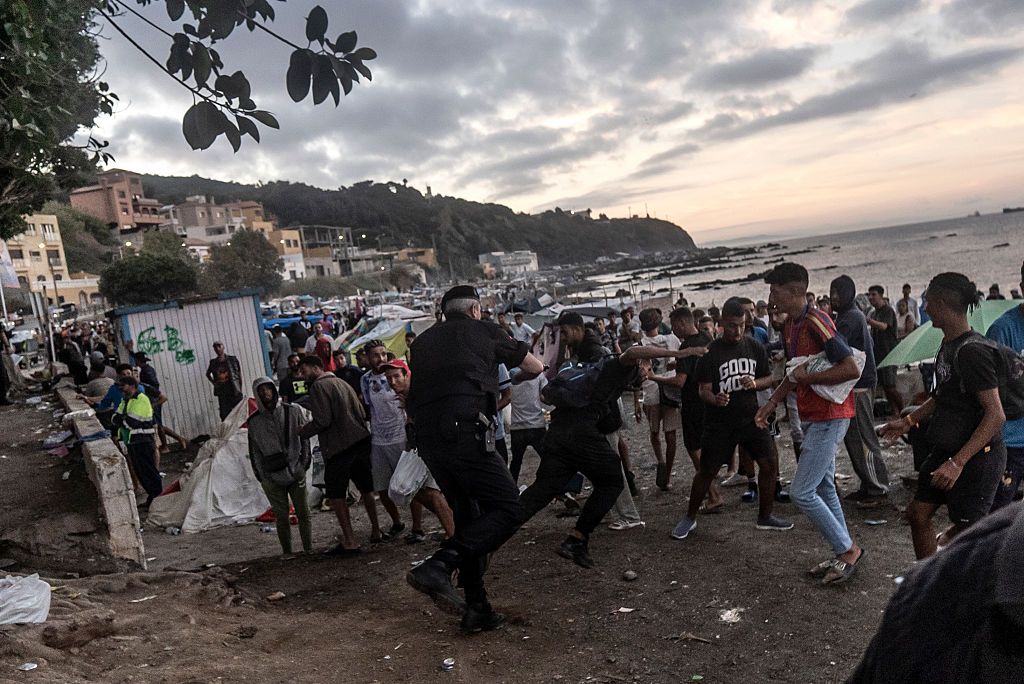
It’s now nearly nine weeks since tens of thousands of migrants poured across the Moroccan frontier into Ceuta. Most quickly returned to Morocco. But estimates of how many are still in Spain’s tiny North African exclave, which has a population of just 83,000, have varied alarmingly. At one point Madrid said that “only” about 5,000 remained. Government sources now accept that around 20,000 were still in Ceuta after 30 July; last week Ángel Víctor Torres, the minister in charge of the crisis, put the current figure at around 18,000.
On Saturday, police arrested two Moroccan men following the alleged rape of a 17-year-old girl at the Trampolín beach settlement
Although Ceuta occupies an area of just seven square miles, the Spanish state has somehow proved unable to establish even approximately how many migrants are still there. Firemen only recently discovered a previously unknown settlement used by dozens of migrants in old military tunnels. On Saturday police identified more than a hundred young migrants sleeping rough around the abandoned Guano industrial site and among rocks on the nearby shoreline. They are only a fraction of the problem: police and child-protection officials estimate that at least 600 unaccompanied children are still sleeping rough or hiding in Ceuta’s hills and neighborhoods.
For weeks Pedro Sánchez defended his government’s decision to absorb those who had poured into the country as “the most humanitarian decision”. But two months after the mass influx his government has concluded that returns need to be accelerated. It now hopes to approve emergency legislation allowing Spain to return some asylum applicants before their cases have been finally decided.
Morocco has long insisted that it is willing to take its nationals back and blames Spain for the delays while migrants are processed and those seeking international protection go through the asylum system. The proposed decree would remove some of the legal and administrative obstacles which can otherwise hold up returns for months.

Meanwhile, Madrid says nearly 8,000 migrants have returned voluntarily to Morocco since 10 August and claims that between 150 and 200 are now leaving each day. Police on the ground dispute that figure: their union says officers monitoring the border have counted an average of only about 60 voluntary returns a day over the past three weeks.
Many of those returning have spent weeks sleeping in shelters made from plastic sheets and reeds, dependent on charities and volunteers for food. The first sustained autumn rain has now soaked both the shelters and their possessions; some migrants say the worsening conditions are making them consider going home.
But Madrid is racing to move those still sleeping rough into reception centers. With a bed, regular meals and washing facilities in warm, dry accommodation, remaining in Ceuta suddenly becomes much more attractive.
Even moving the migrants around Ceuta has proved difficult. On Sunday hundreds of police were deployed to clear settlements around Benítez beach and transfer their occupants to temporary accommodation. Many of those transferred promptly fled into the hills and rocks, reportedly because they feared being returned to Morocco.
Sánchez has said that he hopes to have the situation “stabilized” by the end of the year. Addressing the United Nations last week, he praised the people of Ceuta for confronting the crisis “without renouncing decency, maintaining legality and respecting human rights.”
But to many Ceutís, Sánchez’s “stabilized” sounds suspiciously like “normalized.” They don’t want the migrants who are sleeping rough simply to be moved into reception centers and wandering around the town by day. They want them moved out of Ceuta.
That’s why some residents have been trying to prevent volunteers distributing food to migrants. Make life comfortable, they have argued, and migrants will stay; make it uncomfortable and they might go home.
Hostility towards those helping migrants has now become so intense that some aid organizations have removed their logos from vehicles and staff conceal their identification when they are not working. NGO workers report being insulted in the streets. One says people tell them: “The migrants are staying because of you.”
On Saturday, police arrested two Moroccan men following the alleged rape of a 17-year-old girl at the Trampolín beach settlement. Officers found the girl semi-conscious and injured; she subsequently lost consciousness and had to be resuscitated before being taken to hospital.
Ceutís complain of migrants sleeping, drinking, fighting, defecating and urinating in their gardens and on their steps. Residents in one neighborhood next to migrant accommodation have had their streets enclosed by high protective fencing.
It remains to be seen whether Sánchez’s minority government can get its emergency legislation approved and accelerate the return of migrants from Ceuta. But two months after the crisis began, Madrid has at least discovered some of the urgency that Ceutís have felt since the start.






Comments