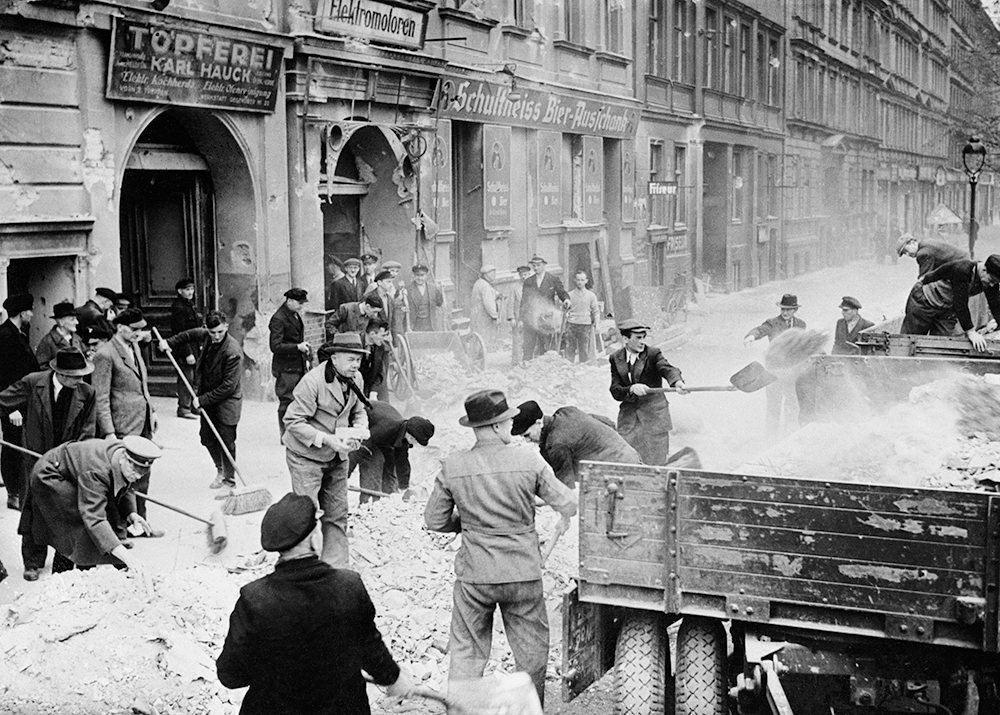
Can you be a true, thoroughgoing patriot and still want your country to lose in a war? It’s a dilemma that faced countless thoughtful people in the past century who lived under totalitarian regimes, and I know is torturing many Russians today. It’s the stark question at the centre of Ian Buruma’s subtly nuanced and beautifully written book about the lives of Berliners in the second world war as their city was being destroyed by a combination of aerial bombardment and the manic cruelty of their own leaders.
Buruma follows disparate groups of Germans – some ardent Nazis, a very few silent dissidents, a small number of surviving Jews and the majority of people who were neither cynics nor bullies nor ideological fanatics but simply conformed, kept their heads down and prayed they could feed themselves and stay safe.
His survivors also include his father Leo, who lived in Berlin for three years from 1942. As a law student in the Netherlands under German occupation, he was drafted to work in a factory to cover for an acute labour shortage in Germany because all the young men had been conscripted into the armed forces. By accident, in 2020, Buruma found a tin box full of Leo’s wartime letters back home, which inspired him to write this book about the last years of the city under the Third Reich, when ‘a common way for Berliners to say goodbye was no longer Auf Wiedersehen, or Heil Hitler, but Bleiben Sie übrig: Stay alive.’
By 1939, virtually all vocal opponents of the Nazis had been killed, jailed or had exiled themselves abroad, so most of the population had been cowed into submission. The left had been wiped out; when the war started and there was a clear external threat from abroad, all hope – slim though it had been – of overthrowing the Nazis or organising a coup against Hitler entirely disappeared. There was nothing that ‘respectable conservatives could do’ except try to live as decent a life as possible, argues Buruma. ‘You could not be inside a criminal state without being corrupted, and open resistance meant death and so… they created their own private social counterworld.’
Well-known journalists such as Ruth Andreas-Friedrich and Ursula von Kordoff, socialites such as Christabel Bielenberg and Missie Vassiltchikov, kept secret, highly discreet diaries, written in a kind of code that named no names in case they were found by the Gestapo. These were the sort of people who felt shame and guilt in the early days of the war with the news of victories – and a mixture of shame and hope when the tide turned.
Later, after the war, the diaries were re-worked and turned into books from which Buruma has drawn heavily but added new colour and detail. He eschews cliché, so we encounter Germans who lived at the centre of the Nazi state – some at the apex of the regime – who managed to remain decent, even when decency was dangerous. A passage that surprised me, as I had never read this before, described the week in 1941 when Berlin’s Jews were forced to wear the Yellow Star in public and large numbers of Germans bowed their heads as a sign of sympathy when they passed them.
A common way for Berliners to say goodbye became simply: ‘Stay alive’
The bombardment of Berlin, and then the final bloody siege of the city by the Red Army, brilliantly described here, were on an altogether different scale to the sufferings of London. Vast swaths were entirely flattened; for the last year and a half of the war Berliners were living underground much of the time.
There was a Teutonic version of the ‘stiff-upper-lip’ Blitz spirit. But one big difference between our experience and the Germans’ was obvious. Berliners had two enemies: Allied armour and their own deranged leadership’s death wish and determination to fight to the last German. It was hard to know which was the more dangerous.
And then there was guilt. How much did most Berliners know about the crimes committed in their name until the last days of the war? They noticed when their neighbours disappeared from one day to the next, never to return; and they were aware that around 100 prisons had been built in the city since the Nazis had seized power, including the Sachsenhausen concentration camp in a Berlin suburb. The novelist Erich Kästner witnessed his own books being burned in the first year after Hitler took power but remained in Germany anyway. In his diary midway through the war, he wrote that it was wrong to say sympathetically: ‘“Forgive them for they know not what they do.” That they don’t know, that they still do not know, is unforgivable. One feels ashamed for all of us.’





Comments