
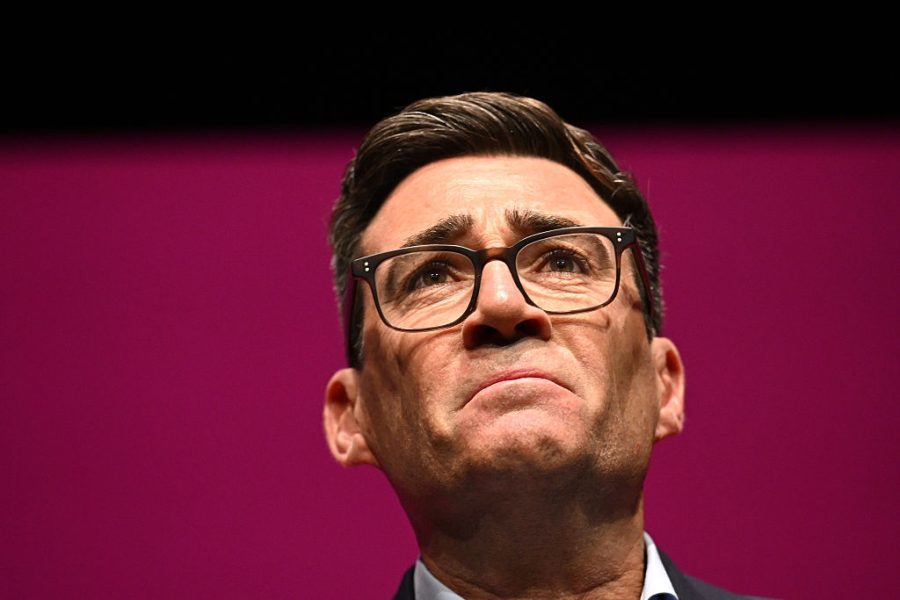
Normally when politicians really cry, it’s because they’re on their way out of a big job, rather than just getting settled. Today, Andy Burnham cried on stage at the Labour conference as he explained what he wanted to do and why he wanted to do it. He was talking about his father Roy, who died earlier this month. He told the conference hall that on the day of his father’s death, John Swinney had said that Burnham would be the last prime minister of the United Kingdom. He suspected that the First Minister of Scotland hadn’t yet heard the news of his bereavement, he added, but ‘I want you to know how it made me feel – utterly determined to prove him wrong’.
Crying doesn’t always help a politician (think of Matt Hancock wiping away a tear none of us could see live on TV when talking about the Covid vaccine rollout). But this show of emotion worked for Burnham because it was clearly genuine. It actually held him up from being able to speak for about ten seconds, with the conference hall erupting into a standing ovation to allow him to gather himself.
Burnham has always been an openly emotional politician, so it was entirely in keeping. And it wasn’t so much a loss of control as it was a sign of fire in his belly about what he wanted to achieve as Prime Minister. But the levels of emotion varied throughout the speech, giving us clues as to what Burnham is genuinely personally committed to, and what he feels he has to pay lip service to in order to satisfy the electorate or niche interests of his party.
Burnham has always been an openly emotional politician, so it was entirely in keeping
There were a lot of big things in that speech that Burnham clearly does want to achieve, chief among them the National Care Service – which he accepts could be the thing that also does for him as a PM. ‘I won’t pretend some of this won’t be difficult,’ he said, after a passage where he blasted politicians – himself included – for their failure to reform social care over the decades. ‘I accept I may pay a political price. But someone has to go through the pain barrier and rip the plaster off.’ You could tell from the emotion he put into this section that he really is ready to go through the pain barrier – even if he doesn’t fully know what he’s going to be pushing for. The details of that will come when Louise Casey reports back.
He also had a lot of anger and emotion about the state of housing and utilities, promising to increase council house building and to give councils the powers to compulsorily purchase privately rented homes that fall below decent standards of living. He told the conference – to rapturous applause – that Angela Eagle will present a ‘strengthened water bill to parliament’ and that ‘the centrepiece of that bill will be this: the repeal of Margaret Thatcher’s ideological ban on the public ownership of water’.

As with many things that Burnham announces at full emotional throttle, the detail here will be quite different to the implication, and even the wording of his speech accepted that. He was not announcing that the government would be nationalising water, merely that it would be repealing a ban on public ownership.
There were other areas where he clearly isn’t as bothered. Even though he has long toyed with electoral reform, the fact that Burnham announced a national commission on the matter shows that he has no desire to get on with moving towards proportional representation. He knows better than anyone how pointless national commissions are: they’ve been used repeatedly over the years to delay social care reform. He danced quite quickly through a passage on young people who are out of work, though he did make a moral argument for ‘a different approach to welfare’. He presumably did not want to provoke a negative emotional reaction from the conference hall to any suggestion that there might have to be tough love alongside the promises to ‘invest in our young people’.
And this is the problem with emotion: sometimes prime ministers have to power through a tidal wave of it from their own parties when they try to do what is right but what is initially difficult and unpopular. Burnham knows that he’s facing one hell of a row on benefits, but his slogan for this speech was ‘all together now’. He wanted this conference to be an upbeat one that sent the party back to Westminster and their constituencies feeling inspired about change, rather than downbeat about the difficulties ahead.
Much of what Burnham was proposing today was admirably ambitious, almost to the point of seeming impossible to most political imaginations. He will need more than fire in his belly to be the prime minister who pays a political price for wanting to reform social care while actually managing to achieve that reform (just ask Theresa May how it went for her attempt). He will need a focus on implementation that no government in the past decade has really demonstrated. And an ability focus on that despite other events and challenges that previous prime ministers have been able to use as an excuse for not using what power they did have to address the difficult questions facing the country.
If it’s emotion that’s going to keep Burnham focused on answering those difficult questions, then jolly good. But there will come times when the feelings are more of despair at the prospect of anything really changing than the current hope he’s given his party.




Comments