
Daqing, China
You may have seen clips of the recent Chinese robot Olympics, where a bipedal, humanoid robot beat Usain Bolt’s 100-meter sprint record by almost a second. Last month, Beijing hosted competitions in soccer, weightlifting, tennis and gymnastics, too. There have also been boxing matches between robots, which occasionally punched each other’s heads off. So far, robots can only really excel at one task at a time, so the prospect of a very fast, very effective fistfighter is some way off.
Still, the Chinese government is deeply concerned about employment and has been far stricter at regulating AI than the US. That’s partly because of the differing economies of the two countries. The USA’s comparative advantage is capital. AI in the US tends to help capital markets, propelling huge valuations driven by scarcity and profit margins. Creative destruction is all part of the process. China’s government, unlike the US government, cannot print dollars. But what China has is people, and the power structure in China cherishes them just as much as the US government cherishes its stock market.
So while white-collar workers in the West worry about the impact of AI on their jobs, China is instead pursuing the embodied, robotic AI of the future. How can Beijing promote robotics while also protecting workers? The answer is that the number of Chinese workers is already in decline. Even though the one-child policy has been abandoned, the fertility rate is still well below replacement level. China’s population is projected to fall from 1.41 billion today to roughly 800 million in 2100. By developing robotics, China can mitigate that huge population decline without threatening its economy or the jobs of existing workers.
Chinese courts have been decisive that automation cannot replace white-collar workers
Beijing knows that it needs to convince the population that this is all for the best. Hence the robotics competition, in which thousands of Chinese spectators cheered on machines in a Beijing stadium. Robots are already a growing part of everyday life here. On business trips, I have the habit of ordering coffee to my room through an app called Meituan. It’s incredibly cheap, and still delivered by a human motorcycle courier. But the front desk will often pass my coffee to a robot, who will take the elevator up to my floor and ring the doorbell. The whole process takes about ten minutes. On a recent visit to my wife’s parents in northeast China, my three-year-old son was fascinated by the robotic vacuum cleaner, which had a speech model inside so you could ask it questions. He had lost a toy swan and kept asking the vacuum cleaner where it was. The vacuum cleaner responded in eloquent Mandarin that the toy swan sounded like a lot of fun. So far, so useless. But AI and robotic adoption has already begun in earnest.
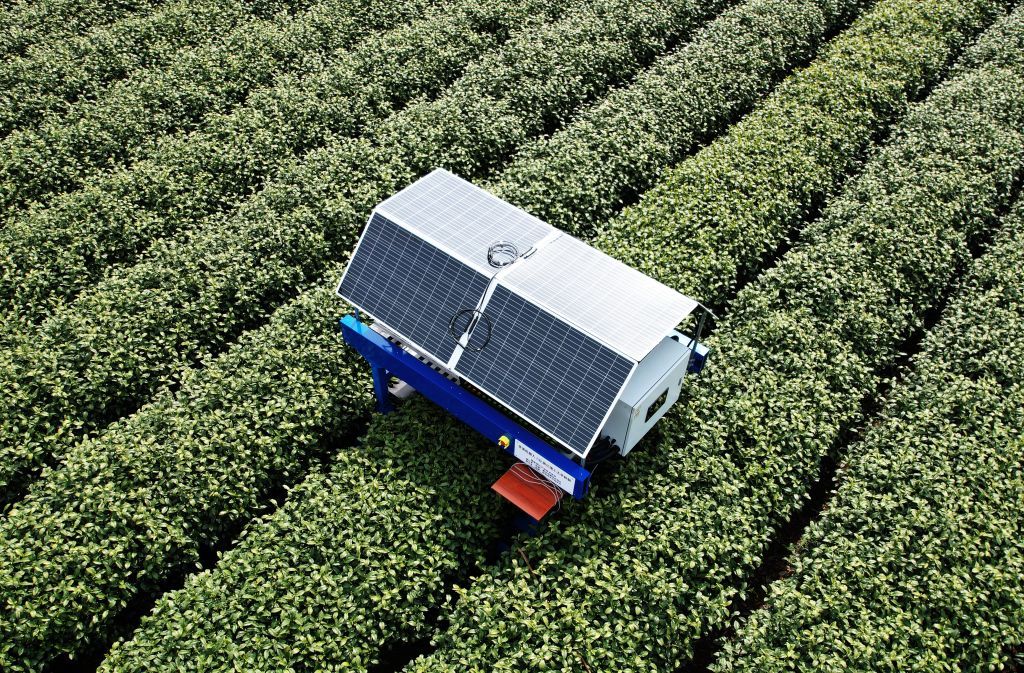
Self-driving metro trains were introduced in Shenzhen in 2021. In Chongqing, there’s a factory that uses more than 2,000 robots to build a new car every 60 seconds. The port of Tianjin is almost entirely automated, with robots lifting containers on and off ships and zipping them around. The XAG R150 Autonomous Ground Vehicle is a robot farmer that goes around on hot days to spray crops in Xinjiang. And here in my wife’s hometown Daqing, the useless talking vacuum cleaner has a much more successful cousin: a massive AI model that has been used to discover new oil reserves.
Much as the West outsourced blue-collar jobs to China a generation ago, the children of Chinese factory workers are outsourcing work in factories, ports, mines and trains to machines. Today, like a Buddhist who meditates himself into a state of Nirvana, the Chinese economy is slowly perfecting itself to a point where farmers and workers won’t really be necessary. As the population slowly declines, these workers will be replaced by Chinese machines. This poses a metaphysical question for the Chinese Communist party. On the country’s flag, there’s one big star – for the CCP itself – and four smaller stars, which represent the working class, the peasantry, the petit bourgeoisie and the national bourgeoisie. The national bourgeoisie is already under state control: China’s government long ago implemented what it calls the “olive-shaped economy” where the returns on capital are limited so both the top and the bottom of society are rounded off. With the automation of the working class and the farmers, that will leave only two stars: the party and the urbanized middle classes, white-collar workers. Their jobs increasingly use AI, but they’re unlikely to be eliminated.

Chinese courts have been decisive that automation cannot replace white-collar workers (even though that’s kind of the point of automation). In a major recent case, a tech worker called Zhou successfully argued that he should keep his job despite automation. He had earned 25,000 yuan ($3,700) a month checking AI large language model queries, but after AI took over his tasks, his company tried to demote him to a 15,000-yuan role. When he refused, they fired him. The Hangzhou Intermediate People’s Court ruled the dismissal unlawful, stating corporate tech upgrades may not legally shift transformation costs on to employees.
In Beijing, a data-mapping department was fully automated by AI. An arbitration panel ruled in favor of the displaced workers, noting that deploying AI is a voluntary business choice that does not constitute a “significant change in objective circumstances” required to legally void an employment contract. In Guangzhou, a graphic designer lost his job after a tech firm started using AI image generation tools like Midjourney and Pixso AI. The Guangzhou Intermediate People’s Court ruled that market adaptation via AI does not qualify as an uncontrollable external event that justifies terminating standard labor contracts.
There has been far less concern about the automation of manual jobs. That’s mostly because in many manual industries, workers are old and dying off. There has been some pushback. In Wuhan, for example, there have been protests at the rollout of self-driving taxis. Driving is often the go-to job for those who can’t find employment elsewhere. Overall, however, automation remains popular. As China’s population decreases, robots and AI will allow China to avoid accepting immigrants and remain ethnically coherent – something the likes of Tucker Carlson can only envy. Moreover, as a Chinese government official recently observed, if GDP remains constant while the population decreases, then GDP per capita will grow. This China would be a cohesive bloc of 800 million people with a comfortable, upper-middle-class standard of living, fully backed by an automated, AI-driven economy wielding massive global trade leverage.
While the West has imported Muslim populations into Europe, China is exporting technologies to Indonesia, Pakistan and Saudi Arabia (and of course, to Xinjiang). My personal favorite is NurAI, a Chinese LLM that dispenses legal judgments in accordance with sharia law; uptake in Malaysia has been brisk. There’s a massive data center in China’s Guangxi province built with the sole purpose of disseminating Chinese AI models to Southeast Asia.
This is the world China is hoping to build: one in which a growing number of nations rely on Chinese technology. Not long ago, Jakarta was quite unpleasant; nowadays, the Chinese-built subway system makes it a lot easier to get around. Increasingly, this kind of manufacturing and construction will be done by machines. In this future, the CCP hopes that physically demanding work will no longer exist. And the economic benefits of all this automation will be realized by consumers rather than shareholders (what shareholders? It’s communism).
China aims to become a post-abundance society. In some ways, that’s already happening
An automated China will lead to very low prices, not only for manufactured goods but also food and energy. China grows 30 percent of the world’s fruit, for example, and it’s projected that a third of all Chinese-grown greenhouse produce will be picked by machines within a decade. One cotton farm in Xinjiang claims that three quarters of its production is now unmanned. Fleets of robot pickers are being developed that can be rented out to smaller farms, with growers charged per kilogram of produce picked rather than having to pay for the machinery itself. Labor shortages in rural China mean that currently something like 60 percent of the cost of produce goes on farm workers. As the labor supply shrinks further, Chinese-built robots will take their place.
When it comes to energy, China is pursuing a massive buildout of solar and wind. Renewables now account for just less than half of China’s generating capacity; last year alone, the country built the renewables equivalent of 430 nuclear power stations. Robotic arms are increasingly used to install solar panels. Automated factories are already building wind turbines and blades, with a plant in Shaoshan stating that production was up 33 percent after robotic blade grinders were installed. China aims to become a post-abundance society. In some ways, that’s already happening: there are more houses than people, more food than stomachs, more cars than drivers.
This overcapacity will be exported using China’s already dominant global supply chains. By manufacturing so much, from pharmaceuticals to cars to food to Labubu dolls, China is like a nest of termites in the wooden structure of capitalism. It will exert downward pressure on prices, which is good for consumers. In some ways, China and America aren’t really in the same race. What both countries have done is mobilize the threat of the other to coax their populations into accepting the trade-offs of their own particular technologies. The US is building advanced general intelligence. China is building China: trains, ports, factories and various 20th century technologies, just automated and cheaper. Those robot Usain Bolts will soon, the CCP hopes, be part of a labor force building a new, automated economy.





Comments