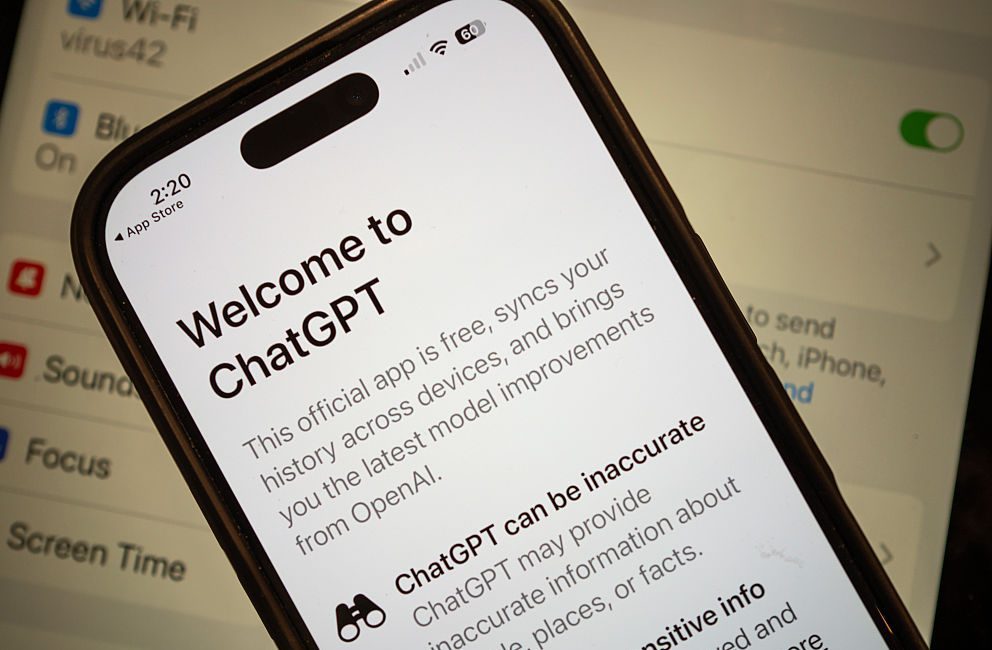
It seems AI is not just making everyone sound the same, but now everything must look the same too. I haven’t been able to walk into a pub, cafe or shop this summer without noticing the uncanny, slightly unreal sheen of an AI-generated poster. From caricatured cartoon children on a nursery advertisement to an abnormally glistening burger on a food menu, every billboard, flyer and sign now seems to have been regurgitated from the same ChatGPT printing press.
We are hurtling ever closer to a flattened future in which everything converges towards the average, the mediocre, the visual mean
There are many telltale signs that a sign is generic AI-slop. The big, flashy text on a dark background (normally block letters paired with a more ‘handwritten’-style script, angling up to the right). Every square millimetre will be saturated with visual information and distracting details. The arrows, check-marks and bullet points haphazardly strewn throughout. The over-saturated colours. The weird smoothness that draws your eye to nothing at all in particular. The strange sweatiness to the images, inconsistent with the physics of light.
All these posters feel garish, derivative, completely insubstantial: the visual equivalent of artificial sweeteners or colouring agents. I’m sure some tech-bro somewhere will try and convince me that this is a good thing: that this trend has the potential to democratise access to design and illustration, and that being able to produce promotional material quickly and at little-to-no cost is helpful for small businesses. Maybe it’s fine to spew out something second-hand and soulless when you’re promoting a village family fun day: no one’s expecting Cannes Lions-level creativity for a cake stall and a bouncy castle.
Yet this scourge of low-effort, stylistically-indistinguishable mush is just teaching the machines that this is what its users want. We are hurtling ever closer to a flattened future in which everything converges towards the average, the mediocre, the visual mean.
AI doesn’t know if something is ‘good’: it only knows if something is ‘similar’. The reason why AI-generated copy is so generic and jargon-heavy, so full of clichés and buzzwords, is because it relies on patterns and probabilities: it does not create, but uses technology to predict the most statistically likely next word. It reassembles content that gravitates towards the safest, most common expressions and structures, and this optimised blandness is like listening to elevator music: inoffensive, but easily forgettable.
This same emotional emptiness is now happening with visual media: where is the quirkiness, the personality, the originality? I would honestly rather see a menu hastily scribbled on a post-it note, or a flyer poorly-made on Photoshop, than I would another lazy attempt at AI ‘art’ screaming lists of three at me. Give me eraser marks on a blackboard or an off-kilter handwritten notice any day: at least these imperfections show some semblance of effort and thought, some evidence of human origin.
Things will only get worse. As more and more people rely on AI to generate content, we then create a feedback loop in which AI trains on AI-generated text and images, and the more AI feeds on itself, the harder it will be to get anything fresh from it. As Shakespeare said, ‘It is a monster, begot upon itself, born upon itself’, (although he was talking about jealousy, not large language models).
This ‘AI-cannibalism’, this tendency to make a copy of a copy, will only accelerate our descent into sameness: the same stock phrases, the same layouts, the same icons, gradients and fonts. We have seen this in the way it gravitates to the same lexical quirks over and over again – triadic phrasing, over-use of lists, equal-length paragraphs – and this is now influencing how we write and speak, homogenizing our style and vocabulary (researchers have found that we too now overuse words that abound in AI-generated text, like ‘delve’, ‘adept’ and ‘meticulous’.)
I expect to have to filter through AI-spam on my social media, but it’s another thing to be affronted with it in my local village shop. If AI is now invading the real world as well as the online world, then with this comes an unspoken cognitive load in which we suddenly have to second-guess everything we see and hear. Is this AI? Why does this sound or look or read so strangely? Does this person write or talk like this? Is this a person at all? Why does my village community noticeboard now look so unsettling, or like I’m on the set of Stepford Wives, where everything is cookie-cutter?
Online I can scroll away from the inevitable deluge of ‘slopaganda’ and AI-generated reels. But what do you do when AI-generated content is splashed on buses, lamp-posts, even the front of your local primary school? I fear that there will soon be no escape.



Comments