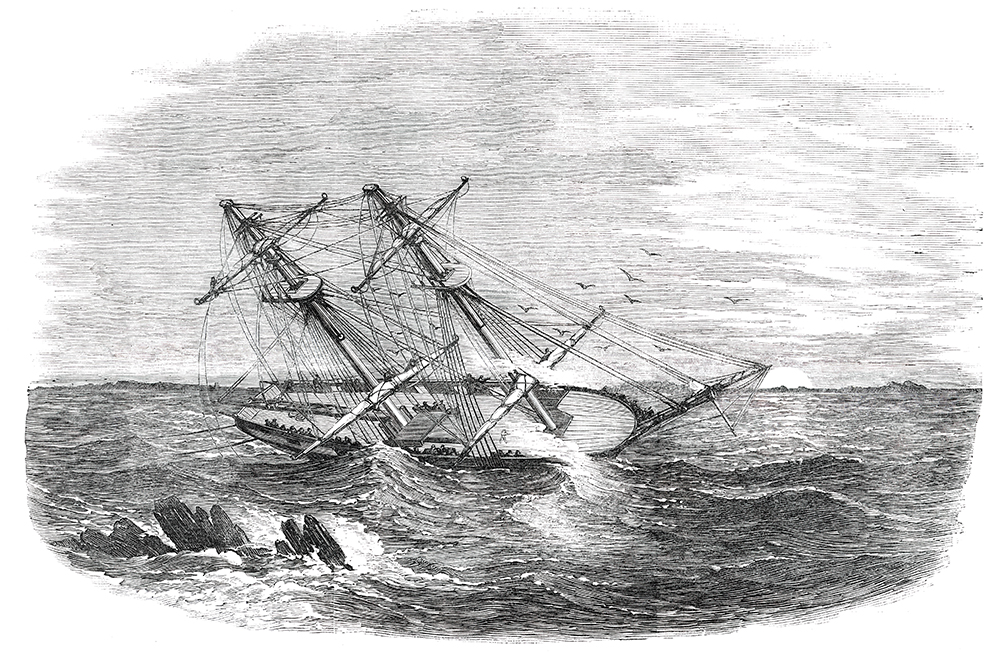
When the American shipbuilder Enos Bright constructed the Mentor in 1807 he had no inkling of the tale it would one day tell from its watery grave. Many ships faced harrowing voyages on the high seas, but this one stood out more than others. It was an expedition that turned into a disaster that few could have foreseen.
Eric Jay Dolin brings this long-forgotten story back into the public eye. The author of 17 books that have largely focused on maritime history, he is a talented researcher and natural storyteller. ‘The Mentor,’ he writes, ‘is not just another example of a shipwreck during the Age of Sail. It is one of the most complex and intriguing of such stories ever told.’ It contains many twists and turns, and a ‘cast of fascinating characters that are forced by dramatic circumstances into a sometimes deadly and almost always fraught embrace’.
The Mentor’s crew had hurriedly to prove they weren’t English, or they were done for
Bright’s original vision for the Mentor was of a merchant ship. It was later converted into a whaler, which Dolin describes as a ‘floating killing machine’, used for chasing and harpooning whales. The ship’s owner, William Rotch Rodman, profited handsomely from the sale of whale meat and oil from rendered blubber. Whaling expeditions in a then-unregulated market steadily increased to meet the demands of consumers.
The Mentor might have been nothing more than a historical footnote had it not been for one fateful voyage. The ship set sail on 21 July 1831 from New Bedford, Massachusetts, then America’s foremost whaling port and nicknamed ‘the city that lit the world’. The captain was Edward Barnard, already a sea dog at the age of 31. His crew of 21 included his brother-in-law James Meader and eight ‘green hands’ with no whaling experience. They dreamt of returning home with great riches.
The whaling expedition began in Cape Cod and continued to the Grand Banks of Newfoundland. Unsuccessful but undaunted, Barnard then crossed the Atlantic to the Azores, where he hoped his luck would change. He sailed down Africa’s western coast, then round the Cape of Good Hope to Mozambique and the Comoros, north-west of Madagascar. He followed the Indian Ocean to Timor in March 1832 and set a course for Guam. But on 21 May the ship foundered on a reef in Palau, an archipelago in the western Pacific Ocean about 500 miles due east of the Philippines.
Dolin’s masterful storytelling is on full display as he details how the shipwrecked men faced indecision, intrigue and sheer terror in a part of the world they barely knew. After hitting the reef, they didn’t all go in the same direction. The first mate, Thomas Colesworthy, fearing that the Mentor would break up, took the quarter boat with nine others. They were never heard of again. Barnard convinced the remaining ten men to join him in the whaleboat, carrying supplies including clothes, gunpowder and pistols. They were the luckier ones.
They ultimately reached the island of Babeldaob, where the sight of ‘naked, heavily armed Palauans standing on the edge of the cay’ could have ended badly. Barnard had already told his crew about Henry Wilson, the captain of the Antelope, a packet ship wrecked off Ulong in Palau in 1783, who developed good relations with the supreme chief of Koror and his son Prince Lee Boo. Barnard felt that could be repeated; but there was one problem. When his crew reached the village of Ngarchelong and sought assistance, they discovered that the villagers mistook them for English, whom they regarded as ‘enemies’, because the Antelope’s survivors had helped Koror ‘achieve a position of dominance in Palau’. The Mentor’s sailors had hurriedly to prove they were American, not English, or they were done for.
They eventually surrendered on the island of Tobi, where they were enslaved. While the Tobians were ‘most definitely not savages’, writes Dolin, it was still a small, primitive and remote island. Barnard managed to escape in February 1833 aboard the Spanish merchant ship Sabina. He pleaded with the captain, D.A. Somes, to rescue his men as well, but to no avail – possibly because the latter ‘feared being surrounded and overpowered by the natives’. Thankfully, some crew members and one Ngarchelongese chief escaped Tobi in dramatic fashion the following year.
The Wreck of the Mentor is a fascinating adventure story – one which the Age of Sail produced few quite like. Dolin’s keen observational eye will ensure that it will never be forgotten again.





Comments