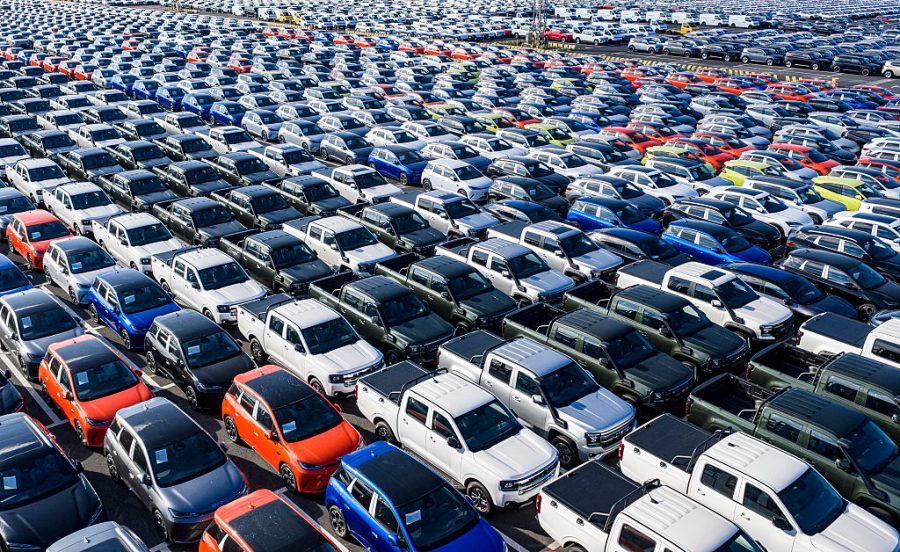
If you have your eye on a shiny new Jaecoo 7, affectionately known as the ‘Temu Range Rover’, or a BYD Sealion or an MG4 then you probably need to scoot down to your local dealer as quickly as possible. The government is considering imposing tariffs on Chinese imports that could add 40 per cent or more to the cost. We all know why: the Chinese auto companies are taking the British car market by storm. But are tariffs enough to stop them in their tracks? In truth, it seems all we can do is learn the lessons from the electric vehicle fiasco and try not to repeat it.
It seems a long time ago that the former prime minister Boris Johnson and other enthusiasts for a ‘green industrial revolution’ were boasting that Britain would lead the world in the transition to battery-powered cars, creating hundreds of thousands of ‘well-paid green jobs’. Instead, the industry has simply moved to China. Figures for September showed that Chinese brands, which barely existed five years ago, took 20 per cent of the British car market last month. The Jaecoo 7 topped the entire list for the month, with more than 10,000 sold, and it is now the second-best-selling car of the year so far. Meanwhile, BYD, MG and Jaecoo are all in the top ten brands, with BYD only a few thousand units short of taking the top slot from Volkswagen.
The government is so alarmed it is now considering following the European Union and slapping 45 per cent tariffs on Chinese EVs. Of course, it is not hard to see why. The Chinese manufacturers are advancing so quickly that before long they may take almost all the market. The purists may dismiss them, just as they did Japanese and then Korean cars a generation ago, but the Chinese EVs are well made, have world-beating technology, and are a lot cheaper than anything made here or in Europe. Tariffs are the only thing that might stop them.
It is hardly an accident that the likes of BYD and Jaecoo have taken the market
Here’s the problem, however. It is hardly an accident that the likes of BYD and Jaecoo have taken the market. The British government decided to lead the world in creating a net zero economy by banning the sale of new petrol cars by 2030. It imposed quotas for the traditional manufacturers to sell a set number of EVs regardless of whether they could make them or not. It also pushed up energy costs so relentlessly that it became impossible to make anything in Britain anyway – even if the demand was there.
Political leaders complacently assumed that British manufacturers would somehow appear from nowhere to make all the EVs they insisted should replace petrol cars. It didn’t happen. Instead, Chinese companies seized the opportunity to take the market.
It is hard to see how, at this late stage, tariffs can change that. All they will do is drive up the price of cars, making new ones even less affordable for most people. True, it is a shame that successive governments, in both Britain and the rest of Europe, made such a mess of the transition to EVs that they destroyed one of their largest domestic industries. But all they can do now is try to learn the lessons of that, Tariffs on Chinese EVs will, it seems, only make the whole mess even worse.





Comments