
For most of human existence, we have mined the heavens for clues to a grand design. We made gods out of planets and mapped myths on to constellations, in some attempt to understand their mute progress and win their favour for our empires, dynasties and rulers. The subject of Night Maps at the Warburg Institute is this entanglement of heavenly influence and the mundane work of empire-building. The collection appears to belong somewhere between a fusty library and a filing cabinet: rare books, woodcuts, geological maps, nautical almanacs, scrapbook photos of Soviet officials, measuring instruments, stamps, manila envelopes.
The mapping of the night sky requires an army of personnel. The tiny island of Hven, where 16th-century astronomer Tycho Brahe built his Uraniborg observatory, hosted not only a rotating team of technical assistants, but also domestic staff who tended to them (and, presumably, to the observatory gardens, ponds and paper mill as well). It was Europe’s largest observatory at the time and was state-subsidised to the tune of 1 per cent of the Danish budge. I wonder if it is purely coincidence that Brahe’s miniature bureaucracy resembled early models of a stacked and ordered universe. Aristotle envisioned crystalline spheres of planets and stars rotating around the fixed Earth; an engraving in Night Maps depicts Uraniborg’s geometric world of neat little hedges, walls and paths surrounding the observatory at the centre.
It is tedious work, staring endlessly at the sky. Louis Le Comte, a Jesuit missionary in 17th-century China, observed five mathematicians as they stood watching the stars, night after night. One gazed towards the zenith, the others facing north, south, east and west, so that ‘nothing of what happens in the four corners of the world may escape their diligent observation’. Every morning, they brought their observations to a surveyor, who kept a strict register of the weather and any unusual phenomena. Nonetheless, Le Comte writes, the Chinese astronomers had not, after 4,000 years, composed a wholly accurate calendar: ‘Provided their salary be paid as usual, and their income constant, they are in no great trouble about the alterations and changes which happen in the sky.’
By the 20th century losing the heavens amounted to losing, period
In imperial China, the heavens were thought to be a mirror of the state. The ‘celestial bureaucracy’, as it was called, was arranged in rings around the divine Jade Emperor, corresponding with different offices, ministers and bureaus on Earth. A map of the celestial bureaucracy is on display in Night Maps. Its universe is ordered around the ‘purple forbidden region’ (in Prussian blue, but never mind) where the celestial emperor resides. The map has a twin, which is not on display, of the mortal emperor’s ‘purple forbidden palace’ in Beijing.
The virtuous Daoist priest could rise through the ranks over the course of his life, and mortals could earn promotion to godhood within the celestial bureaucracy for their exceptional deeds. Anyone who worshiped a bhugola – a Nepalese map of the universe, here depicting Brahma at the centre on an eight-petalled lotus – could obtain longevity, wealth and even mukti, ultimate liberation. Maps of the heavens once implied an attitude of awe and devotion. Eventually, they became instruments for grasping and mastering the heavens.

Peter Apian, a German mathematician, started a popular craze for cosmography in the 16th century. His Cosmographia contained rotating paper volvelles, which allowed amateurs to do their own calculations of the heavens. Nautical almanacs essentially standardised the positions of the sun, moon and stars for the use of navies and maritime trade. Personal gadgets such as sharkskin-covered pocket globes, in which the constellations were painted on the inside, placed the heavens in the palm of one’s hand.
By the 20th century losing the heavens amounted to losing, period. Welcome to the space race and Ronald Reagan’s Strategic Defense Initiative – ‘Star Wars’, as it was nicknamed – which aimed to build a shield in space and on Earth to protect the United States from Soviet missile attacks. During the Cold War, space came to be seen as an extension of the battlefield, where wars could be won or lost.
Mrs Reagan believed the heavens exerted their power on Earthly affairs in a more personal way. After her husband’s near-assassination in 1981, Nancy employed astrologist Joan Quigley to consult the stars on everything from the timings of the president’s press conferences, debates, trips abroad, his second inaugural oath and his first cancer operation. Reagan’s Star Wars were, in Quigley’s opinion, the outcome of something already written in the stars. The president was born under the forces of Mars in Capricorn and Saturn in Taurus. ‘It was this combination,’ she wrote, ‘that enabled Reagan to plan his great strategy of refurbishing the military at home and establishing missiles in Europe. This grand design enabled him to deal with Gorbachev from a position of power.’
But man has also made its own mark on the heavens. Our planet is surrounded by tens of thousands of defunct satellites, spent rockets and other various junk we’ve shot up there. And then there are the millions of little bits of debris – shrapnel, flakes of paint – that you must pray don’t fall out of orbit and pulverise the human race. We have an international Outer Space Treaty to hold countries responsible for their floating trash. The global financial system, standardised time zones, weather forecasting, navigation, the battlefield: all rely on the 17,000 or so satellites in space (about 70 per cent of which are owned by Elon Musk). When you wake up to an alarm, check a bus timetable or drive using GPS you are, in some way, consulting the heavens.
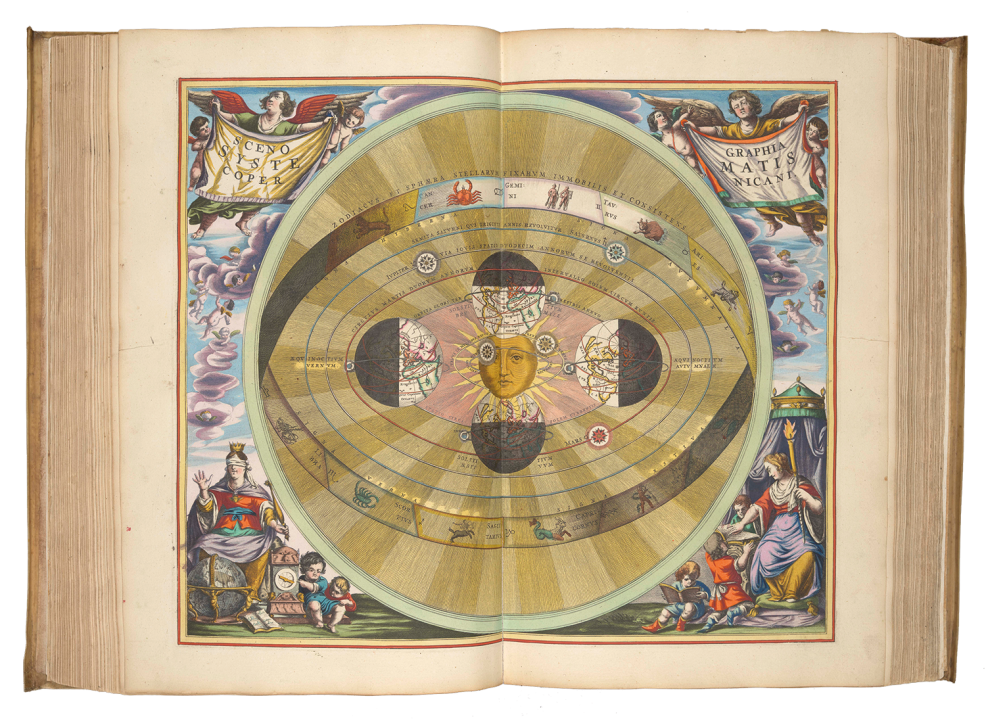
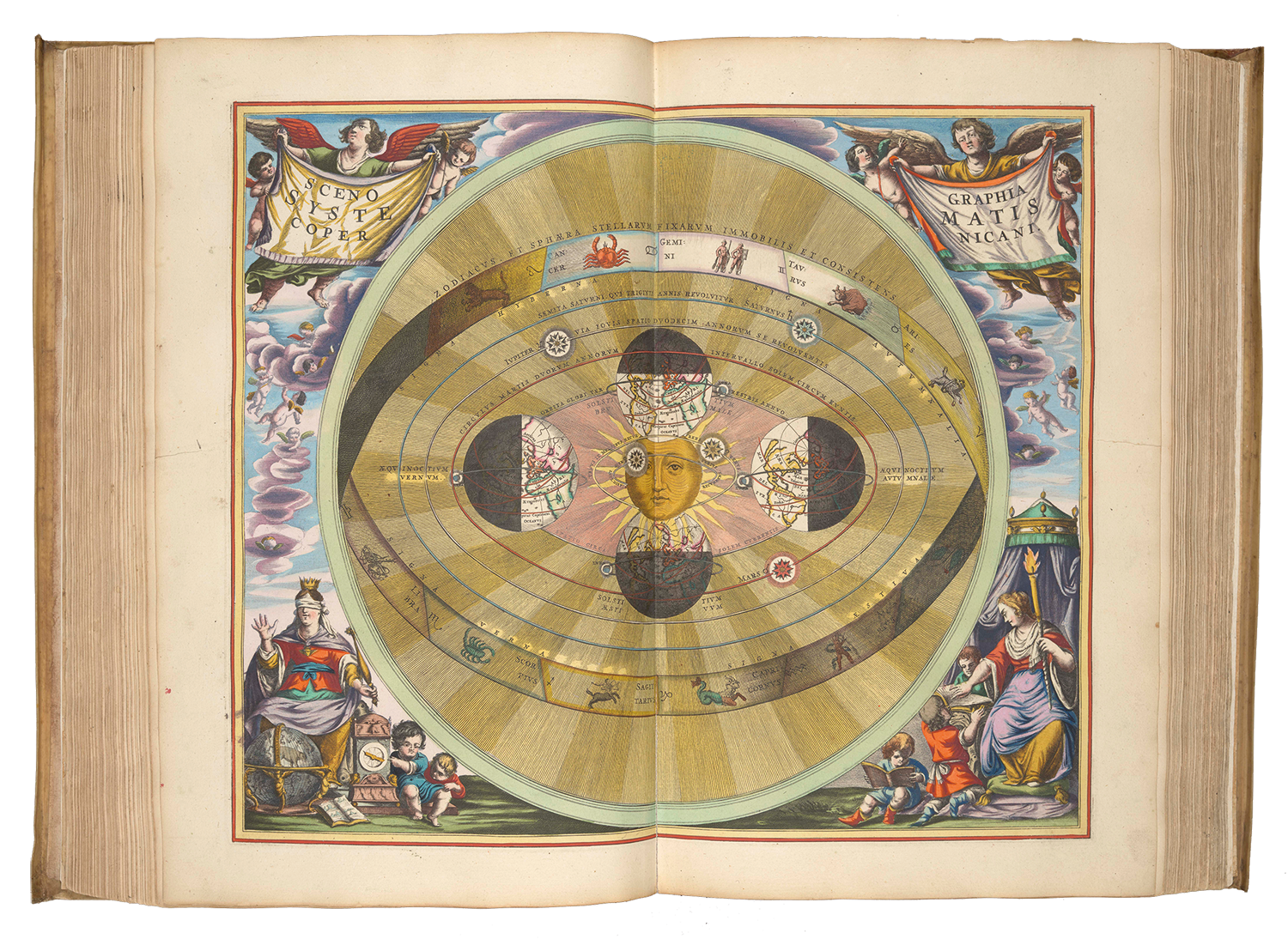
How did we go, in such a short time, from believing that the Earth was the centre of the universe to launching rockets into the abyss, to having aspirations for outposts on Mars? The ‘Copernican revolution’ is considered a turning point in our attitude towards the cosmos, but Nicolaus Copernicus was not radically different from his contemporaries. ‘He still thought the aim of cosmology was beauty, aesthetics, harmony,’ says John Tresch, the curator of Night Maps. His heliocentric model of the universe was an attempt to better reflect the elegance of God’s design, and it is presented alongside Ptolemy and Brahe’s models in Harmonia Macrocosmica, a 1660 atlas of different cosmological systems across 29 spreads. These models were placed together for comparison: the cosmos was still up for grabs, to be defined by whoever put forward the most convincing model.
The great revolution has been the discovery of a universe without centre, indefinitely expanding, making us incomprehensibly small and smaller still – an unmappable universe. Hannah Arendt, in the prologue to her book The Human Condition, pointed to the Sputnik satellite launch in 1957 as the sign of our alienation from Earth. We had already shifted our view of nature from a fixed, Earthly standpoint to an unfixed, universal one. We had even imported cosmic processes: nuclear physics, the atomic bomb. Our terrestrial nature was then like a condition to be overcome. Arendt asked whether our modern age, ‘which began with a turning-away, not necessarily from God, but from a god who was the Father of men in heaven, end[s] with an even more fateful repudiation of an Earth who was the Mother of all living creatures under the sky?’
When you wake up to an alarm or check a bus timetable you are, in some way, consulting the heavens
From this cosmic standpoint, we are able to destroy life on Earth at a massive scale – even without using nukes. The crisis over Ukraine’s Starshield satellite access has made us more aware of our dependence on the heavens for defence and safety, as well as their role in raining down death, in the form of drone swarms or missile strikes.
In his magnum opus, Bilderatlas Mnemosyne, Aby Warburg drew together constellations of images, from antiquity to the early 20th century, to challenge the idea of straightforward progress away from superstition towards rationality. He placed a 15th-century woodcut of Mars – personified as a knight, looming over a scene of chaos and conflict – beside newspaper clippings of Zeppelins, appearing in the skies like monstrous omens of war.
I have never heard the real death rattle of an FPV drone, but I have felt some kind of dread at the buzz of the Amazon delivery ones, the sinister gaze of aerial video cameras. I have been tempted to imagine a living, alien pulse somewhere among a string of Starlink satellites as they march across the night sky. A Chinese propaganda print in the exhibition, resembling a Star Wars poster, urges the public to ‘uphold science, eradicate superstition’. Have we eradicated our fear of the gods? Perhaps I’m too paranoid about these things. But it’s possible that, in spite of our efforts to draw up an endless, indifferent cosmos, we still feel a primitive anxiety that our planet is not insignificant, tiny or absurd enough that the wrath of the heavens can’t locate it.
Night Maps is at the Warburg Institute until 17 April 2027.


Comments