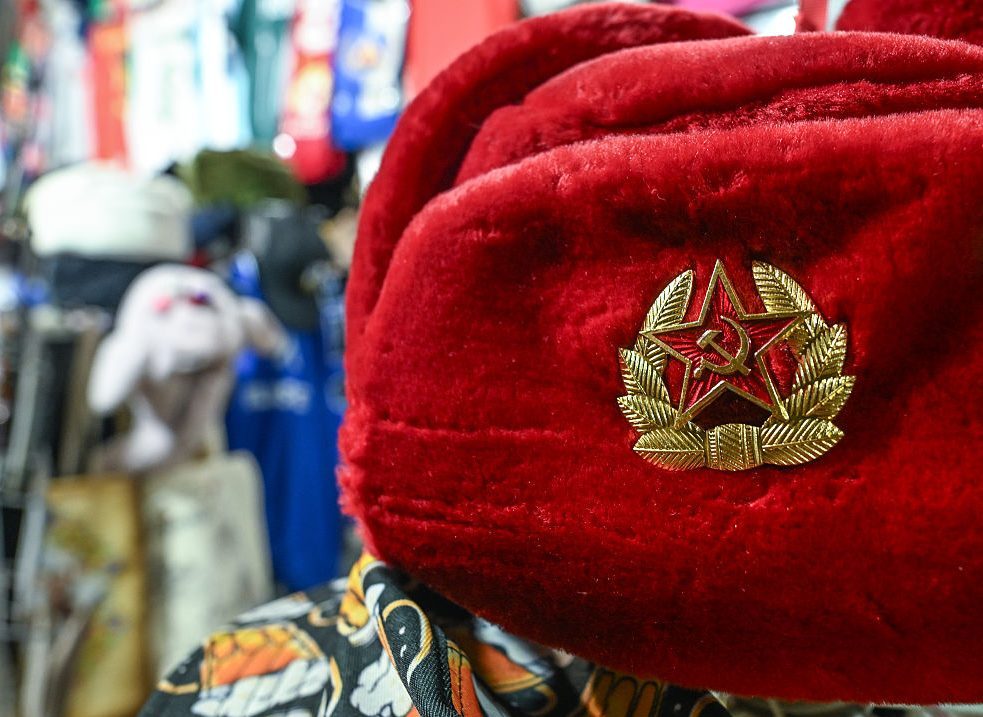
The USSR is striking back. Nearly forty years after its collapse, there are a growing number of young people in the West who are now avid enthusiasts of the Soviet Union. Curiously, this is a somewhat apolitical phenomenon. Lenin and Stalin apologism still remains the preserve of the chubby, the slobby, the grizzled and the graduate student, no matter how avidly they wave their flags at protests. Instead, Soviet culture and style have become decidedly in vogue, whether that be the resurgence of the Slavic doll look, schoolboys making TikToks to the USSR national anthem, or viral videos of abandoned Communist buildings. Defanged and denuded of its political belief system, Soviet aesthetics are decidedly cool.
The embrace of the Soviet is not so different from the growing numbers of young people going to church
It helps that there is a consistency of look. Within a second of looking at a Soviet building, outfit or poster, there can be no doubt as to its provenance. Compare that to the modern West’s hodgepodge of styles. There is minimal sense of a unifying civic identity. As a branding exercise alone, the Soviet Union wins hands down. Instagram content creators know they can reliably get millions of views for a video of abandoned Soviet Bloc architecture or a 70s-styled GRWM (Get Ready With Me). Throw in a grimy filter and a backing track from Molchat Doma (a modern Belarusian band who have cornered the market for gloomy Soviet aesthetics), and you’ve got yourself a hit.
Encompassed in this imagery of Soviet decline is a strange dichotomy: its collapse and failure are both present and not present. Sure, a building may be sad and derelict, but its decline is presented as merely physical – the scale of ambition only failed practically, not conceptually. There’s enough of a time gap that few millennials – let alone Gen Z – can remember the hangover of the Soviet Union.
For them, there’s a lost history in which it could have survived Gorbachev: a great ‘what if?’ in which the Soviet project wasn’t traded in for blue jeans and Pizza Hut. Photos of the architecture thriving during the Soviet heyday are often edited in for comparison, and commenters make reference to a lost world of aspiration, where the moon was still in reach and the ‘pursuit of greatness’ wasn’t yet something to be ridiculed. Timothée Chalamet used those words last year to describe his goals as an actor and was mercilessly mocked. Soviet aesthetics, meanwhile, are reassuringly irony-free.
The embrace of the Soviet is not so different from the growing numbers of young people going to church. If you’ve glutted yourself on consumerist excess, you eventually find yourself thirsting for something simpler, heartier and more substantial. The simplicity of the Soviet Union as presented by pages like ‘Soviet Visuals’ (two million followers) is enticing: an unpolished parallel world of bad haircuts, homemade vodka, borscht, Ladas and hairy men sweating in coal-fired banyas. For those fatigued by endless ads telling them how to keep their health and appearance in check, it’s a welcome alternative. Dobbing your neighbours in to the secret police for spurious offences isn’t back in fashion just yet – except for a brief period in 2020–2022.
It would be easy to call it plain old yearning for a world without phones and the strictures of modern life. The Soviet fantasy is, after all, a particularly convenient one – you get to keep America as the great evil. Yet there is something deeply relatable about the feeling of an empire in twilight, one that really thought it would last. Maybe it’s a bit far to claim the current trend for workwear symbolises a nation of nascent Stakhanovites (workers in the Soviet Union who were celebrated for their exceptional productivity), but it aligns with a generation of young people who pine for purpose and employment but feel like their governing class have written them off and left them behind. It’s no coincidence that edits of Lee Kuan Yew’s Singapore also go hugely viral – particularly the speech in which he states: ‘Over 100 years ago, this was a mud-flat, swamp. Today, this is a modern city. Ten years from now, this will be a metropolis. Never fear.’
When I mentioned this phenomenon to my mother, she was appalled. Her father’s side of the family had all their property seized by the Bulgarian Communist Party, and the hatred and fear of socialism run deep. To her, flirting with Soviet imagery was tantamount to exonerating the horrors of Soviet oppression: akin to reminiscing about 1940s Hugo Boss fits or making TikTok edits of Leni Riefenstahl films (admittedly, the latter does exist). Yet not even Gorbachev could have sanitised and neutralised the political power of the USSR as effectively as Instagram influencers have.
We still live in the afterglow of the Soviet Union – even the Bond films still haven’t found a sufficiently potent replacement bogeyman – and rely on it as a countervailing force to cling to the myth of continued Western hegemony. The version of the USSR romanticised online is its natural endpoint: tempered and mummified, and put on a pedestal as a fairytale that could never really last.




Comments