Soviet union

Welcome to Transnistria: the country that’s not a country

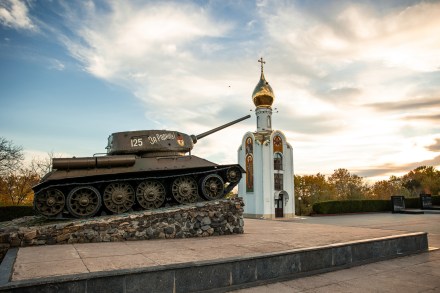
I’ve been on holiday to a country that doesn’t officially exist. It has its own border, passport, flag, currency and army but no one recognizes it – not even its main sponsor, Vladimir Putin. Transnistria is sandwiched between its proper motherland Moldova – which is itself really Romania – and Ukraine, which Putin thinks is part of his motherland. Confused? It doesn’t get any easier.  In 1992 there was a short war between the newly created state of Moldova and separatist, ethnic Russians which resulted in nearly 1,000 deaths and the breakaway "country" (via a peace accord) policed by Russian "peacekeepers.

Transnistria

The Adventures of Elektronik is not your average children’s comedy

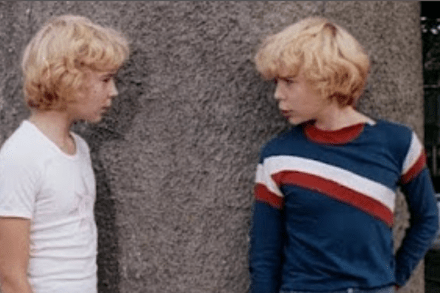
For people from the former Soviet Union, the holiday season brings with it two certainties: mayonnaise and movies. Mayonnaise, because no winter festivity is complete without the traditional mayo-infused salads with such evocative names as “herring under a fur coat” and “Olivier,” which are eaten for days straight. These calorific concoctions are best accompanied by a dozen or so cult films from around 1965 to 1985, which are ritually rewatched every year by Homo Sovieticus and his descendants. Of these classics, one of the most beloved is the musical The Adventures of Elektronik (1979). Adapted from the novels of the science-fiction writer Yevgeny Veltistov, the movie tells the story of a young robot named Elektronik.

Cambridge University should be ashamed of itself for honoring Angela Davis

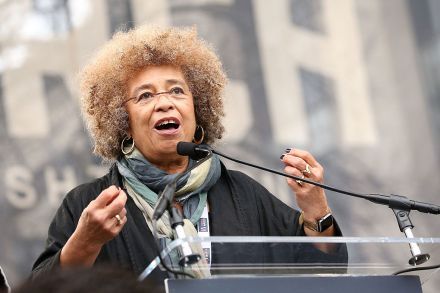
Remember Angela Davis? Few people under fifty do. Was Cambridge University counting on that historical ignorance when it decided to honor Angela Davis with an honorary degree?   In case you, Dear Reader, are a little fuzzy about Davis, I note for the record that the former Black Panther and two-time vice-presidential candidate on the Communist Party ticket with Gus Hall is the recipient of many honors, including the Soviet Union’s Lenin Peace Prize.  Cambridge University, of course, has long demonstrated a certain fondness for Commies, as the names “Kim Philby,” “Guy Burgess” and “Anthony Blunt” remind us.

Zohran Mamdani’s grocery chain will be a crime against New Yorkers

Of all the policies proposed by Zohran Mamdani, the socialist winner of last week’s New York’s Next Top Mayor competition, the idea of city-run grocery stores has proved the most divisive. If you want to reduce prices at halal carts by taking away regulations on street vendors, you’re going to get 80-plus percent approval rating. But state-owned groceries are another story. Modern history is strewn with tales of state-owned grocery disasters.

Zohran Mamdani

Soviet America’s revolutionary wars

Niall Ferguson is far from the first intellectual to compare the United States today to the Soviet Union of old. But Ferguson’s Free Press essay “We’re All Soviets Now” stirred up more discussion, and outrage, than earlier forays by others on the same theme. (Ferguson himself credits the Princeton professor Harold James with originating the phrase “Late Soviet America.”) Joe Biden already seemed like America’s analogue to the superannuated Soviet premiers of the 1980s even before his disastrous June 27 debate with Donald Trump — who is himself older in 2024 than Brezhnev, Andropov or Chernenko were when they died.

Soviet

The man who made Reagan

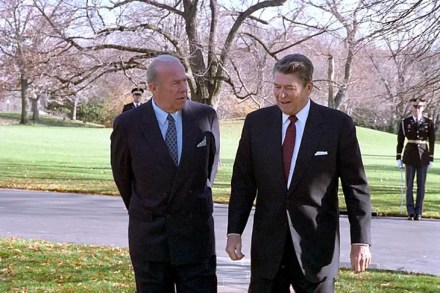
Ronald Reagan has been dead for nearly twenty years, but sometimes it still feels like he’s still the head of the Republican Party. The fortieth US president has been etched in American folklore as one of the country’s most effective and historic statesman, the man who stared down the Soviet Union and pursued policies that ultimately brought down the so-called “Evil Empire” in December 1991. Republican politicians of all stripes, from presidential aspirants to local councilmembers, utter his name at every opportunity. The first GOP presidential debate took place at the Reagan Library in Simi Valley, California, where multiple candidates looked back at the 1980s as a time when the mighty US shook off the cobwebs from the Vietnam War and rediscovered its self-confidence.

President Reagan walking with George P. Shultz outside the Oval Office (Wikimedia Commons)

Who or what are ‘the Palestinians?’

It’s so cute when politicians like AOC and Rashida Tlaib, to say nothing of hysteric undergraduates and ill-informed lefties across the country, complain that Israel is an “apartheid state” that is illegitimately “occupying” the land West of the Jordan River from the Golan Heights down to the border of the Sinai Peninsula.  Responding to the murderous attacks on Israeli civilians by Hamas on October 7, AOC decried “the occupation of Palestine” while Tlaib urged “ending the occupation, and dismantling the apartheid system” that can “lead to resistance.” Hermeneuts of the world, unite! What does Tlaib mean by “resistance” here? Slaughtering innocent partygoers? Incinerating and beheading babies?

palestinians

The Doomsday Clock has been corrupted by ideology

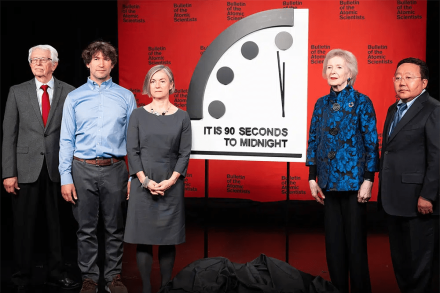
Ever since I can remember, I have always been aware of something called the “Doomsday Clock,” a symbolized calculation produced by a panel of prominent scientists of just how close humanity is to destroying itself. Published on the cover of every issue of the Bulletin of the Atomic Scientists, a journal founded in 1945 by Manhattan Project physicists, the clock’s hands would move toward or away from the dreaded midnight hour depending on how near Armageddon was believed to be. As a kid, the Doomsday Clock seemed an appropriate warning of how the conflict between the US and the Soviet Union might accidentally spin out of control.

The Cuban Missile Crisis has become a cultural touchstone

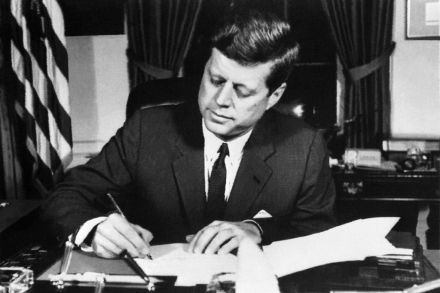
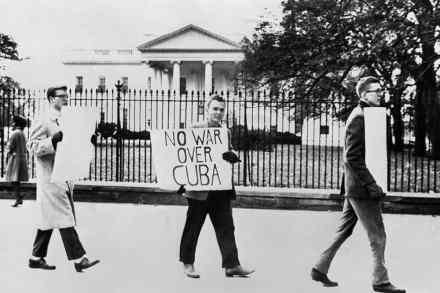
At the beginning of 1962, President John F. Kennedy had high hopes for a peaceful year with the Soviet Union, the United States’ most dangerous adversary. On December 30, 1961, Kennedy issued a statement offering his good wishes for the new year to Soviet Premier Nikita Khrushchev and the Soviet people. Ten months later, in October of 1962, the US and the Soviet Union were on the brink of war. The Soviets had moved missiles into Cuba, which initially went undetected by US intelligence. On October 14, an American U-2 spy plane took pictures showing missile base construction taking place in Cuba. The next evening, American analysts realized the implications of what that construction meant.

Joe Biden and the Sovietization of America

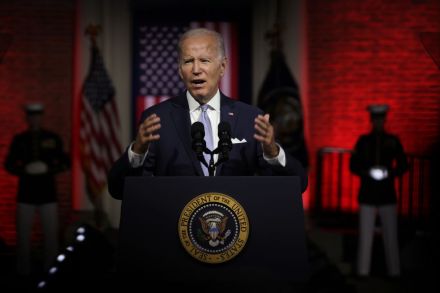
I write with the clangorous strains of Joe Biden’s speech at Philadelphia’s Independence Hall still ringing in my ears. By the time you read this, the attendant tinnitus will doubtless have abated. The effects of the speech, however, will be echoing throughout the land for many months if not longer. The commentator Ben Shapiro was, I believe, correct in judging Biden’s brief speech “the most demagogic, outrageous and divisive speech... ever seen from an American president.” In sum, “Joe Biden essentially declared all those who oppose him and his agenda enemies of the republic. Truly shameful.” But what has been true of Joe Biden from before his administration began continues to be true.

biden

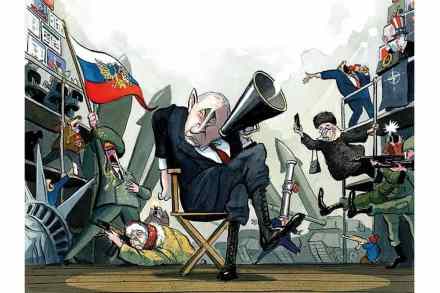
Vladimir Putin is simply mad

Vladimir Putin is mad: not in the cognitive but in the emotional sense of the word. He is an odd mixture of the cold, the plotting, the calculating, and the bloodless; the emotional, the impulsive, the hotblooded, and the sentimental. He is mad, in other words, in precisely the way that Adolf Hitler was mad. And like Hitler, Putin is disconnected from the world of fact but not of logic. This is a fundamental truth about the man that I think the West had never experienced before February. His condition became apparent in the diatribe against the West that he gave on Friday, which corresponded almost exactly to Hitler’s customary rants.

nuclear tactical putin war

Is the Ukraine conflict a civil war?

The strategic Ukrainian port city of Mykoliav, that has been under constant Russian bombardment since the onset of war, was locked down for an entire weekend in early August as troops searched for Russian collaborators that had been calling in locations of Ukrainian troops and ammunition. The government arrested scores of traitors during their house-to-house search. Meanwhile in the capital Kyiv, President Volodymyr Zelensky has also been sounding the alarm over Russian collaborators after firing both his prosecutor-general and head of the intelligence agency for treason. The former spy chief was a close childhood friend of the president. There are allegations that the entire intelligence agency is riddled with spies, with many defecting to Russia in the early days of the invasion.

ukraine

Pelosi is right to put China on notice

House speaker Nancy Pelosi has always had a flair for the dramatic. During the Trump presidency, for example, she ostentatiously tore up his State of the Union speech. But for sheer spectacle, it will be hard for Pelosi to top her “will she, won’t she” visit to Taiwan this week. In spite of the suspense, there was never really any doubt about it. For weeks China has issued dire warnings about the perils of her visit. So, as it happens, have several commentators, including The Spectator’s Freddy Gray, whom I debated on the Americano podcast, and who seems to have a bad case of the collywobbles about the Pelosi trip.

Following the seam of the Iron Curtain

Just before the pandemic, I spent several months traveling through Europe, from the north of Norway to Istanbul and beyond to Azerbaijan. I saw unforgettable sights: the endless daylight of the Arctic summer; the vast Hammershus castle on the Danish island of Bornholm; Vienna’s ornate Prunksaal library; and the sandy beaches of Corfu. But the focus of my journey was precisely those things that most travelers to these places often ignore. I was following the route of the Iron Curtain. My aim was to visit every part of that old great divide, all the places where NATO once abutted the Warsaw Pact, where overwhelming military might stood constantly primed for apocalypse.

Putin’s Victory Day speech shows he’s not backing down

“Victory Day” is one of the most solemn events on the Russian calendar. Every year on May 9, the country gets together to celebrate the defeat of Nazi Germany in what Russians call “the Great Patriotic War,” in which as many as 26 million Soviet troops and civilians perished. It’s a time for reflection, for an appreciation of history, and, yes, for pomp and circumstance, with Russian troops decorated in dazzling uniforms marching in unison throughout Moscow's Red Square. This year’s Victory Day celebrations, however, had much of the world on edge. In next-door Ukraine, Russian forces were taking a beating, with smaller but nimbler and more determined Ukrainian units continuing to mount stiff resistance against a Russian military offensive in the Donbas.

Among Moscow’s lost generation

Vladimir Lenin famously said that there are “weeks where decades happen.” He was talking about the Bolshevik Revolution, but the panic-stricken weeks after Vladimir Putin shocked even his own people by invading "brotherly" Ukraine will also be remembered as an intensely transformative period in Russia’s history, when the ground shifted and Moscow was yanked back to its Soviet past. Those crazy weeks when my phone rang non-stop now feel like decades in retrospect, especially from the perspective of New York. The changes were apparent even after the first mad days of the "special operation." Anti-war Russians had panicked at Putin’s cruel gambit and fled the country by the tens of thousands, along with thousands of Western expats.

The imperfect spy

On one level, Lis Wiehl’s enthralling and grimly astonishing A Spy in Plain Sight is simply the story of Robert Hanssen, an FBI agent whose espionage activities were described by the Department of Justice as “possibly the worst intelligence disaster in US history,” a crowded field even at the time of his arrest in February 2001. “Over twenty-two years,” explained the DOJ in a 2002 report, Hanssen had “given the Soviet Union and Russia vast quantities of documents and computer diskettes filled with national security information of incalculable value.” And his betrayals had cost lives.

spy

Why Biden’s slip-up is so revealing

The White House might have issued the fastest correction of a sitting US president’s remarks in history this weekend. But it doesn’t matter one bit. The bottom line is Joe Biden — and most of the civilized world — wants to see Vladimir Putin out of power in Russia. More to the point: they want to see his regime changed and him most likely Gaddafi'd for his sins. And, to be frank, who can blame them? There is just one problem: getting rid of Vlad means World War Three. And I can tell you from gaming out such a conflict countless times in simulators, such a conflict leaves tens of millions of people dead. But let’s step back for a moment. I'm going to cut the president a little bit slack for saying out loud what we are all thinking.

regime change

The reporter who covered up the Ukrainian famine

Now would seem to be an excellent time for the Pulitzer Committee to withdraw the award it bestowed on Walter Duranty in 1932 for his reporting on events in the Soviet Union. I know I am far from the first to call on the Pulitzer Committee to withdraw the award. I know as well that the Pulitzer Committee responded to one such call in 2003 by declaring that it could find no “clear and convincing evidence of deliberate deception” in Duranty’s 1931 reports from the Soviet Union published in the New York Times in 1931. Those thirteen reports on which the original award was based, admits the Pulitzer statement, amount to work that “measured by today's standards for foreign reporting, falls seriously short.” And time has moved on, etc., etc.

walter duranty

The strange ideology that could be driving Putin

Vladimir Putin’s motives in attacking Ukraine have become the subject of many deep and searching speculations. Is he seeking a personal legacy by attempting to reassemble the parts of the Soviet Union that fell asunder? Is he pursuing Russian national security by making sure Ukraine never becomes the frontline of NATO? Is he gleefully taking advantage of a weak and incompetent US president? Is he vindicating the glorious history of the KGB? These theories are not mutually exclusive, and there are many more possibilities. I want to enter the discussion from my nearly pristine ignorance of Russian geopolitical designs.

eurasianism