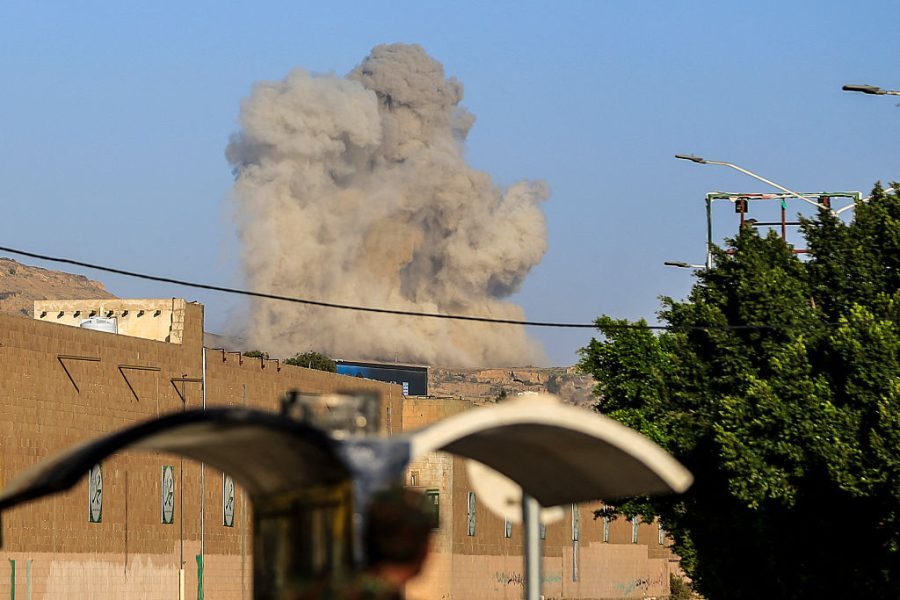
Saudi missiles hit the Houthi-controlled Yemen Petroleum Company’s al-Sabaha facility near the Yemeni capital of Sana’a on Tuesday night. The Saudi strikes came in response to the Houthis’ earlier targeting of King Khalid International Airport on Saturday, when 12 people were killed. Another individual died in a similar attack the following day.
The ongoing and deadly exchanges of fire accompany a fierce ground conflict now under way in Yemen between the Iran-backed Houthis and the forces of the Saudi-supported Presidential Leadership Council (PLC), representing the legally constituted government of Yemen. Close observation of the events in Yemen showcases a dramatic imbalance in the combatant sides: between the relatively coherent alliance of which the Houthis are a part and the dysfunctional and divided gathering to which the Saudis are connected.
In September, responding to Saudi air strikes on Sana’a, the Houthis launched a ground offensive toward the strategically vital Bab el Mandeb Strait. They succeeded in gaining control of this area. Roughly 7 per cent to 12 per cent of global seaborne oil trade and millions of barrels of oil and natural gas per day pass through the strait from the Persian Gulf. With Hormuz still contested between the US and the Iranians, the Saudis had been using Bab el Mandeb as an alternative route for getting oil out to Asian markets. Effective control of the strait by the Houthis has long represented a strategic nightmare for Riyadh. Indeed, the Saudi and Emirati intervention in 2015, widely and wrongly dubbed a failure in the west, had successfully prevented this eventuality – until now.
A struggle between two camps is under way
In early October, the Saudis and the PLC launched a counter offensive, dubbed ‘Fajr al-Yaman’ (Yemen Dawn). It is still under way. The amount of progress that has been made is unclear. Saudi media is claiming that Riyadh-backed forces have completely reconquered the Bab el Mandeb area and Perim Island. Pro Iran media denies this. Some gains have clearly been made. But the Houthis, meanwhile, have launched their own counter offensive in the Taiz area and as of yesterday are reported to have completely surrounded Taiz city. As the Iran-backed fighters begin a siege of Taiz (population 1.4 million) a potential humanitarian disaster is looming. The World Food Programme is seeking to raise the alarm in this regard.

The latest events in Yemen represent a limited advance for the pro-Iran camp, which may yet be reversed. It is noteworthy that the Houthis have until now studiously avoided hitting non-Saudi targets in and around the strait. They appear to have transferred a message to the US in this regard. Houthi political bureau member Mohammed al-Bukhaiti told the Associated Press that:
We confirmed that we are not targeting the United States, or any other nation, in the strait, with the sole exception of the Saudi enemy.
At the same time, the Houthis made clear that this would change in the event that the US intervened in support of the Saudis. The US has reportedly rebuffed a series of requests from Saudi Crown Prince Mohammed Bin Salman to intervene in the fighting. The president appears wary of opening up any new active fronts in the run up to the mid term congressional elections.
The much trumpeted ‘Mecca Pact’ of Saudi Arabia, Turkey and Pakistan, announced on 7 August, has been subjected to an immediate stress test by the renewal of fighting in Yemen. It appears to have entirely failed. Both Turkey and Pakistan have stated they will not send troops to Yemen, contenting themselves with the provision of some limited resources to Riyadh for air defence purposes.
But while the revelation of the Mecca Pact as something of a dead letter is unsurprising, the latest Yemen events reveal a further discrepancy: the bloc of which Iran is a part contains genuine internal differences and fissures, yet it manages to cooperate on vital strategic issues and to function to a great extent as a coherent unit. By contrast, insofar as there can really be claimed to be anything as coherent as a counter-alliance against Iran, it is dysfunctional, possesses no common analysis, let alone vision or strategy and as a result is incapable of responding coherently to developments.
The Houthis, surely for their own reasons but entirely in line with Tehran’s interest, pushed south to take Bab al-Mandeb. Simultaneously, the Iran-backed Shia militias, again no doubt with interests of their own, struck the Saudi East-West pipeline, which enabled the Saudis to pipe oil from eastern Saudi Arabia to the port of Yanbu. This strike fitted perfectly with the Houthis’ efforts to disrupt Saudi efforts to transit oil both through Bab al Mandeb but also northwards through the Egyptian Sumed pipeline to the Mediterranean.
More broadly, on a reporting trip to Yemen last year, I was able to see information showing in detail the presence of Iranian, Iraqi and Lebanese specialists in the Houthi-controlled part of Yemen. These individuals were and are engaged in providing the Houthis with the strategic capabilities in the area of drone and missile warfare which are currently being employed against Saudi Arabia. It is a commonplace among supporters of Iran and its allies to marvel at the military capacities of the Houthis. But as with the similarly once lauded Lebanese Hezbollah, no particular miraculous capacities are at work. The Yemeni Shia Islamist fighters are without doubt tactically capable, tough and zealous. But the capacity to strike with telling force at Riyadh comes from external assistance, not north Yemeni native prowess.
While in Yemen, I and my colleagues received detailed evidence regarding the role of Chinese companies in providing drone components to the Houthis. China evidently finds it useful to keep the Houthis in the game, even as Beijing proclaims its official strategy as ‘no proxies, no spheres of influence, and no attempts to fill vacuums’. The Iran-led alliance, despite the drubbing it has taken at Israel and the US’s hands over the last three years, continues to function, broadly, as a unified whole.
Contrast this with the situation on the other side. The anti-Houthi ground forces in Yemen are functioning at less than peak capacity because the Saudis turned on the clients of the UAE in Yemen earlier this year in an internecine dispute. As a result, many south Yemeni ground elements have not taken part in the fighting. The US seems determined to avoid involvement and to leave the Saudis to cope with the problem themselves. Israel, meanwhile, has offered to join the military campaign alongside Saudi Arabia, viewing it as an opportunity to deepen security ties and work toward normalisation. But the Saudis have rejected the offer, evidently fearing a public backlash because of events in Gaza (which of course saw Israel fighting another Tehran-supported Islamist militia).
The Yemeni example casts in bold relief the fundamental lack of a common strategy from the West in the current set of interlocking global conflicts under way. The UK’s pandering to the Iranian government, even as Tehran launches attacks on US airbases on British soil, and sanctioning Israel for building houses in the Jerusalem area offer an additional manifestation of this. A struggle between two camps is under way. Only one, however, appears to be aware that the struggle is taking place.





Comments