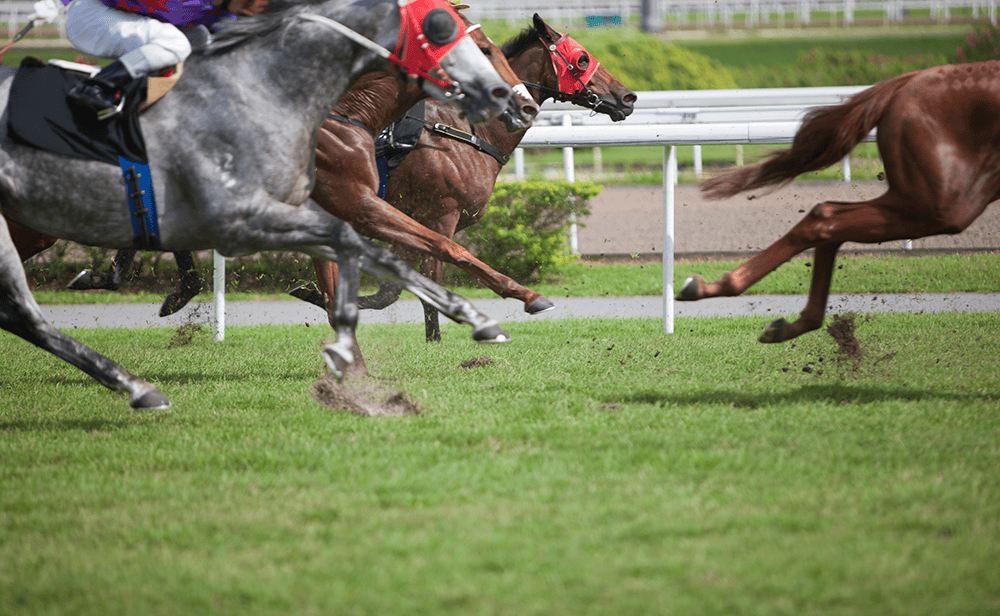
Inspecting yearlings in the rain at Newmarket last Thursday was a bit like looking at girls in the Windmill Club – in the old days, of course – with their wet weather cycling kit on. You just don’t get much of an idea of what they might be capable of. But whatever the weather, when you enter the sales ground at Tattersalls, you step into a parallel universe populated by an eclectic bunch of coves.
Over the three days of the premiere yearling auction in Europe, 400-odd colts and fillies went under the hammer. But there were two very different games being played out.

The heavyweights in the ring were Sheikh Mohammed Al Maktoum, the ruler of Dubai, and MV Magnier, spearheading the Coolmore Stud from Ireland. It was like watching Muhammad Ali and Joe Frazier slugging it out in the Thrilla in Manila.
By the time the hammer fell for the last time, the sheikh had spent approximately 27 million guineas on 25 prospects, a staggering number when you consider he is merely topping up the hundreds of blue-chip homebreds being prepped on his studs around the world.
For the vendors, the million-dollar question, quite literally, was whether the two superpowers were both locked on to their yearlings. Because the difference between them both going full tilt, or only one of them going for it, is about three million guineas.
It’s an extraordinary game of reading body language for the vendors, many of whom are worried about the price of filling the horsebox up with diesel on the way home. ‘Reading the room’ is an art form, which the breeders selling their pride and joys have to get a nose for pretty quickly. If they under-estimate the interest in their horse when setting the reserve price, they won’t extract the full worth from the bidders. But overestimating how the market values their stock is disastrous. The last thing a vendor wants to hear is the auctioneer saying: ‘£1 million is the final bid. Not sold.’ That takes a bit of explaining as the horse is led back to the box.
The Irish are omnipresent throughout the gruelling 20 hours of auctioneering. But the sheikh retreats to his house in Newmarket if he and his team aren’t interested in any lots coming up for a couple of hours. Or even worse, they go for a wander round Waitrose, as they did last Thursday. Hopefully they found the three-for-two bargains. For vendors with high hopes, the sight of him heading for the exit as their yearlings were about to walk into the ring was the stuff of nightmares. Their dreams dashed for another year.
At that point, they are then in the hands of the second game, which is played out by mere mortals, many of whom are considered pretty damn rich out there in the normal world. But it didn’t take long to realise that at last week’s sale, a million quid might not even get you a table in the restaurant.
Disappointment is littered all over the place. Vendors who laid out a small fortune to send their mare to a top stallion might not be covering their costs if they get only 200,000 guineas. Buyers who fancied their chances can look like tyre-kickers when they get blown out of the water by some hood who looked like he hadn’t got a pot to piss in. You just never know who is lurking in a stairwell, furtively tipping their catalogue at one of the auctioneers’ spotters.
That’s the thing about horse racing: it draws in the fascinating and the fascinated more powerfully than the sirens luring sailors onto the rocks.
The million-dollar question was whether the two superpowers were locked on to their yearlings
I met Romeo Sia, who’s from the Philippines, in the ‘top bar’. That is distinct from the ‘back bar’, which is where the bad boys and agents who don’t want to be seen drinking get stuck in. Romeo has 45 organic food stores in his home country, and two wine shops. He smiles a lot more when he’s talking about claret and burgundy than he does when he’s chatting about carrots.
Romeo used to spend time in King’s Lynn but he’s bought a house in Epsom, presumably to beat the traffic on Derby Day and to be closer to the trainer George Baker, whom he met via a ChatGPT recommendation. Which goes to show it isn’t always wrong.
Romeo bought his first horse in April. He now has 13 fillies, whom he will breed from after he’s raced them. ‘I’m trying to catch up on missed opportunities,’ he beamed, loving his first visit to the Book One sale. I don’t think it will be his last.
Baker is an excellent trainer, but his budget is normally in the Vauxhall Astra grade. This year, though, he managed to slip away from his wife and stuck his finger up in the ring for a stunning filly by Mehmas for 100,000 guineas. She thought he’d gone to buy a sandwich. I think he might be planning to increase Romeo’s string to 14. If Romeo is going to get up at dawn and saunter across the Downs to watch his horses working, he might as well have a few to watch.
Readers will remember that, four weeks ago, I highlighted Lot 237, a colt by Frankel out of a mare called Shambolic, consigned by Newsells Park Stud. The colt made four million guineas. And on this occasion MV Magnier outbid Sheikh Mohammed. Maybe he was in a rush to get to Aldi.
For racing tips, go to Penworthy.





Comments