Aphrodite – talk about a difficult birth. Her father the Sky (Ouranos) had come to resent the fertility of his wife/mother the Earth (Gaia). They’d had 18 children already – a gamesome brood that included Titans, Cyclopes, and the 100-handed Hecatoncheires. The last of these were so hateful that Ouranos convinced himself that he would be murdered by one of them and usurped as ruler on high.
Ouranos’s way of coping with his complex was to keep on having sex with his wife so as to hole up his offspring in the birth canal. Gaia urged her sons to save her, but only Kronos, the youngest of the Titans, was brave enough. While his father was still at it, Kronos went in and lopped off his genitals with a sickle. The divine bits plopped into the sea, and from the resulting froth emerged the goddess – beautiful, fully formed and, for a time, impervious to her family’s dire dysfunctionality.
The ‘Capitoline Venus’ was so realistic a man ejaculated over it in the 4th century BC
It was popularly believed that Aphrodite was named after that amniotic sea foam – aphros in Greek – but the debated etymology has also been linked to the Hebrew-Phoenician Ashtoreth, which the Greeks rendered as Astarte. Astarte was the name of Aphrodite’s forebear, an ancient Near Eastern deity who, like her associated goddesses Inanna and Ishtar, served as patroness of beauty, sex and war.
Astarte was sometimes worshipped as a Queen of Heaven; a beautiful double-statuette survives from the 2nd century showing a grey marble Aphrodite Ourania (‘Of the Heavens’) dressed in a star-spangled gown, alongside a more plainly dressed white Aphrodite Pandemos (‘Of all the people’). The sculpture comes from Cyprus, Aphrodite’s island. Having bobbed up on the sea, the goddess was said to have floated towards Kythera before arriving in Paphos – she would for ever be associated with seafaring as well as love.
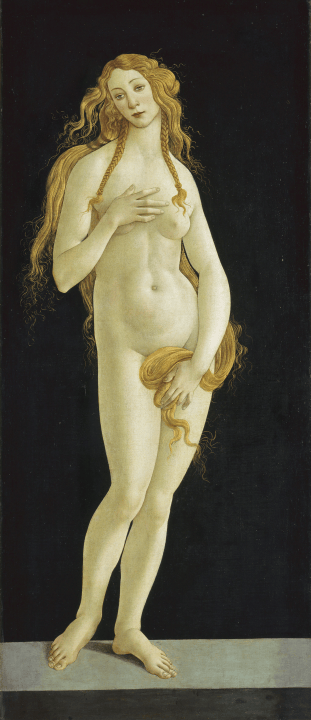
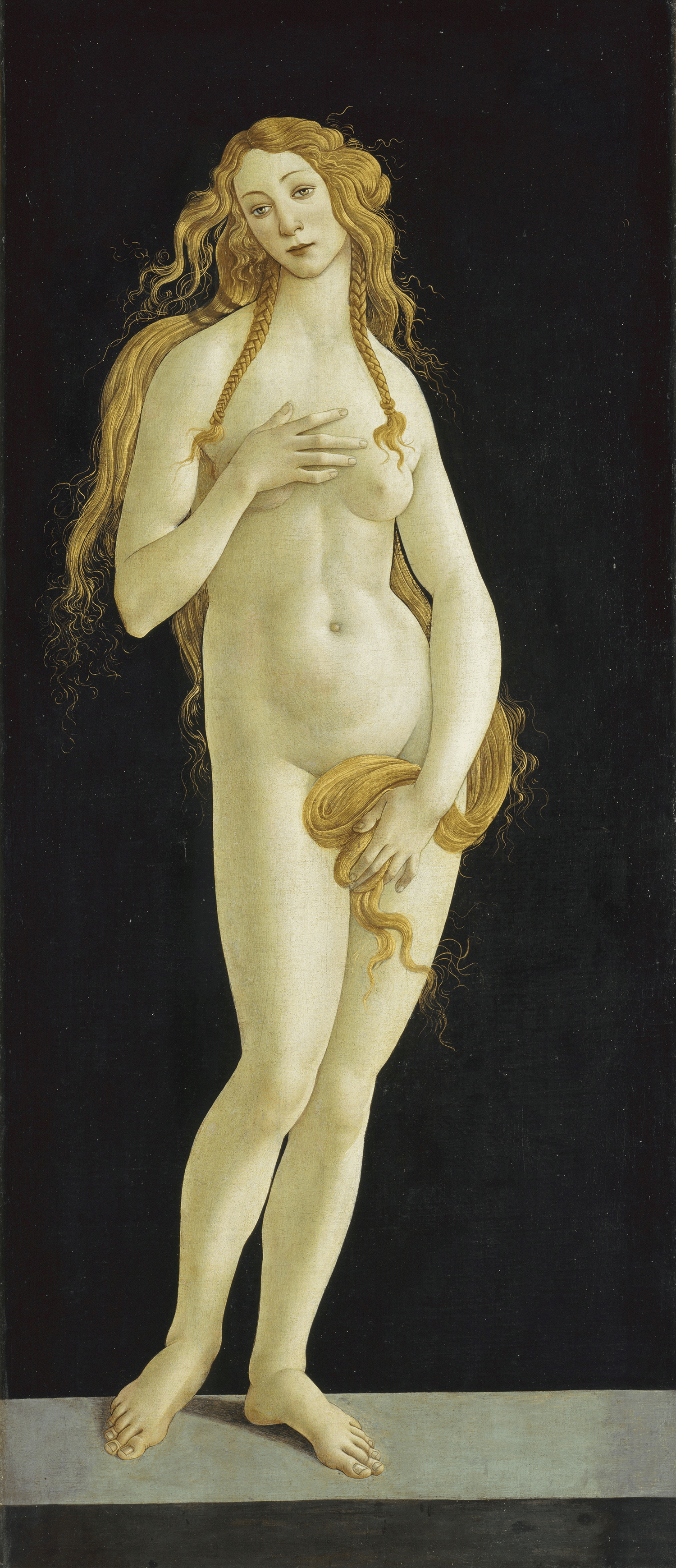
She stepped ashore gracefully, tentatively, as though treading ice. A number of enigmatic sculptures survive showing her placing one foot on a tortoise or turtle. Other pieces, often made of terracotta, show her emerging from a shell of her own. You see the influence of these on Botticelli’s ‘Birth of Venus’ (c.1485), in which the golden beauty glides ashore atop a scallop shell, blown in on the exhalations of Zephyrus and Aura. Shells, doves, mirrors and dolphins remained her favourite things.

People had begun to worship a fertility goddess on Cyprus as early as the Neolithic period. Hundreds of stone and terracotta figurines, dating from 4000 to 2500 BC, have been uncovered, and it is clear that pilgrims visited her sanctuaries on the island from at least as early as 1000 BC. Some of the offerings left to her are shaped as mothers holding children; Aphrodite would later acquire the epithet ‘Kourotrophos’ (Nurturer of Children) to complement her role as protectress of wives and prompter of child-making.
It was on Cyprus that the mainland Greeks learned her appeal. Absent from the surviving Mycenaean clay tablets, which name Hera, Athena, Persephone and other chief goddesses, Aphrodite made her mark as a distinct Greek goddess with a Greek name only after the collapse of the Bronze Age. (On Cyprus she would continue to be known as Kypria – ‘Cyprian Goddess’ – or Astarte until the end of the 4th century BC.)
The new era brought many more mainlanders to Cyprus and its religion. The sex goddess is first attested as both ‘Aphrodite’ and ‘Kypris’ in the 8th-century BC epics of Homer. In the Odyssey, she is presented as the unfaithful wife of Hephaestus, the lame-footed god of metallurgy. Their marriage, though unhappy, made perfect sense, for Cyprus was associated chiefly with the mining and export of bronze.
A copper alloy figurine from Cyprus of an Astarte/Aphrodite-type goddess, dated to the end of the Bronze Age, stands on a base shaped like one of the island’s export ingots. Nude, with apple-like breasts and owl-alert eyes, she places her hands firmly around her stomach.
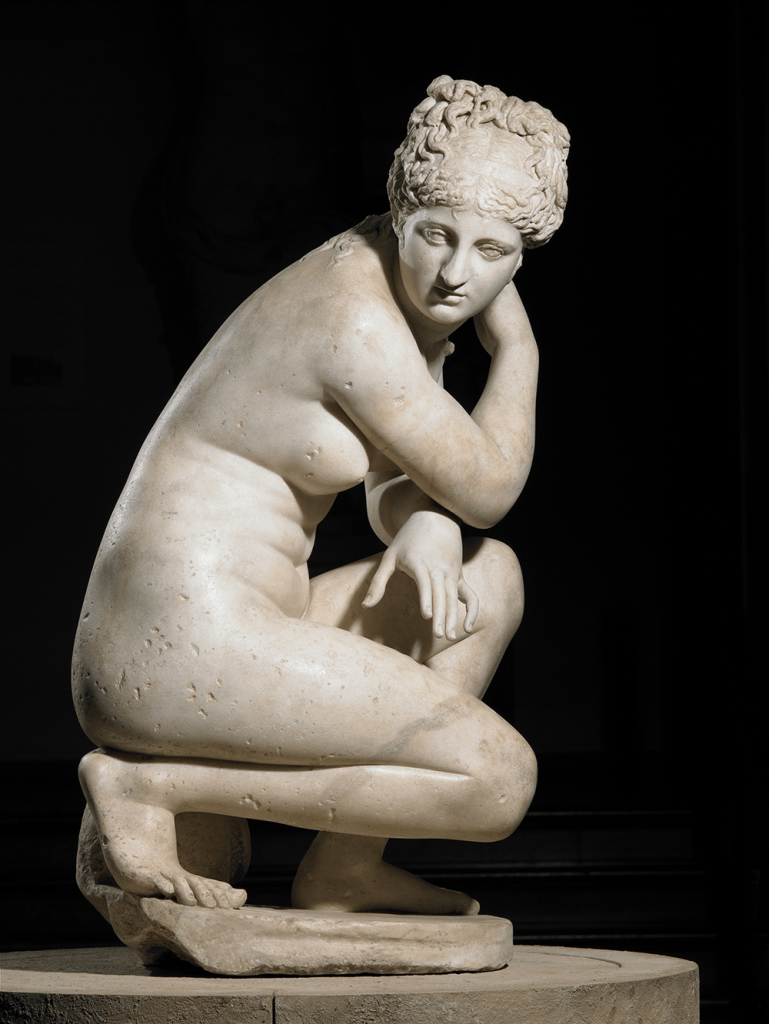
Look at it closely and you’ll also discern a long plait hanging over her right shoulder. Aphrodite’s hair – and her fondness for touching it – enthralled the Greeks and Romans, who worshipped her as Venus. She was often depicted wringing it out on the shore. Artists went in for modelling and painting her as she rose from the sea, dripping wet, her breasts riding up her ribcage as she stretched, as she does in a lovely 5th-century BC marble panel found in the grounds of Villa Ludovisi in Rome. Botticelli had Venus touch her hair, not to dry it, but to cover her pudenda. There’s a similar coyness to some of the most celebrated ancient statues. There is the ‘Crouching Aphrodite’, whose position artfully conceals her nudity, and the ‘Venus de’Medici’, who hovers one hand over her breast and the other over her vagina. Then there is the ‘Capitoline Venus’, a Roman version of a Greek original by Praxiteles, which was said to have been so realistic that a man ejaculated over it in the 4th century BC. Being caught in the nude – too slow to cover herself up – evidently made Venus only more desirable.
Michelangelo Pistoletto’s ‘Venus of the Rags’ (1967, 1974), which you may have seen at the Tate, riffs on the goddess’s unlikely modesty. His garden-centre statue of her has her back to us as she stands before a heap of laundry as if to say, ‘Get me some clothes!’
Why did Aphrodite become so shy? She does not look shy in those very early figurines. She is not shy in Homer, where she embarks upon a steamy affair with the war god Ares, only to be caught in flagrante in a web of her husband’s invention. It is even recorded that a temple was built for her in 6th-century BC Athens using the proceeds of a tax on brothels.
Her bashfulness must be a reflection of the feelings she engendered in those who carved and wondered at her. It was a complicated thing to embrace the lustiness of an adulterous goddess while praising the chastity of mortal women. Artists, seldom timid about baring flesh, knew what the authorities wanted to see. An apocryphal tale of a courtesan and artist’s model escaping prosecution by baring her breasts to the jury was told with one part opprobrium to two parts titillation. Love, marriage, sex, children – all things to pray for, but what was acceptable for the gods was to be watered down for mortals. That was just the order of things.
Aphrodite’s sexiness was not, in the end, an insurmountable problem. Roman politicians still embraced her as if she were their glamorous old granny. Lucius Cornelius Sulla, a dictator of the late Roman Republic, viewed Venus as his familial patron and gave both her name and his own to the Roman colony of Pompeii (Colonia Cornelia Veneria Pompeianorum).
Roman politicians embraced Aphrodite as if she were their glamorous old granny
More directly, Julius Caesar claimed descent from Venus via her grandson Iulus, child of Aeneas, hero of the Trojan War. The dictator even erected a temple to Venus Genetrix in his forum at Rome. There’s evidence that Caesar’s recent ancestors had courted the same divine connections. Whether or not the plebs took him at his word, the association lent a dash of humour and charm to Caesar’s otherwise scandalous seduction of other senators’ wives. What else to expect of a man with the love goddess’s blood coursing his veins?
Given the history, you can see why the suffragettes took umbrage. ‘I didn’t like the way men visitors gaped at it all day long,’ said Mary Richardson of Velazquez’s ‘Rokeby Venus’, into which she’d sliced gashes worthy of sickle-wielding Kronos. Man Ray’s reassemblage of the goddess in his ‘Vénus Restaurée’ of 1936 involved enwrapping her defenceless torso in rope which, even to the most sympathetic female eye, cannot fail to evoke the strains of female bondage.
The Greek philosophers would have enjoyed unravelling the psychology of this. Who are we punishing, the all-powerful but naughty goddess or the naughtiness we struggle to keep power over in ourselves?
Aphrodite: The Making of a Goddess is at the Ashmolean Museum, Oxford, from 8 October until 11 April 2027.





Comments