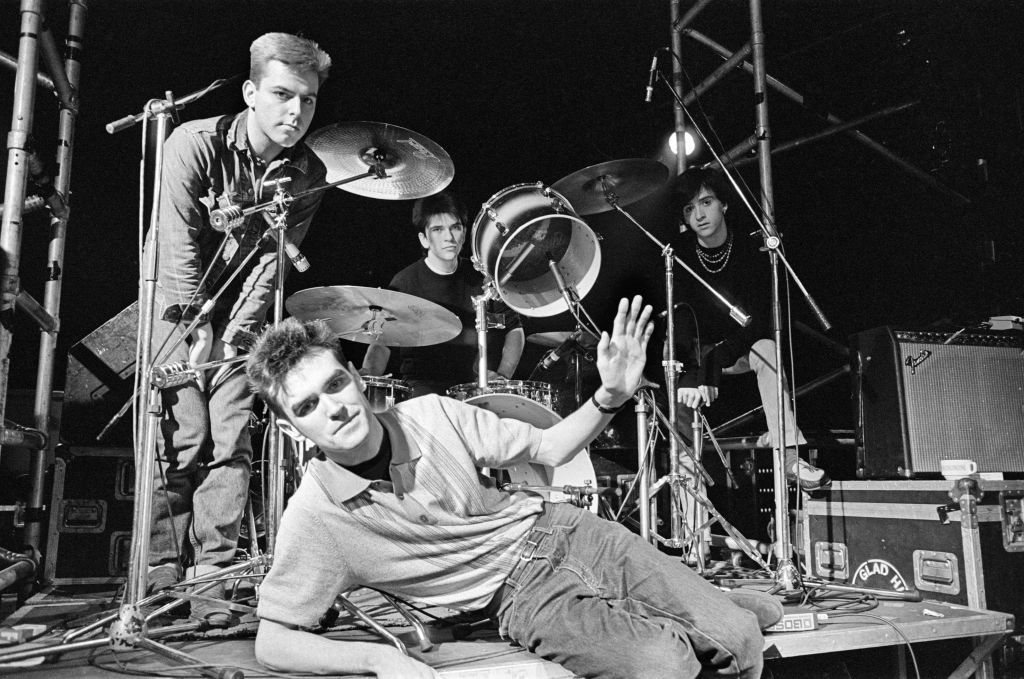
There is a Smiths lyric for almost every moment. Whether it’s telling a friend that their jokes just aren’t funny anymore or being herded into the corner of a Northern pub-cum-club and contemplating hanging the DJ, every song that contains Morrissey’s melodramatic teenage misery becomes useful vocabulary for the most mundane scenarios. Including visiting troops in Ukraine, as the Prime Minister proved earlier this week.
Gen Z is proving rather less doctrinaire about culture than previous generations
Perhaps that is just one reason that helps explain why, more than 40 years after The Smiths first appeared, they are finding a new audience amongst those who were not even alive when the band split up, let alone released their first album. ‘There Is a Light That Never Goes Out’ has now been streamed more than a billion times, whilst Smiths T-shirts – deemed casual wear – still adorn teenagers up and down the nation.
It’s hard to quantify whether this is just the enduring interest of Gen Xers and Millennials, but gig audiences suggest there may be more to it. I have seen Moz twice in the past two years in Manchester and London. The audiences were similar in some ways, but surprising in others. There were plenty old enough to have bought The Smiths’ records when they were first released, with many donning sycophantic Morrissey quiffs. Yet there were many who must have discovered them through Spotify or sifting (and scratching) through their parents’ vinyl collections.
But for anyone familiar with Morrissey, his ongoing popularity with Gen Z is rather curious. Supposedly, each generation is more politically progressive than the last. Yet Morrissey has made numerous remarks over the years that have led to him becoming an unexpected hero (or at least ally) of right-wing music fans. Anyone with a sufficiently curated Twitter feed would have seen a disproportionate number of young, right-wing commentators join me in the audience at the O2.
The Smiths were hardly a right-wing band in their heyday. They produced songs that suggested state power made the rich richer and the poor poorer. ‘Meat Is Murder’ is not just an animal rights manifesto, but a political statement against institutionalised violence. Someone on the Right probably also wouldn’t want Margaret on the guillotine or the Queen dead.
Many would suggest that Morrissey’s politics have travelled quite a way from his fashionable leftism of his youth, and his more recent pronouncements have made him persona non grata in much of the cultural establishment. But this is a little too simplistic. My best guess is that Morrissey would likely say his views haven’t changed considerably over the years. To use the example above, it’s still quite unlikely he would scamper around with the same devotion as some Conservative Party Conference attendees when picking up Maggie merch.
He’s better understood as an enduring left-leaning lover of English particularity, similar to figures such as George Orwell or Michael Foot. But such particularity is now right-coded, such as his assertion that ‘the higher the influx into England, the more the British identity disappears’. Coupled with his commitment to free speech, it has left him with more admirers to his right than to his left in recent years.
For much of his career, any soundbite caused an adverse reaction from the media, irritating people who preferred him to behave differently. Much to the frustration of his detractors, Moz has proven time and again that he has an almost pathological inability to express an opinion in a diplomatic manner.
In a culture where politicians are adept at saying exactly what they are ‘supposed’ to say, but not what the ‘people’ would like them to say, there is an instant attraction to an individual who is willing to speak his or her mind. Over the years his controversial utterances have included describing halal slaughter as ‘evil’, claiming that Sadiq Khan ‘cannot talk properly’ and penning a song addressing the 2017 Manchester Arena terrorist bombing titled ‘Bonfire of Teenagers’, referring to the tragedy as ‘England’s 9/11’. The album of the same title proved so controversial that it has never been released. You do not necessarily have to agree with Morrissey to admire the fact that he seems remarkably uninterested in whether you do or don’t.
This helps to explain the curious sight at his concerts where there might be an idealistic teenager who has recently discovered The Queen Is Dead, standing right alongside a politically disenchanted, middle-aged bloke. The songs may have a different meaning to each, but they are both singing along. There is something healthy about this. With our modern tendency to judge art by the political credentials of the person who produced it, judging something by its subjective quality may be a better way to go about things.
Perhaps Gen Z, for all its supposed political sensitivity, is proving rather less doctrinaire about culture than previous generations. At this point, we must assume that any youngster getting into The Smiths and Morrissey has access to all of his controversial views but has decided they’re not bothered by them.
Does this mean a lurch to the right? Andy Burnham will certainly be hoping not. It could be for some. But despite caricatures to the contrary, young people aren’t especially right-wing. Perhaps they have simply decided that a good song is a good song.





Comments