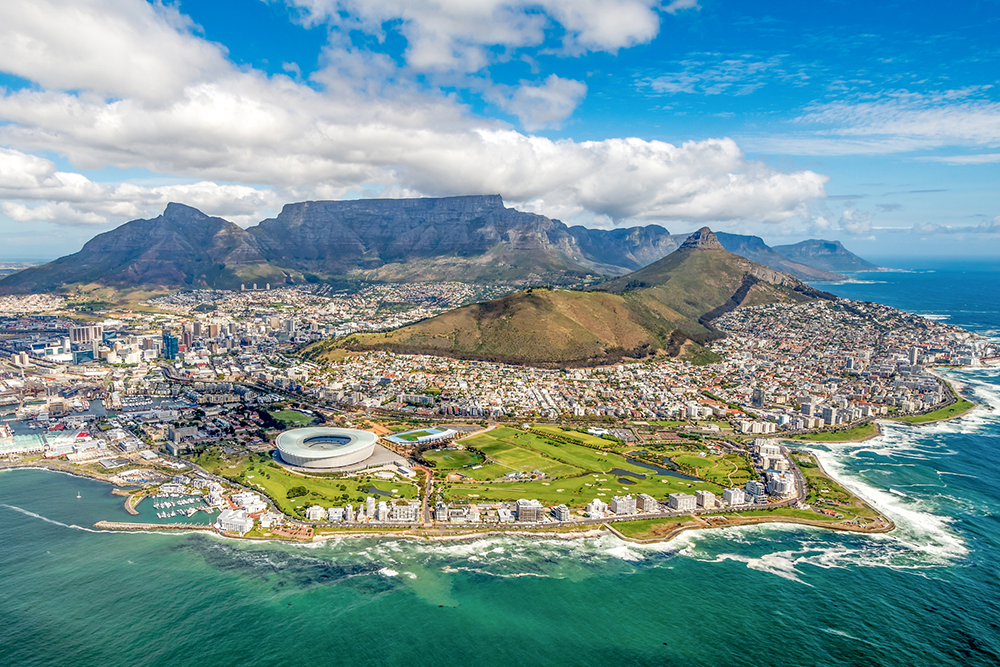


There can be few foreign cities where the Spectator, Times and Telegraph are more widely read than Cape Town. In a queue where I waited before coming home this week, readers volunteered to me – a columnist whom they recognised – their thoughts about these journals, their contents and their columnists.
I love Cape Town but it’s not Africa. Along with Nairobi it’s perhaps the African city where white English people could now most easily imagine settling or retiring; but, though visits are always pleasant, I can never quite escape a nagging feeling that something’s not quite right about this lively, wealthy, cultured city in its breathtaking setting – and I’m not just talking about the appalling black slums you pass as you drive to or from the airport. White settlers from across sub-Saharan Africa – those who do not end up in Perth in Australia – often end up there but (to me) to resort to Cape Town represents a kind of retreat from Africa.
That said, there’s no better, nicer or more comfortable place from which to start discovering the southern part of the continent. We stayed (and this was no freebie – we paid full whack throughout) at an absolutely charming little ‘boutique’ hotel, Derwent House, near the leafy fringes of the city as the slope upward to Table Mountain steepens.
The mountains have been eroded and left jagged, toothlike, by variations in the hardness of the rock
The next morning our mini-adventure north of Cape Town began. It’s the Eastern Cape where tourists from overseas usually choose to drive; and some readers will be familiar with the ‘Garden Route’ through the lovely mountains east of Cape Town, then the Karoo with its ostrich farms, Johannesburg and finally the Kruger national park.
That’s an excellent itinerary if, in a single journey, you want to pack in as much as possible. Whereas the thing about the Atlantic side is that it isn’t really on the way to anywhere else. Except Namibia, on a highway plagued by thousands of massive mineral lorries, hundreds of miles up the cold Atlantic coast.
Come in from the Atlantic, though, not far out of Cape Town, and head into the interior. Within no more than a few miles the highway ushers you over a pass between tottering, towering rocky peaks into another, almost secret, kingdom. I say ‘almost secret’ because not many foreign travellers go there. But South Africans do. You are entering an escape for city dwellers: a destination for rock climbers, mountain bikers, hikers, off-roaders, lake swimmers, wine tasters and families with children who want the excitement of hills, mountains, rushing rivers and green valleys in the relative security that we’d associate, for example, with our Lake District.

The geography: I spare you an attempt to name and locate the many different ranges and ridges that dominate this ragged section of the Earth’s crust. Further north the range inland from the coast is called the Cederberg, but for around 200 miles north-west of Cape Town, gaunt peaks rising from rocky cliffs to five or six thousand feet march along the skyline. Behind and between them lie very wide green, flat and fertile valleys – almost plains – watered by streams running down from the mountains, and sometimes dusted by snow in winter. These plains sustain vast orchards: cherries, citrus and vineyards among them.
The geology is surprising because it looks volcanic but is in fact sedimentary: a jumble of very hard sandstone, mudstone, shale… the ruins of much higher mountains which over the ages have been eroded and left jagged, toothlike, by variations in the hardness of the rock. Weird, almost frightening shapes and figures result: fingers of rock, monumental, riven, sculpted by wind and rain. These great spines look like another planet. The rock is red, yellow and orange, stained by iron and oxidation, but these mountains bleed milky white into rivers and streams whose stony beds look at a distance like ivory roads climbing towards the peaks. And everywhere is pale sand.
We drove up one of the flat and little-populated valleys called the Koue Bokkeveld (cold antelope country), stopping at a smart country store-cum-coffee shop to buy sausage, wine, butter and local bread. The tourist trade here is thriving.
Then onward to our destination: the remote Kaya Hi cottage a little way up the mountainside. All across these mountains, campsites, chalets and farmhouse B&Bs abound. Ours was out of this world. If you go, hire a 4×4 with high clearance and hang onto your hat as you buck and slither up what looked more like a riverbed than a track.
But what a nest! Built of the local stone in a patchwork of ochres, yellows and maroons, Kaya Hi looked out across the valley. There was solar electricity, gas-fired cooking, an outside shower and even electric blankets. The stars were bright, the wood-fired hot tub (once we’d worked out how to get its boiler lit) disgracefully luxurious, the nights dead silent and the dawn chorus the nicest of wake-up calls to watch a chilly sunrise over a valley submerged in cloud.

I haven’t mentioned the most wonderful thing of all: the flora. What flora! Pink and white proteas (huge, waxy flowers), pale lavender and deep purple buddleia-like bushes tumbling in waves down the mountainside, little African olive trees, bright orange and yellow daisy-like carpets, succulents and flowering shrubs … the whole thing was like a botanical garden stretching up a mountain. My plant-identifier app hardly recognised any of them. And indeed this part of the Cape has a higher concentration of endemic plants than almost anywhere on the planet, many of them found nowhere else.
That’s the science. But it was the beauty that overwhelmed me. In the silence, as the sun sank crimson through the teeth of a far ridge, a phrase from Wordsworth’s ‘It Is a Beauteous Evening’ surfaced: ‘Breathless with adoration’.





Comments