The City was once Freetown’s most storied hotel. It burned down in the early 2000s, a few weeks after British paratroopers fought off Revolutionary United Front rebels in a battle which helped bring an end to Sierra Leone’s decade-long civil war. But the hotel had been on its uppers for a while before then. The Ferraris, a family of Swiss hoteliers, had long since abandoned it, and the City had become a brothel, where clients were serviced in dingy, candle-lit rooms. One correspondent who visited the site shortly after its destruction found a pile of rubble and a sign warning in Krio: “No piss ya.”
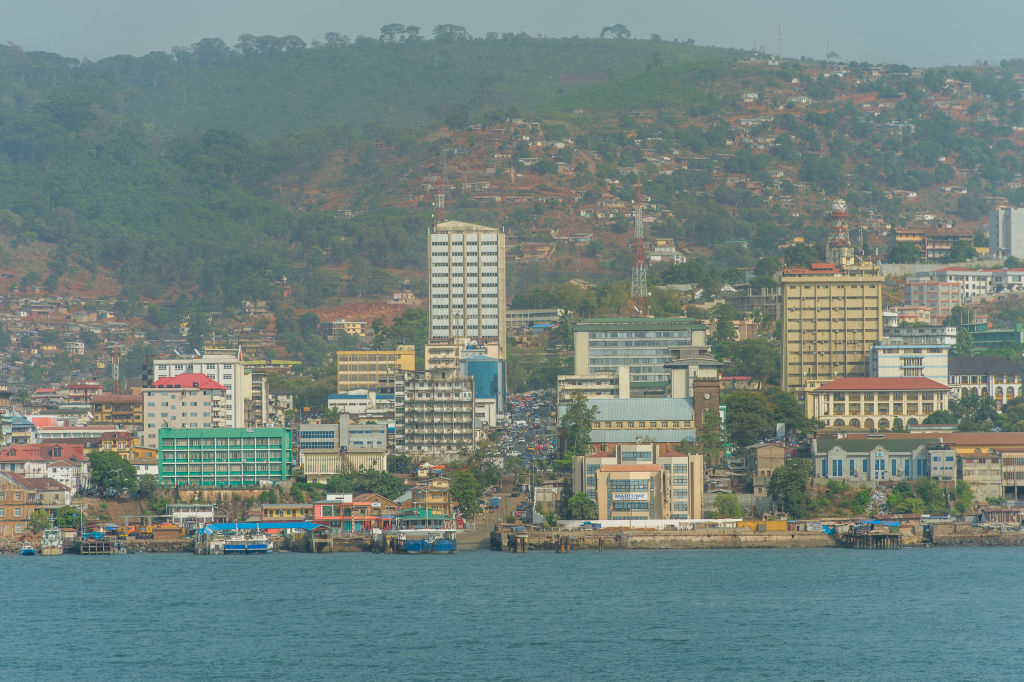
Nowadays, there’s a scruffy Leonco gas station where the City once stood. On one side is Philton Guesthouse; on the other is Paty’s Beauty Salon. In fact, it looks almost exactly like another anonymous junction in Sierra Leone’s litter-strewn, chaotic and intoxicating capital.
Graham Greene found Freetown “a place of unreality… an exhausted shabby enchanted town of bougainvillea and balconies, tin roofs and funeral parlors.” He stayed at the City several times – there’s a photo of him on its entrance steps – and drank there more often. And he set the famous opening scene of his 1948 novel The Heart of the Matter there. The book finds Wilson, a man so newly arrived in the then-British colony that his knees are still pale, observing from his balcony the book’s conflicted hero, Scobie, a morally upright policeman: the last good man in Freetown. It’s a superb, cinematic moment of the kind Greene excelled at, even if the rest of the novel – which sees Scobie embark on an ill-judged affair and a long, tedious teatime of the soul – doesn’t quite live up to it. Greene wrote it four years after he returned from his wartime MI6 service in Freetown. But the novel is drenched in the fevered amorality of the “soupsweet land” of Sierra Leone: a world of pink gins and adultery, spies and diamond smugglers, fierce Catholic priests and old Coast lags, gone half-mad in the heat and malarial air.
Greene first came to West Africa in 1935. Over too much champagne at a family party, he had recruited his 23-year-old cousin, Barbara Greene, to accompany him on an overland expedition through Sierra Leone and the then-uncharted interior of Liberia. Complete with a lumbering chain of mutinous carriers, they set off on a four-week march to Monrovia and the coast. Barbara packed Somerset Maugham novels; Greene brought along The Anatomy of Melancholy and an automatic pistol. He got a book out of it – the excellent travelogue Journey without Maps – but the journey nearly killed him. Fevered and weak with hunger, the cousins eventually reached the coast, with Greene carried by stretcher the last few days; his cousin fretted about the correct Catholic funeral rites for him. Afterward, he wrote, “my memories chiefly were of rats, of frustration and of deeper boredom on a long forest trek than I had experienced before.”
He returned a few years later, in 1942. He left his job as The Spectator’s film critic and was sent back to Freetown as an SIS intelligence officer, reporting on the movement of shipping along the coast. Greene was, by his own admission, a hopeless spy. He arrived into a world “far from James Bond” where his cover – first as an employee of the Department for Overseas Trade, then at the British Council – was repeatedly blown by envious colleagues. Technologically useless, he contrived to lock his codebook inside his safe and forget how to open it.
His principal achievements in three years of secret service were to smuggle the word “eunuch” into his coded reports and get the locals to stop using the neighboring rubbish dump as a latrine. Rats swung into his bedroom on the curtains, and vultures crashed on his tin roof. Once he was so bored he spent half an hour “standing on the staircase watching two flies make love.” Crushed by loneliness in the humid solitude, he took refuge at the City. There, he found others “who had not encountered success at any turn of the long road and who no longer expected it… I suspect I was at home in the City because, after six months or so, I was beginning to feel like a failure too.”
These days, you’re more likely to encounter an influencer than a diamond smuggler in its bars
While in Freetown, Greene reported back to his superior, Kim Philby. Philby backed him during a scuffle with MI5, and the two remained friends for more than half a century – long after Philby’s great betrayal and defection to Moscow. In fact, Greene wrote a sympathetic foreword to his friend’s 1968 memoir, My Silent War, and visited Philby in the USSR shortly before his death. In one essay, he saluted his old comrade: “[He was] the spy as craftsman… always relaxed, completely unflappable. He had all the small loyalties to his colleagues, and of course his big loyalty was unknown to us.” It’s a typical Green-esque fudge – one that might have been cooked up in a sweaty West African fleapit over a couple of sundowners.
What would Greene have made of Freetown today? I suspect the seasoned correspondent would have relished its undimmed atmosphere of gossipy seediness. These days, you’re more likely to encounter an influencer than a diamond smuggler in its bars. But lately the talk of the town has been of the whereabouts of the Dutch cocaine kingpin Jos Leijdekkers, said to be running his operation from Sierra Leone with the protection of high-ups in the government. The chatter has it that he is married to the president’s daughter, and they are rumored to have a child together – a useful insurance policy in a state with no extradition treaty with the Netherlands.
But Africa stood for something deeper in Greene’s thinking as well. What first attracted him was its boundlessness, its surplus of marvels. For Greene – a great believer in psychoanalysis and a meticulous chronicler of his dreams – Africa was closer to the unconscious, the wilder shores of human experience. Greene recalled his first sight of the continent on a steamer bound for Freetown. “It was like seeing a place you’ve dreamed of. The hot sweet smell from the land… will always be to me the smell of Africa, and Africa will always be the Africa of the Victorian atlas, the blank unexplored continent the shape of the human heart.” In this, if in nothing else, it remains unchanged.



Comments