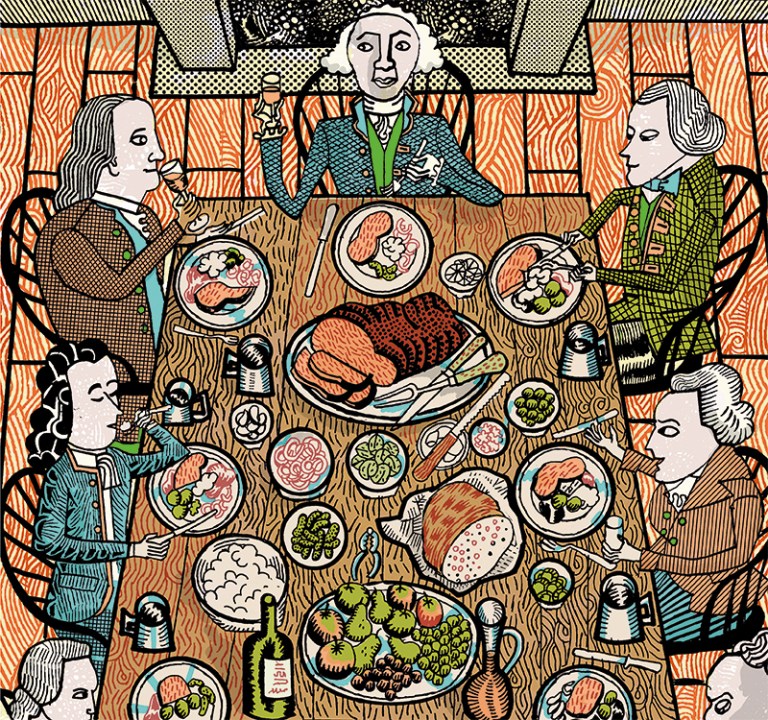
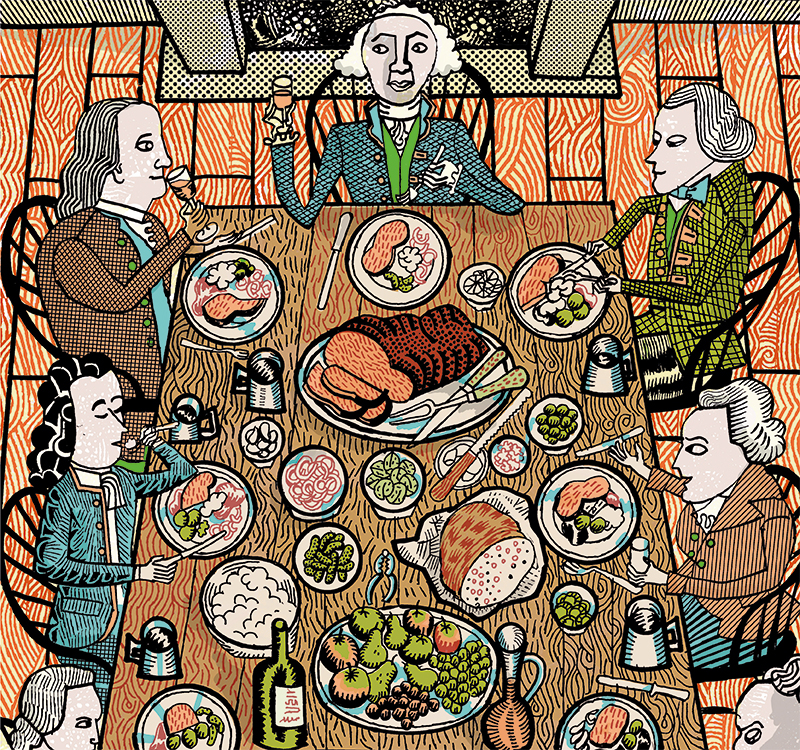
The Constitution was signed on a Monday. That much everyone knows. What the official record tends to skip is what happened right afterward. Forty-two men – some of them barely on speaking terms, three of them having refused to sign at all – stepped out of the Pennsylvania State House into the thin September air. Their wigs were damp from the long, sticky summer. Instead of heading back to their lodgings at the Indian Queen or Mrs. Marshall’s boarding house, they turned south on Chestnut, walked a couple of blocks, and went to City Tavern.
At the tavern, on the corner of Second and Walnut, they sat down and ate together. George Washington, who had presided over that bruising summer mostly in silence, wrote about it later in his diary with his usual economy: “The business being thus closed, the Members adjourned to the City Tavern, dined together and took a cordial leave of each other.” Twelve words. The republic’s public life started with dinner.
We remember the chamber across the street. We’ve turned State House – now Independence Hall – into a shrine, put it in a park, made it a place of pilgrimage. The room nearby never quite got the same treatment. No bell tower, no famous chair, no painting that ends up in textbooks. What it had was Madeira, porter, punch bowls, servants, musicians, weekly bills and the occasional breakage.
Self-government needs more than a document on parchment. It needs men who can lose an argument in the morning and still sit around the same table that evening.
Self-government needs men who can lose an argument in the morning and sit around the same table that evening
City Tavern was built in 1773 by subscription – 53 of Philadelphia’s leading citizens put up the money. The local paper deemed it the largest and most elegant public house in America. When John Adams showed up for the First Continental Congress in 1774, locals took him straight there. He called the supper “as elegant as ever was laid upon a table” and described the place as “the most genteel tavern in America.” Coming from Adams, that was high praise.
If you’d stood on the street that September evening, you would have seen three stories of reddish-brown brick, windows with hand-blown glass throwing candlelight onto the cobblestones, chimneys already going. Inside it smelled of woodsmoke, beef, wine, pipe tobacco and men who’d been arguing since morning and would probably pick it up again after breakfast.
Upstairs was the Long Room, the biggest public space in the city besides the State House. Some nights they cleared it for dancing. Other nights it held town meetings or broke into smaller supper parties. When Charleston fell in 1780 and the southern campaign needed money the government couldn’t raise, Philadelphia merchants met there and pledged their own capital to start a bank that helped make Yorktown possible. City Tavern wasn’t just a bar. It was the republic’s other room.
The tavern allowed the republic’s founders to keep running into each other in ways the formal chamber never allowed. Parliamentary rules required votes. The tavern allowed arguments to stay unfinished while the Madeira did its work.
Philadelphia in the summer of 1787 was a miserable place to spend four months trying to invent a country. The delegates had sworn themselves to secrecy. The press was kept out. Their notes stayed private for decades. Six days a week, five to seven hours a day, in a sealed room with the windows shut against eavesdroppers, they fought over representation, slavery, the executive, the judiciary – everything. By late June, the agreement almost fell apart. Delaware threatened to walk. New Jersey threatened to walk. For a couple of weeks the whole thing teetered. But in the evenings, they still went to dinner.
That willingness didn’t come naturally; it had to be practiced. Major Pierce Butler could sit down with men who thought slavery was an abomination. Roger Sherman could eat with people who found him tedious. Gouverneur Morris could talk to almost anyone – he had opinions on everything. James Madison would sit there quietly, worn out from trying to record a nation into existence. Benjamin Franklin told stories. Washington could be in the room and somehow elsewhere at the same time, which was part of his particular gift.
The bill from the night of September 17 itself is lost. But the one from three days earlier survived – and it might tell us more anyway. The First Troop Philadelphia City Cavalry gave Washington a dinner that night at City Tavern: 55 gentlemen, fruit, relishes, olives, 54 bottles of Madeira, 60 bottles of claret, eight of old stock, 22 of porter, eight of cider, 12 of beer, seven large bowls of rum punch. All this plus food and drink for the musicians and servants. And breakage. Total: £89, 4 shillings and 2 pence.
Somebody broke something. A glass, a decanter, a delicate stem. The republic was built on principle and parchment, but also on cracked stemware.
Washington was partial to Madeira, and that was that. He ordered it by the pipe – about 110 gallons at a time – regular as firewood back at Mount Vernon. The rum punch came by the bowl. Seven large ones meant the evening was organized around the fact that they were all there together.
Three days later, on Monday the 17th, 39 men signed. Edmund Randolph, George Mason, and Elbridge Gerry refused. Then they all went to dinner anyway.
Washington left almost nothing in writing about that night – just the one spare line about adjourning, dining and parting cordially. History wishes he’d given us more: who sat where, what was said, whether Mason looked angry or Randolph uncomfortable. Instead we only get that one word: cordial. After four months of heat and suspicion and clashing vanities, they managed enough restraint to sit together one last time before going home to resume the fight.
That might be the piece of the American character we’ve lost most thoroughly. City Tavern wasn’t full of powdered saints. These men were flawed – sometimes deeply. They compromised where later generations would say they shouldn’t have. They carried blind spots big enough to scar the country from the start.
And yet they also did something remarkable. They built a republic that didn’t rest on bloodline or tribe or conquest. Authority would come from consent. Rights would come before rulers. Power would be divided because human nature is what it is. They didn’t need everyone to be the same blood, the same faith or the same class. Their failures were real. So was their achievement.
That achievement needed habits as much as it needed ink. The dinner didn’t erase their disagreements, it just reminded them that the men on the other side of the argument were still men worth sitting with. The chamber gave us the text. The tavern helped keep the authors from destroying each other.
After dinner, Washington went back to his lodgings and wrote that he had retired to meditate on the work that had taken months of long days. He didn’t record his thoughts. He recorded the hours spent – which feels more honest. But first, there was dinner.
We’ve honored the signing room for two and a half centuries. We’ve been slower to honor the eating room. The republic needed both; it still does. The Constitution was signed in the chamber. The hope of a country survived in the tavern down the road.



Comments