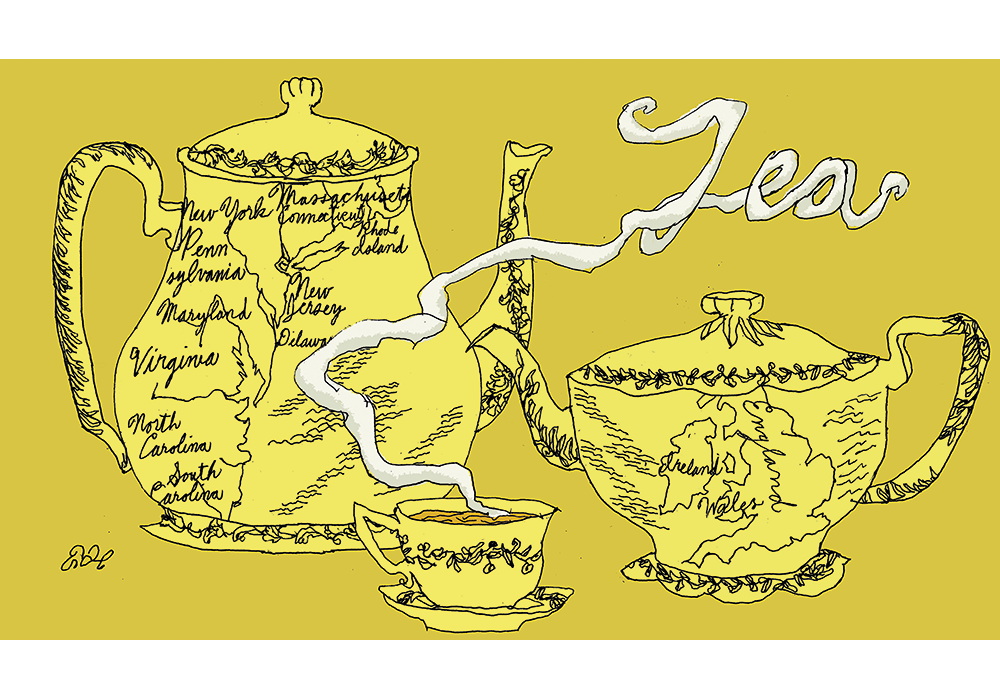


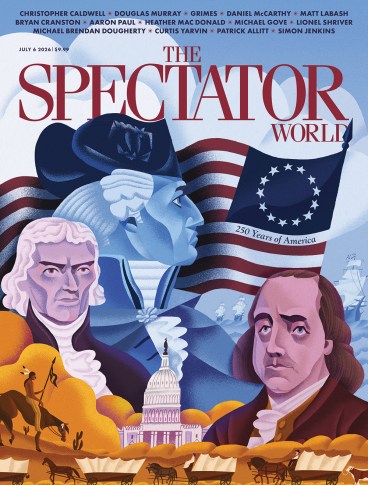
“Last night,” John Adams confided in his diary on December 17, 1773, just after the Boston Tea Party, “3 Cargoes of Bohea Tea were emptied into the Sea… This is the most magnificent Movement of all. There is a Dignity, a Majesty, a Sublimity, in this last Effort of the Patriots, that I greatly admire.”
Some things – like hyperbole and random capitalization – never seem to go out of style in American politics. Tea has been less fortunate. Once the most beloved non-alcoholic beverage in the 13 colonies, it fell so low in America’s regard, as Emily Dickinson would say, we heard it hit the ground. Or the water, in the case of the Boston bunfight.
Sadly for Adams, neither revolution nor coffee is any help when it comes to heartburn
Adams’s interpretation of tea-chucking as a magnificent patriotic effort shows just how deep a hold England really had on him. After all, only a fortune teller or a soul steeped in pure Britishness could detect magnificence, majesty and sublimity in anything, however dramatic, to do with tea leaves.
Before their relationship foundered on the Boston rocks, tea was one of Adams’s favorite beverages. He suffered from heartburn and he found tea, consumed in quantity, a soothing remedy. But English as he was at his core, he could not continue drinking it after the example of patriotism and self-abnegation set by the Boston colonists. He wrote sadly to his wife Abigail: “Tea must be universally renounced, and I must be weaned, and the sooner the better.” Coffee, he felt, was to be the drink of the revolution. Sadly for Adams, neither revolution nor coffee is any help when it comes to heartburn.
The early colonists were, like Adams, all tea addicts on a par with today’s worst coffee fiends. Without a thorough sousing in tea three or four times a day, it appears they could barely function. The English colonists taught immigrants from Sweden and Germany to drink it as well. And as taxation on tea from Britain increased, the popularity of smuggled Dutch tea skyrocketed. It is estimated that in the 1760s, 86 percent of the tea consumed in the American colonies was smuggled Dutch product. So boycotting tea as the drink of the enemy, as Adams proposed, would hurt the Dutch far more than the British. Nonetheless, Adams called for tea to be categorically abandoned and replaced with coffee. It had become – horror – a symbol of empire, and empire was something which America at the time most decidedly would not put up with.
Plenty of revolutionaries lacked Adams’s dedication to principle, however. They might agree on the perils of empire and the important symbolic value of tea in the abstract. But when it came down to it, they liked a few cups in the morning, perhaps with cream, and then another few around noon and several more later on, with the afternoon punch (the ancestor of the sweet iced tea universally beloved in the Southern states).
Paul Revere, famous for his midnight ride, became even more famous after the War of Independence for his skill in making neoclassical silver teapots. George Washington, breakfasting at Mount Vernon, made a habit of downing three cups of tea before getting on with the day. His favorite was Hyson, a Chinese green tea whose leaves had to be picked young, in the spring. When ill as a young man, he wrote to beg a pound of it from kindly neighbors – and he was known to place special orders for it in England. Hyson was Thomas Jefferson’s favorite as well, and in 1794 – well after the Revolutionary War – he wrote to his supplier praising “young Hyson” for both “flavor and strength.” Of the tea jettisoned in Boston Harbour, 15 chests were of Hyson.
But in the land of Starbucks, nobody could seriously contend that Adams’s push for coffee was a failure. It seized hold of our culture and still hasn’t let go. Who ever heard of that quintessential American, the cowboy, drinking tea? Out on the range, only the tarriest brew is considered acceptable; if you can stand a spoon up in it, it’s probably about right. And they consider coffee a survival food, too; cowboys in books have been said to survive for years at a time on coffee, bacon and a little dried elk meat, with no water, it seems, and certainly no tea. Stomachs must have been stronger back then.
But choosing coffee over tea cuts both ways. During the Civil War, the Union inflicted great hardship on the South by blockading coffee shipments to Southern ports, driving prices sky-high and availability through the floor. No wonder sweet iced tea took off in the South after the war ended. The troops suffered a great deal from the lack of coffee and tried hard to devise substitutes from roots, acorns and whatever else they could forage. A Confederate soldier on furlough once thought he had found a deal: two pounds of coffee for $30. But sadly, it turned out to be dried peas.
Who ever heard of that quintessential American, the cowboy, drinking tea?
Today, 66 percent of Americans are daily coffee drinkers; it adds more than $343 billion to the US economy each year. Not bad, for a roasted bean. Tea stands at a relatively paltry $7 billion. But America still imports the most tea in the world, more, even, than the UK. For a nation that began with a tea party – if a mad one – this is appropriate.
Adams has been in his grave for many years now, and his opinion on hot beverages no longer needs to control the narrative. Earl Grey could be sold in America as “Lieutenant Grey.” English Breakfast could become “Breakfast of Champions.” Contemporary Young Hyson producers could rebrand as “the favorite tea of the Founding Fathers. Steep in saltwater or fresh, to taste.”
Coffee is great and all. But more than 250 years after the original tiff, isn’t it time, in the spirit of reconciliation, to give tea a second chance?





Comments